OpenAI New Reasoning Models and Open Source Coding Agents
Source:Indian Express ↗
Why It Matters
The evolution of AI from conversational chatbots to autonomous reasoning agents (Agentic AI) is a critical technological shift. It has profound implications for automation, cybersecurity, and the digital economy, all of which are key focus areas in the UPSC GS3 Science and Technology syllabus. The dual approach of proprietary foundational models combined with open-source local tools (like Codex CLI) also touches upon themes of technology democratization and open-source ecosystems.
Summary
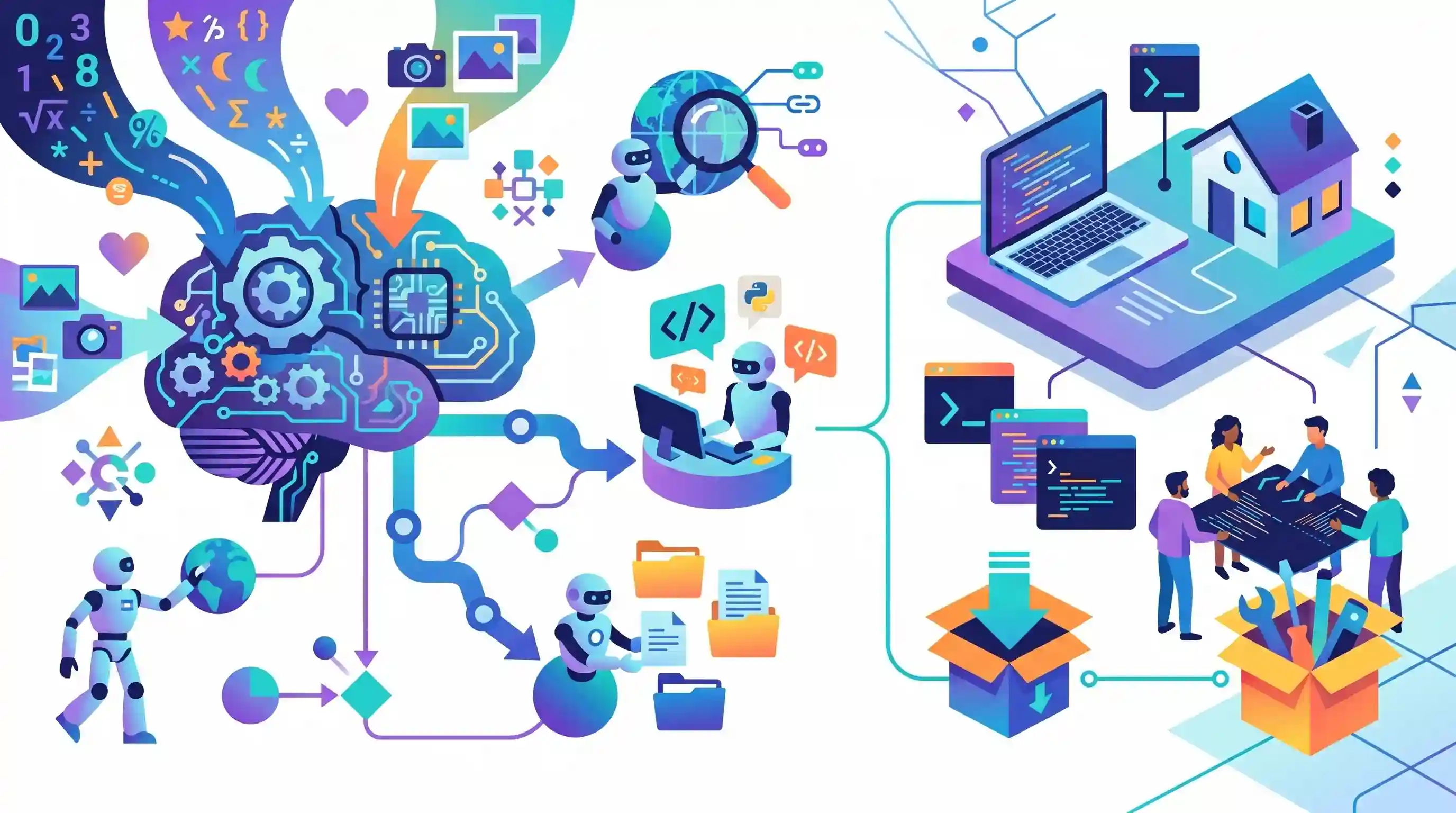
OpenAI has unveiled its latest generation of reasoning artificial intelligence models, 'o3' and 'o4-mini', marking a shift towards more autonomous 'agentic' AI. These models are capable of executing complex workflows by autonomously utilizing tools like web search, Python, and file interpreters. A major upgrade is their multimodal capability, allowing the models to 'think' using images as part of their reasoning process. Alongside the proprietary models, OpenAI released 'Codex CLI', a fully open-source coding agent designed to run locally on users' computers, expanding accessibility for developers.
Key Points
- OpenAI launched new reasoning models, 'o3' and 'o4-mini', replacing its earlier 'o1' and 'o3-mini' versions.
- The models feature advanced 'agentic' capabilities, allowing them to autonomously use tools like web search, Python, file interpretation, and image generation.
- They introduce multimodal reasoning through a feature called 'Thinking with Images', enabling the AI to incorporate visual data directly into its chain-of-thought process.
- OpenAI also released 'Codex CLI', a fully open-source coding agent that developers can run locally on their own computers to write and execute code.
Important Terms
Agentic AI

AI systems capable of autonomous goal-setting, planning, and task execution with minimal human intervention, moving beyond simple response generation to proactive workflow management.
UPSC context
GS Paper 3 (Science & Technology); tests awareness of evolving AI paradigms and their implications for industrial automation in India.
Multimodal Reasoning
The capacity of AI models to process and synthesize information from multiple formats—such as text, images, and audio—simultaneously to draw logical conclusions.
UPSC context
GS Paper 3 (IT & Computers); relevant for understanding human-like machine cognition and applications in healthcare and disaster management.
Reasoning Models
AI architectures (like OpenAI's o-series) designed to 'think before speaking' by utilizing internal chains of thought to solve complex logical, mathematical, and coding challenges.
UPSC context
GS Paper 3 (Science & Technology); distinguishes between simple predictive pattern matching and deeper logical deduction in advanced AI systems.
Codex CLI
An open-source command-line tool that acts as a local coding agent, allowing developers to execute AI-powered code modifications and workflows directly on their machines.
UPSC context
GS Paper 3 (Information Technology); pertains to open-source software, developer accessibility, and data privacy in software development workflows.
Frontier Models
The most advanced, large-scale AI models at the cutting edge of technology, possessing broad capabilities that often exceed previous benchmarks and pose new safety risks.
UPSC context
GS Paper 3 (Security & Tech); critical for discussions on international AI governance, safety standards, and ethical deployment.
Generative AI
A category of AI focused on creating new content—such as text, images, or code—by learning patterns from existing data, typically responding to user prompts.
UPSC context
GS Paper 3 (S&T); foundational concept for understanding the transition from creative content tools to autonomous task-executing agents.
Chain of Thought (CoT)
A prompting or internal processing technique that enables AI to break down complex problems into intermediate logical steps to improve accuracy in reasoning.
UPSC context
GS Paper 3 (Science & Tech); explains the mechanism behind advanced logic and STEM problem-solving in modern large language models.
Prelims Trap
"Agentic AI models require continuous step-by-step human prompts and cannot independently execute web searches."
Agentic AI represents a leap to autonomous systems. They plan workflows, set sub-goals, and use tools (web search, coding) independently, unlike traditional prompt-dependent generative AI.
Static Concepts Connected
What distinguishes Edge Computing (Local AI) from Cloud-based AI processing?
- Data Privacy: Local models process information directly on the user's device, eliminating the need to transmit sensitive data to external servers, ensuring data sovereignty.
- Low Latency: On-device processing provides near-real-time responses by removing the transmission delay (latency) of sending data to the cloud and waiting for a reply.
What are the defining characteristics of Open-Source Software (OSS)?
- Public Codebase: The source code is freely available for users to inspect, modify, and enhance, promoting decentralized and collaborative technological development.
- Govt Adpotion: The Indian government heavily relies on OSS for critical digital public infrastructure, forming the backbone of platforms like DigiLocker and Aarogya Setu.
Cross-Topic Patterns
Agentic AI vs. Indian IT Services
Autonomous coding agents directly challenge India's traditional labor-arbitrage IT model by automating routine programming. This forces a rapid pivot toward complex AI-integration consulting to prevent job losses.
Local AI + Data Protection Act (DPDPA)
'Local' AI execution aligns perfectly with India's data localization push, allowing enterprises to use advanced reasoning models on sensitive data without exposing it to global cloud servers.

Expect a 2026 Prelims multi-statement question testing the exact differences between Generative, Agentic, and Multimodal AI capabilities.
Linked PYQs · 4
Linked PYQs · 4
- 2023MainsGS3
Introduce the concept of Artificial Intelligence (AI). How does Al help clinical diagnosis? Do you perceive any threat to privacy of the individual in the use of Al in healthcare?
- 2020PrelimsGS1
With the present state of development, Artificial Intelligence can effectively do which of the following? 1. Bring down electricity consumption in industrial units 2. Create meaningful short stories and songs 3. Disease diagnosis 4. Text-to-Speech Conversion 5. Wireless transmission of electrical energy Select the correct answer using the code given below:
- 2025PrelimsGS1
Consider the following statements: I. It is expected that Majorana 1 chip will enable quantum computing. II. Majorana 1 chip has been introduced by Amazon Web Services (AWS). III. Deep learning is a subset of machine learning. Which of the statements given above are correct?
- 2022PrelimsGS1
Consider the following : 1. Aarogya Setu 2. CoWIN 3. DigiLocker 4. DIKSHA Which of the above are built on top of open-source digital platforms?
