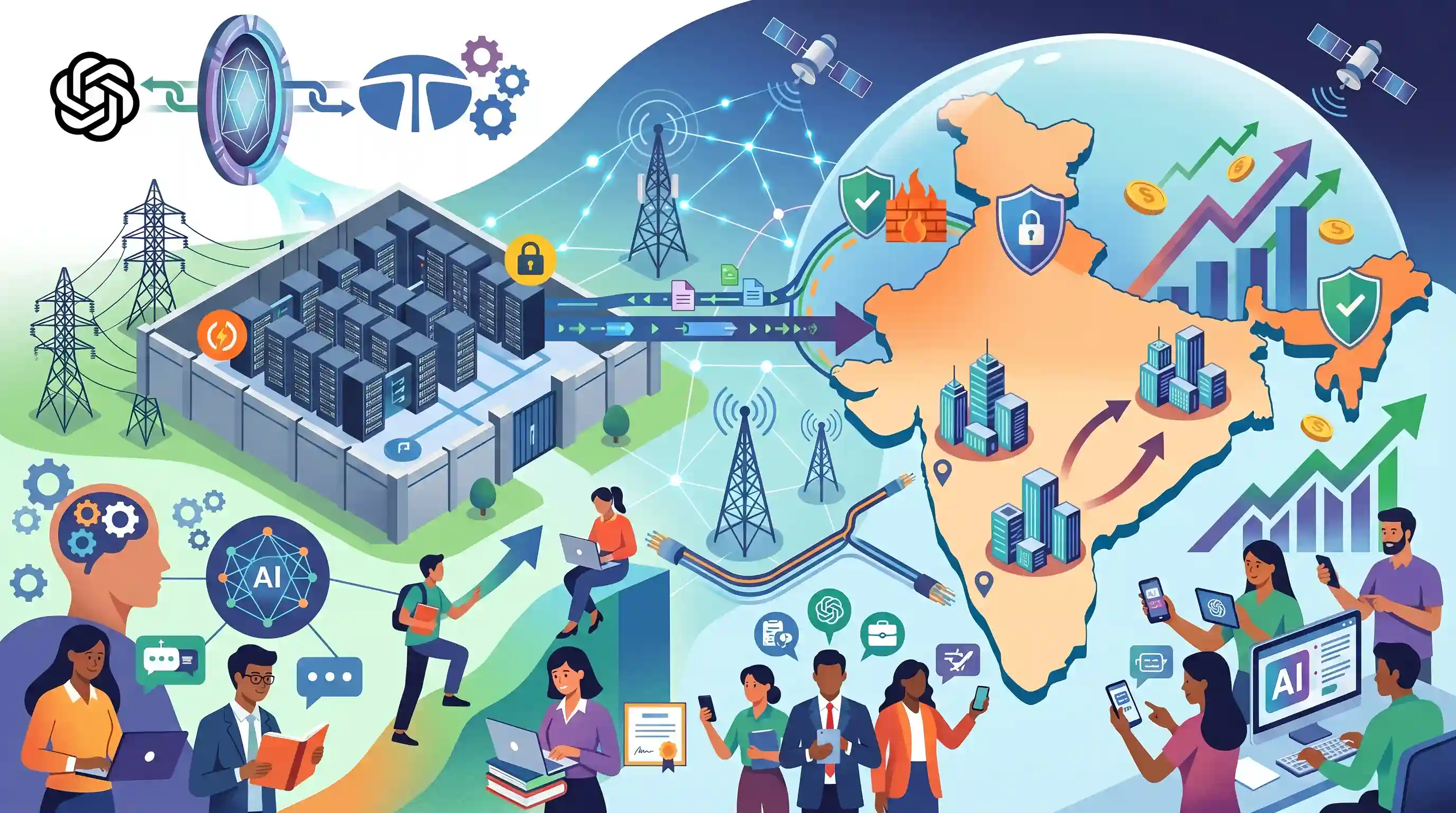
OpenAI partners with Tata group for AI infrastructure in India
Source:Indian Express ↗
Why It Matters
Highlights the growing importance of data residency and localized infrastructure for global AI companies operating in India. It showcases private sector partnerships (OpenAI and Tata Group) in building India's digital capabilities and the expanding role of generative AI in Indian enterprises and education, touching on critical GS3 themes of digital sovereignty, technology adoption, and cybersecurity.
Summary
OpenAI has announced a major expansion in India through the 'OpenAI for India' initiative, emphasizing localized AI infrastructure, data residency, and skill development. Partnering with the Tata Group under the global Stargate initiative, OpenAI will leverage TCS's new HyperVault data centres to meet stringent data localization and security needs, scaling up to 1 GW of capacity. This move not only addresses data compliance and cybersecurity concerns but also bolsters India's digital economy. Furthermore, the collaboration includes widespread deployment of ChatGPT Enterprise by TCS, extensive AI certification programs, and educational outreach with 100,000 ChatGPT Edu licences. By opening new offices in Mumbai and Bengaluru, OpenAI aims to deepen its engagement with its rapidly growing Indian user base.
Key Points
- OpenAI launched the 'OpenAI for India' initiative, partnering with Tata Group under the global Stargate program to significantly boost localized AI infrastructure.
- To address data residency and compliance requirements, OpenAI will serve as the first customer for TCS's new HyperVault data centre business, ensuring Indian data stays within the country.
- The infrastructure investment includes developing AI-ready data centres initially at 100 MW, with plans to scale up to 1 GW to support advanced generative AI workloads.
- The expansion emphasizes education and skill development, featuring TCS rolling out ChatGPT Enterprise, offering AI certifications, and distributing 100,000 ChatGPT Edu licences to Indian academic institutions.
- OpenAI is solidifying its physical presence by opening new offices in Mumbai and Bengaluru, catering to an active user base of over 100 million weekly users in India.
Important Terms
OpenAI for India initiative

A localized strategy launched in 2026 to expand AI access via domestic infrastructure, enterprise partnerships with firms like Tata, and large-scale workforce skilling.
UPSC context
GS Paper III (Science & Tech); relevant for Artificial Intelligence and digital economy strategy.
Stargate initiative
A $500 billion global project by OpenAI to develop hyperscale AI data centers; in India, it is anchored by a Tata partnership to build gigawatt-scale capacity.
UPSC context
GS Paper III (Economy/Tech); tests knowledge of global digital infrastructure and international tech collaborations.
India AI Impact Summit 2026
A major international summit held in New Delhi focusing on practical AI implementation. It is notable as the first global AI summit hosted by a Global South nation.
UPSC context
GS Paper II & III; relevant for international relations and India’s leadership in global technology governance.
HyperVault
A TCS-owned data center business providing secure, green-energy-powered, liquid-cooled infrastructure. It acts as the local anchor for OpenAI’s data residency and sovereign AI efforts in India.
UPSC context
GS Paper III (Science & Tech); relates to digital infrastructure and self-reliance in high-end computing.
Data Residency
The legal requirement to store and process data within a country's borders. In India, it is essential for compliance with the Digital Personal Data Protection (DPDP) Act, 2023.
UPSC context
GS Paper III (Internal Security/Tech); crucial for data privacy, security, and digital sovereignty.
Sovereign AI
A nation's capacity to build and control AI using its own infrastructure, data, and talent, ensuring autonomy from foreign centralized systems for critical governance and security tasks.
UPSC context
GS Paper III (Science & Tech); addresses digital sovereignty and national security in the Fourth Industrial Revolution.
Prelims Trap
"India's DPDP Act 2023 mandates strict data localization for all generative AI and machine learning data processing."
The DPDP Act 2023 actually abandoned strict data localization (from earlier drafts), adopting a 'negative list' for cross-border transfers. OpenAI’s localization is driven by enterprise trust and sectoral rules, not a universal mandate.
Static Concepts Connected
What are the core differences between data localization, mirroring, and residency?
- Data Localization: Mandates that specific data must be stored and processed exclusively within the physical borders of a country (e.g., RBI's payment rules).
- Data Mirroring: Requires a copy of the data to be stored locally, but allows the primary data to be processed and transferred internationally.
- Data Residency: A corporate or operational decision to store data in a specific region, usually to build enterprise trust or meet local sectoral compliance.
Why do Generative AI data centres require specialized liquid cooling infrastructure?
- High Thermal Density: AI servers running advanced GPUs generate vastly more heat per rack than traditional CPUs, making conventional air cooling highly inefficient.
- Liquid Heat Capacity: Liquids (water or dielectric fluids) absorb and transfer heat far more efficiently than air, preventing thermal throttling in intense computing environments.
- Carbon Footprint: Efficient cooling significantly lowers a facility's Power Usage Effectiveness (PUE) ratio, mitigating the massive energy consumption and environmental impact of AI models.
Cross-Topic Patterns
AI Compute vs. Climate Goals
Scaling data centres to 1 GW strains grid infrastructure, creating a direct conflict between India's digital economy ambitions and its 'Panchamrit' net-zero commitments.
Sovereign AI and Data Governance
Global tech voluntarily localizing data anticipates the upcoming Digital India Act and Non-Personal Data frameworks, moving beyond the DPDP Act's baseline requirements to secure state contracts.

Expect a GS-3 mains question linking the immense energy and water footprint of AI data centres to India's climate commitments and grid.
Linked PYQs · 3
Linked PYQs · 3
- 2018MainsGS3
Data security has assumed significant importance in the digitized world due to rising cyber crimes. The Justice B. N. Srikrishna Committee Report addresses issues related to data security. What, in your view, are the strengths and weaknesses of the Report relating to protection of personal data in cyber space?
- 2023MainsGS3
Introduce the concept of Artificial Intelligence (AI). How does Al help clinical diagnosis? Do you perceive any threat to privacy of the individual in the use of Al in healthcare?
- 2020PrelimsGS1
With the present state of development, Artificial Intelligence can effectively do which of the following? 1. Bring down electricity consumption in industrial units 2. Create meaningful short stories and songs 3. Disease diagnosis 4. Text-to-Speech Conversion 5. Wireless transmission of electrical energy Select the correct answer using the code given below:
