Artificial Intelligence Industry Restructuring and Enterprise Focus
Source:Indian Express ↗
Why It Matters
The commercial pivot of industry leader OpenAI reflects the broader maturation of the artificial intelligence sector, highlighting the tension between open-ended scientific research and the pressure to generate enterprise revenue. This trajectory is crucial for understanding the future landscape of AI development, corporate monopolies in technology, and the application of AI in critical fields like clinical diagnosis and drug discovery.
Summary
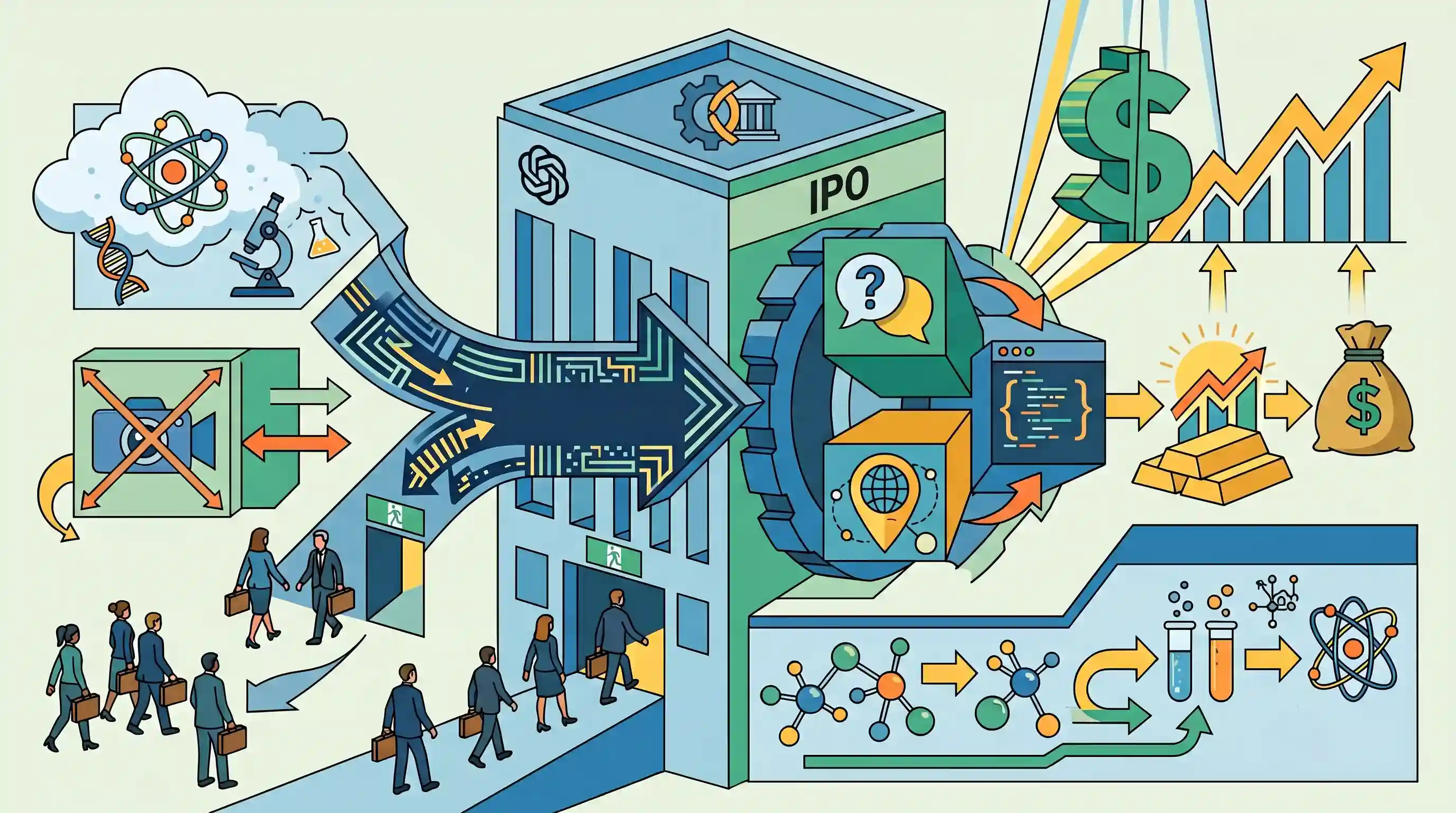
OpenAI is undertaking a major strategic restructuring to focus on enterprise AI, moving away from exploratory projects such as the Sora AI video generator and dissolving its dedicated "OpenAI for Science" division. This pivot, which has prompted the departure of several key executives, aims to streamline the company's product offerings into a comprehensive 'Super App' combining ChatGPT, Codex, and Atlas. Driven by the need to justify its recent $852 billion valuation and prepare for a potential IPO, the move highlights the broader trend of major AI research labs transitioning towards highly monetizable commercial applications, although efforts in specialized areas like GPT-Rosalind for clinical and biochemical research remain active under the broader research umbrella.
Key Points
- OpenAI is discontinuing its AI video generator Sora and other exploratory products to concentrate on enterprise AI solutions.
- The strategic pivot is accompanied by the departure of key executives, including the head of the science research initiative and the lead Sora researcher.
- The "OpenAI for Science" division is being restructured and absorbed into broader research teams, though work on specialized models like GPT-Rosalind for biochemistry and drug discovery continues.
- The company is developing a 'Super App' that integrates ChatGPT, the Codex coding tool, and the Atlas web browser.
- This shift towards commercialization and streamlined product offerings is reportedly in preparation for a potential Initial Public Offering (IPO), following a massive valuation of $852 billion.
Important Terms
Atlas (AI Browser)

An AI-powered web browser developed by OpenAI (released 2025) that integrates ChatGPT directly into web navigation. It features an 'agent mode' to perform autonomous tasks like booking appointments and summarizing web content.
UPSC context
GS III: Science & Technology. Tests knowledge of 'agentic AI' and the integration of large language models into daily internet infrastructure.
GPT-Rosalind
A domain-specific AI model launched by OpenAI in 2026, specialized for life sciences research, including genomics and drug discovery. It is designed to accelerate multi-step scientific workflows and biochemical reasoning.
UPSC context
GS III: Science & Technology (Biotechnology). Relevant for discussions on AI's role in healthcare innovation and pharmaceutical R&D.
Codex
OpenAI's generative AI model designed for software development. It translates natural language instructions into code, functioning as a high-value enterprise tool for increasing developer productivity and accelerating code reviews.
UPSC context
GS III: Science & Technology (IT). Significant for understanding AI-assisted labor and the digital economy's evolution.
Sora
OpenAI's text-to-video generative AI model, discontinued in 2026. While technically groundbreaking, it was shuttered to reallocate massive computing resources toward more profitable enterprise AI applications.
UPSC context
GS III: Science & Technology. Illustrates the trade-off between computational costs and commercial viability in frontier AI development.
OpenAI
An American AI research organization transitioning (as of 2026) into a multi-hundred-billion-dollar enterprise software company. It is known for developing ChatGPT and pursuing Artificial General Intelligence (AGI).
UPSC context
GS III: Economy. Represents a case study in startup valuations, global tech monopolies, and the transition from research to commercialization.
Prelims Trap
Generative AI applications are restricted to text, audio, and video synthesis, lacking capabilities in core scientific fields like drug discovery.
Aspirants often assume Generative AI is limited to language or media. However, GenAI architectures (transformers/diffusion) are actively used to generate novel protein structures and accelerate biochemical research.
Static Concepts Connected
How does Generative AI differ from Traditional/Predictive AI?
- Generative AI: Creates novel content (text, code, video, biochemical structures) by learning patterns from massive datasets.
- Underlying Tech: Relies on foundational models, Large Language Models (LLMs), Transformers, and Generative Adversarial Networks (GANs).
- Predictive AI: Analyzes existing data to forecast trends, detect anomalies, or classify information (e.g., credit scoring) without creating new media.
What characterizes a 'Super App' in the digital economy?
- Core Definition: An omnichannel platform consolidating a diverse suite of services (messaging, payments, enterprise tools, browsing) under a single user interface.
- Regulatory Challenges: Raises concerns over data centralization, user lock-in, and market monopolization, prompting scrutiny from antitrust regulators.
- Indian Context: Tata Neu and Paytm are prominent domestic examples attempting to emulate the success of global platforms like WeChat.
Cross-Topic Patterns
AI in drug discovery & patent laws
Using AI models like GPT-Rosalind for biochemical research raises critical questions about whether AI-generated molecular structures can be patented under Section 3(k) of the Indian Patent Act.
Super Apps and digital market monopolies
The shift toward comprehensive 'Super Apps' connects to the Competition Commission of India's ongoing scrutiny of bundled digital ecosystems and the proposed Digital Competition Bill.

A 2026 Prelims question will likely test specific GenAI applications like drug discovery (GPT-Rosalind) alongside coding (Codex).
Linked PYQs · 1
Linked PYQs · 1
- 2023MainsGS3
Introduce the concept of Artificial Intelligence (AI). How does Al help clinical diagnosis? Do you perceive any threat to privacy of the individual in the use of Al in healthcare?
