DPDP Act Judicial Scrutiny and RTI Exemption Concerns
Source:The Hindu ↗
Why It Matters
This article addresses the friction between statutory data protection frameworks, fundamental right to privacy, and transparency laws like the RTI Act, serving as crucial material for questions regarding checks and balances, judicial review, and governance reforms.
Summary
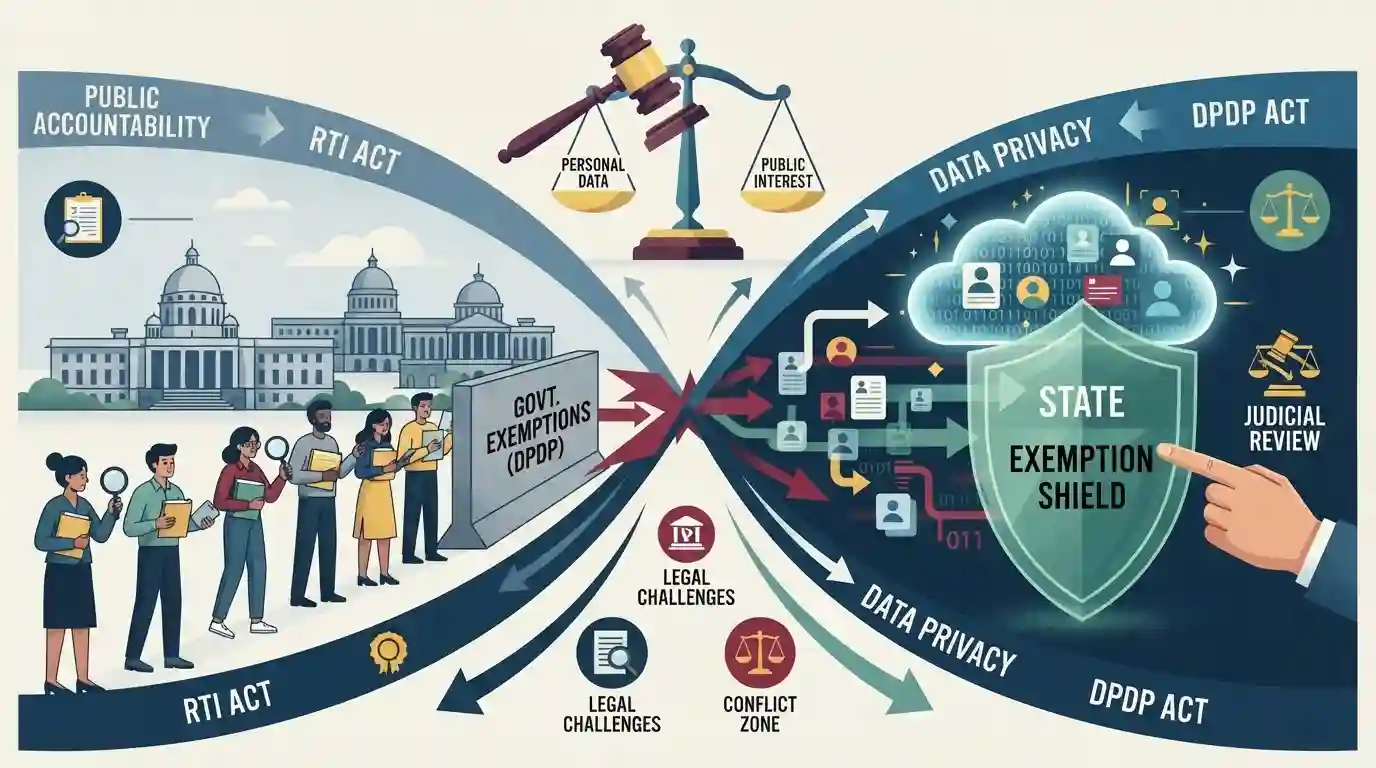
The editorial discusses the legal challenges mounted against the Digital Personal Data Protection (DPDP) Act, 2023, particularly focusing on legislative exemptions for government bodies and their potential clash with transparency laws like the Right to Information Act, emphasizing the judicial scrutiny required to balance data privacy with public accountability.
Key Points
- The Supreme Court of India is examining challenges to the constitutional validity of the Digital Personal Data Protection (DPDP) Act, 2023.
- Key concerns include potential dilution of the Right to Information (RTI) Act, 2005, through exemptions granted to government entities.
- Debates focus on whether the law strikes an optimal balance between individual privacy rights and state surveillance or administrative exemptions.
- The judiciary's scrutiny provides a crucial check on legislative overreach and protects fundamental rights like Article 21 (Right to Privacy).
Important Terms
Digital Personal Data Protection Act, 2023

India's foundational legislation for regulating the processing of digital personal data, balancing individual privacy rights with lawful data processing needs of government and private entities.
UPSC context
Important for GS Paper II (Polity and Governance - Data Privacy, Fundamental Rights). Tests understanding of data protection and legislative exemptions.
Right to Information Act, 2005
Legislation that empowers Indian citizens to request information from public authorities, promoting transparency, accountability, and curbing corruption.
UPSC context
Essential for GS Paper II (Transparency, Accountability, and Governance). Evaluates the balance between citizen transparency rights and executive secrecy.
Information Technology Act, 2000
India's primary law for regulating cyber activities, electronic commerce, digital transactions, and penalizing cybercrimes and online intermediary liabilities.
UPSC context
Crucial for GS Paper III (Internal Security and Cyber Security) and GS Paper II (Digital Governance). Tests framework for cyber regulation.
Prelims Trap
The DPDP Act maintains the RTI Act's larger public interest exemption for disclosing personal information without alteration.
Aspirants often assume the DPDP Act preserves the RTI Act's public interest exemption for personal data, whereas Section 44(3) of the DPDP Act actually amends Section 8(1)(j) of the RTI Act to remove the larger public interest threshold.
Static Concepts Connected
What are the key statutory features and exemptions under the Digital Personal Data Protection (DPDP) Act, 2023?
- Scope & Applicability: It applies to the processing of digital personal data within India and outside India if it involves profiling or offering goods/services to data principals in India.
- RTI Amendment: Section 44(3) amends the RTI Act, 2005, removing the 'larger public interest' test for disclosing personal information under Section 8(1)(j).
- State Exemptions: The Act empowers the Central Government to exempt certain state instrumentalities from its provisions in the interests of sovereignty, security, and public order.
Cross-Topic Patterns
DPDP Act vs RTI Act transparency tensions
The DPDP Act's amendment to the RTI Act creates a direct tension between individual data protection rights and the constitutional right to information derived from Article 19(1)(a).
State surveillance exemptions and Article 21 limits
Broad state exemptions under privacy legislations echo ongoing debates around the balance between national security/administrative efficiency and citizens' fundamental rights under Article 21.

DPDP Act exemptions vs RTI Act amendments and Article 21 privacy limits will feature in mains governance or prelims statutory questions.
Linked PYQs · 1
Linked PYQs · 1
- 2024MainsGS2
Right to privacy is intrinsic to life and personal liberty and is inherently protected under Article 21 of the constitution. Explain. In this reference discuss the law relating to D.N.A. testing of child in the womb to establish its paternity.
