OPEC plus crude oil output amid West Asian conflict
Source:The Hindu ↗
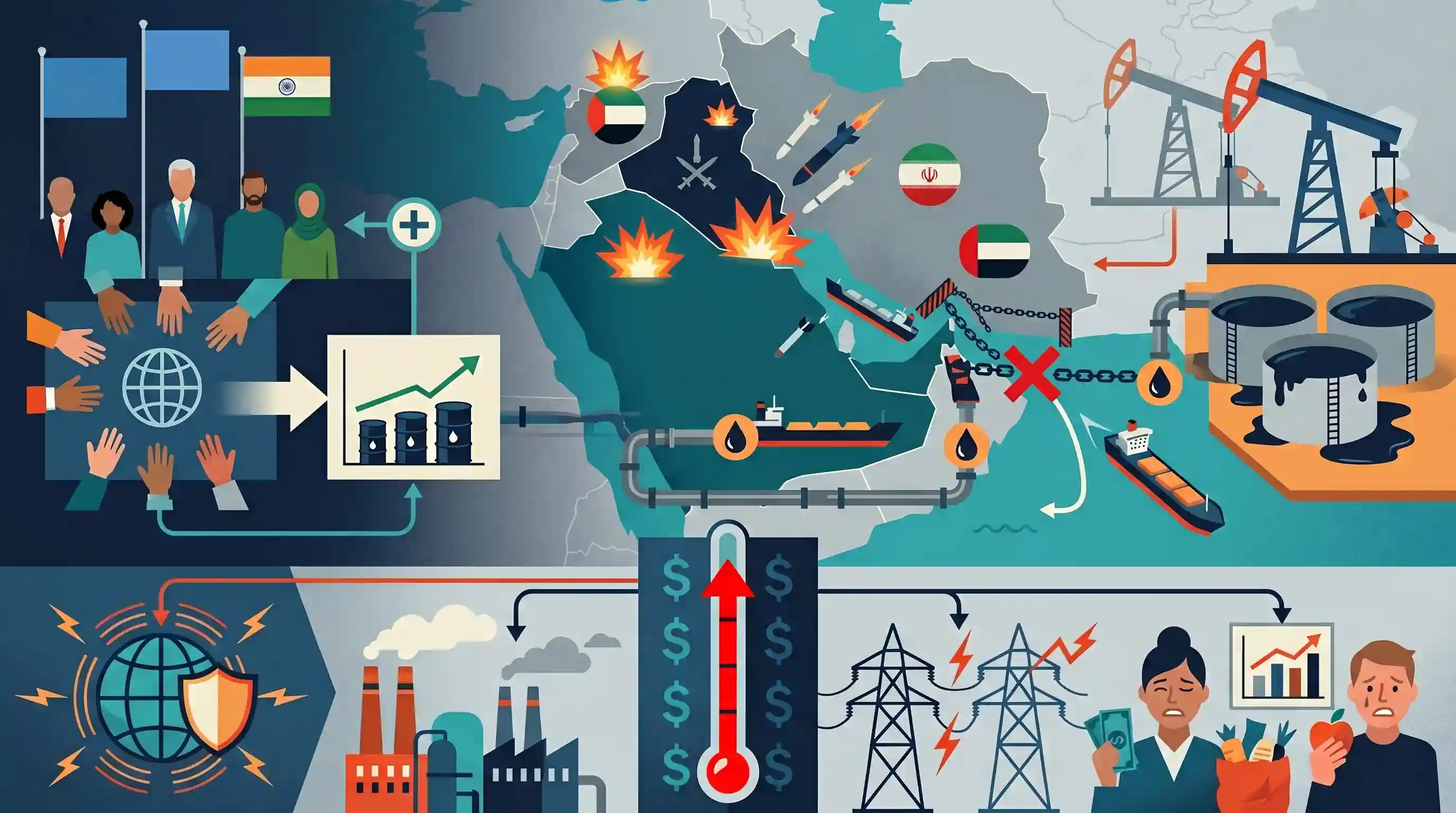
Why It Matters
The closure of the Strait of Hormuz, a critical chokepoint for global oil trade, directly impacts global energy security and macroeconomic stability. For UPSC aspirants, this highlights the intersection of international relations (West Asia geopolitics) and economics (oil pricing, inflation, India's energy import dependence).
Summary
OPEC+ has decided to slightly raise crude oil production by 2.06 lakh barrels per day despite major supply chain disruptions caused by escalating conflict in West Asia. The crucial Strait of Hormuz has been closed for navigation since late February 2026 due to retaliatory actions by Iran following U.S.-Israeli strikes. The naval blockade has hampered the export capabilities of major producers like Saudi Arabia and the UAE, who possess spare capacity but cannot ship it. Consequently, global oil prices have jumped to $73 a barrel, exacerbating concerns over global energy security and inflation.
Key Points
- OPEC+ agreed to a modest increase in oil production (2,06,000 barrels per day) despite ongoing geopolitical conflict in West Asia.
- The strategic Strait of Hormuz has been closed to navigation following retaliatory actions by Iran against U.S.-Israeli strikes.
- Global crude oil prices spiked to $73 per barrel due to the conflict, with analyst warnings of prices potentially reaching $100 per barrel.
- While Saudi Arabia and the UAE hold significant spare production capacity, their ability to export is severely constrained by the naval disruptions in the Gulf.
Important Terms
OPEC (Organization of the Petroleum Exporting Countries)

An intergovernmental organization of oil-exporting nations (e.g., Saudi Arabia, Iran, Iraq) established in 1960 to coordinate petroleum policies and ensure stable global oil prices.
UPSC context
GS Paper 2: International Relations; critical for India's energy security as it manages supply for a significant portion of India's crude imports.
OPEC+
An alliance formed in 2016 between OPEC members and non-OPEC oil producers (notably Russia) to exert greater control over global oil supply and respond to market volatility.
UPSC context
GS Paper 3: Indian Economy; its production quotas directly impact global oil prices and India's trade deficit and inflation.
Strait of Hormuz
A narrow, strategically vital maritime chokepoint between Iran and Oman that connects the Persian Gulf to the open ocean, carrying approximately 20% of the world's oil supply.
UPSC context
GS Paper 2: International Relations & Geography; a key maritime chokepoint whose closure poses a severe threat to India’s energy supply chains.
Energy Security
The reliable and uninterrupted availability of energy sources at an affordable price, encompassing physical availability, economic affordability, and environmental sustainability.
UPSC context
GS Paper 3: Infrastructure and Energy; a core objective of Indian policy to reduce import dependence and fuel economic growth.
Spare Capacity
The volume of crude oil production that can be brought online within 30 days and sustained for at least 90 days; it acts as a market buffer.
UPSC context
GS Paper 3: Indian Economy/Energy; tests understanding of how major producers stabilize markets during geopolitical crises or supply shocks.
Inflation
A persistent rise in the general price level of goods and services, often triggered by high energy costs in oil-importing nations like India.
UPSC context
GS Paper 3: Indian Economy; examines the 'cost-push' effect of rising crude prices on India’s consumer price index (CPI).
Prelims Trap
"The Strait of Hormuz is a critical chokepoint connecting the Red Sea to the Arabian Sea."
Aspirants frequently confuse the Strait of Hormuz (Persian Gulf to Gulf of Oman) with the Bab-el-Mandeb strait (Red Sea to Gulf of Aden), both critical energy chokepoints.
Static Concepts Connected
What are the key maritime chokepoints in West Asia impacting global energy trade?
- Strait of Hormuz: Connects the Persian Gulf to the Gulf of Oman and Arabian Sea. It handles approximately 20% of global crude oil consumption.
- Bab-el-Mandeb: Connects the Red Sea to the Gulf of Aden. It is critical for vessels transiting to Europe via the Suez Canal.
How do sustained crude oil price hikes impact India's macroeconomic stability?
- Current Account Deficit: Increases the national import bill disproportionately, as India imports over 85% of its crude oil requirements, widening the CAD.
- Imported Inflation: Elevates domestic transport and logistics costs, cascading into broader cost-push inflation across the economy.
- Currency Depreciation: Higher dollar demand for purchasing costly oil imports puts downward pressure on the Rupee, leading to depreciation.
Cross-Topic Patterns
Oil volatility & India's SPR program
Disruptions in the Persian Gulf consistently trigger policy debates on expanding India's Strategic Petroleum Reserves (SPR) and expediting ISPRL Phase-II projects in Chandikhol and Padur to buffer supply shocks.
Chokepoints vs. Alternative Trade Corridors
Maritime blockades in Hormuz and the Red Sea amplify the strategic necessity of alternative overland and multi-modal logistical routes like the INSTC and IMEC to bypass vulnerable chokepoints.

Expect a map question pairing West Asian chokepoints (Hormuz, Bab-el-Mandeb) with adjacent conflicts or OPEC+ member geography in 2026.
Linked PYQs · 3
Linked PYQs · 3
- 2024PrelimsGS1
Consider the following statements : Statement-I : Sumed pipeline is a strategic route for Persian Gulf oil and natural gas shipments to Europe. Statement-II : Sumed pipeline connects the Red Sea with the Mediterranean Sea. Which one of the following is correct in respect of the above statements?
- 2022PrelimsGS1
The term "Levant" often heard in the news roughly corresponds to which of the following regions?
- 2018MainsGS3
“Access to affordable, reliable, sustainable and modern energy is the sine qua non to achieve Sustainable Development Goals (SDGs).” Comment on the progress made in India in this regard.
