Anti Defection Law Loopholes and Mergers of Party Factions
Source:Indian Express ↗
Why It Matters
This article illustrates critical vulnerabilities in the Anti-Defection Law (Tenth Schedule) and examines the impartiality of the Speaker's office. It is highly relevant for GS Paper 2, providing contemporary examples of how constitutional loopholes are utilized to bypass anti-defection provisions, and touches upon the broader themes of electoral reforms, internal party democracy, and political ethics.
Summary
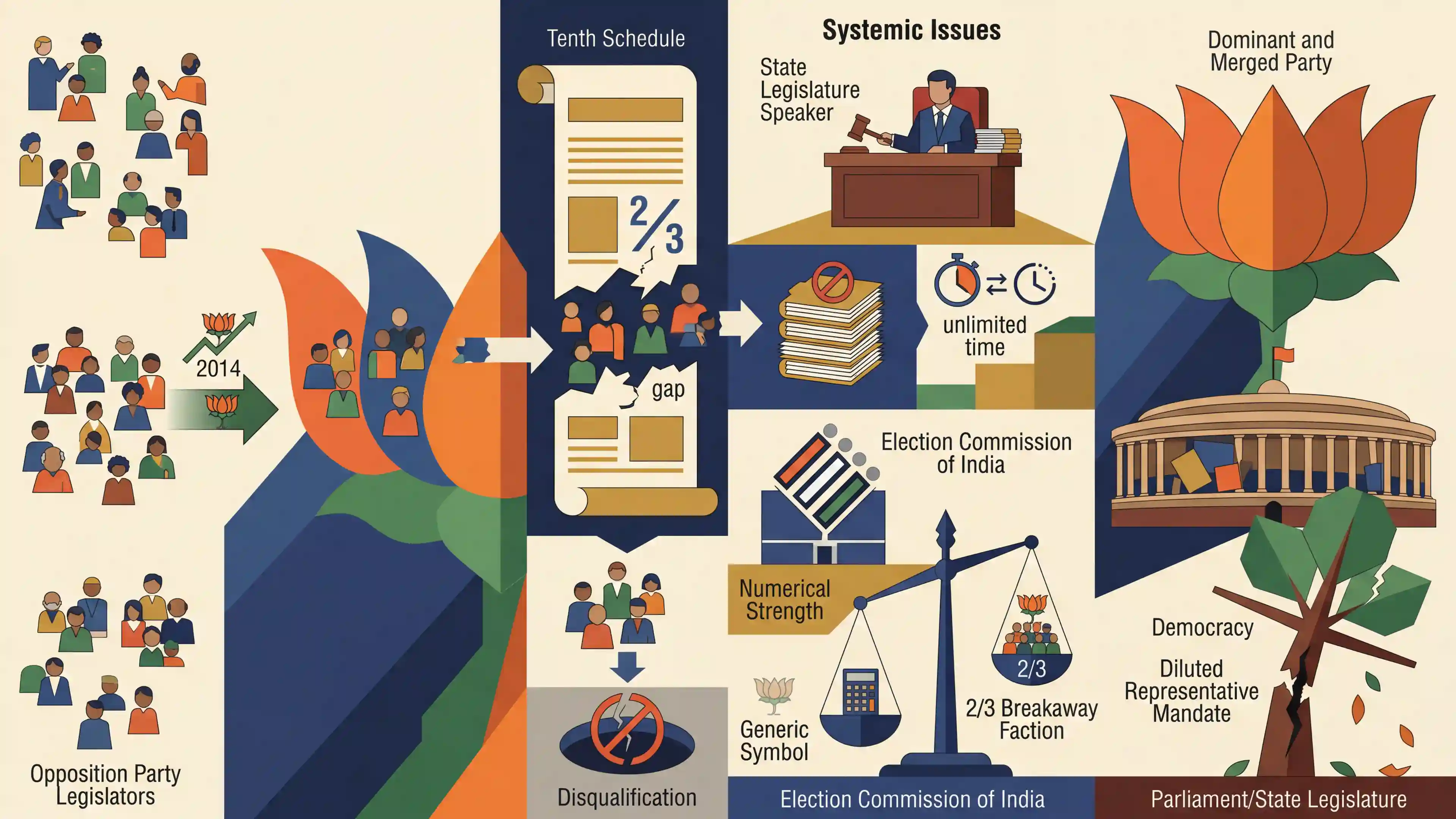
The article details the 'Operation Lotus' phenomenon, describing how opposition party legislators and factions have systematically merged with the BJP across various states since 2014. By exploiting the two-thirds majority exception under the Tenth Schedule (Anti-Defection Law), breakaway groups manage to evade disqualification. The trend highlights systemic issues in India's parliamentary democracy, particularly the partisan conduct of Speakers in state legislatures who delay disqualification proceedings, and the Election Commission of India's practice of allocating the party symbol to the breakaway faction based largely on legislative numerical strength. Ultimately, this practice dilutes representative mandates and exposes glaring loopholes in the current anti-defection framework.
Key Points
- The 10th Schedule (Anti-Defection Law) exempts lawmakers from disqualification if two-thirds of a legislative party agree to a 'merger'.
- Breakaway factions of opposition parties have repeatedly exploited this two-thirds loophole to ally with or merge into the ruling party (BJP), altering state governments since 2014.
- Presiding Officers (Speakers) often display partisan behavior in these scenarios, rapidly recognizing the breakaway groups while delaying action on disqualification petitions filed by the original party.
- The Election Commission of India frequently relies on the 'test of majority' within the legislative wing to recognize the splinter faction as the 'real' party and allocates the official symbol to them.
- This trend undermines the original intent of the Anti-Defection Law to prevent unprincipled political defections, raising serious concerns regarding parliamentary ethics and the subversion of electoral mandates.
Important Terms
Anti-Defection Law

Contained in the Constitution's Tenth Schedule, it disqualifies MPs/MLAs for voluntarily resigning or voting against party whips. It aims to prevent political opportunism and ensure government stability.
UPSC context
GS Paper II: Parliament/State Legislatures. Tests understanding of legislative stability, party discipline, and the 52nd/91st Amendments.
Tenth Schedule
Added by the 52nd Amendment (1985), this schedule provides the legal framework for disqualifying legislators on grounds of defection. It currently allows mergers only if two-thirds of a party's legislators agree.
UPSC context
GS Paper II: Constitutional Provisions. High relevance for questions on constitutional morality and the evolution of parliamentary democracy.
Symbols (Reservation and Allotment) Order, 1968
A 1968 regulation empowering the Election Commission of India (ECI) to recognize parties and allot symbols. Paragraph 15 specifically governs how the ECI adjudicates disputes within split political parties.
UPSC context
GS Paper II: Statutory/Regulatory Bodies. Vital for understanding the ECI’s quasi-judicial powers during party splits and mergers.
Office of the Speaker
The final authority for deciding disqualification petitions under the Tenth Schedule. The Speaker's conduct is often scrutinized for partisan delays, impacting government stability and democratic mandates.
UPSC context
GS Paper II: State Legislature/Parliament. Tests knowledge of presiding officers' roles and judicial review (Kihoto Hollohan case).
Operation Lotus
A political strategy involving the mass resignation or defection of opposition legislators to topple sitting governments or secure a majority, often exploiting the two-thirds merger loophole in the Tenth Schedule.
UPSC context
GS Paper II: Current Affairs/Polity. Used as a case study for challenges to India’s federalism and representative democracy.
91st Constitutional Amendment Act, 2003
A crucial amendment that strengthened the Tenth Schedule by removing the "one-third split" exception, requiring a "two-thirds merger" instead, and capping the size of the Council of Ministers.
UPSC context
GS Paper II: Amendments. Frequently tested in Prelims/Mains regarding limits on the executive and stricter anti-defection norms.
Prelims Trap
The Tenth Schedule prescribes a mandatory three-month time limit for the Speaker to decide anti-defection petitions.
The Tenth Schedule contains no time limit. The three-month outer limit for Speakers to decide disqualification cases was established by the Supreme Court in the Keisham Meghachandra Singh case (2020).
Static Concepts Connected
How does the ECI resolve party symbol disputes?
- Quasi-Judicial Authority: Under Paragraph 15 of the Election Symbols Order 1968, ECI acts as a quasi-judicial body to resolve disputes between rival factions of a recognized party.
- Test of Majority: Established in the Sadiq Ali case (1971), the ECI assesses numerical strength in both the legislative wing (elected MPs/MLAs) and the organizational wing.
- Binding but Reviewable: The ECI's decision on party name and symbol allocation is binding, though it remains subject to judicial review.
How did the 91st Constitutional Amendment alter the Anti-Defection Law?
- Removed Split Exception: Omitted Paragraph 3 of the Tenth Schedule, thereby ending protection from disqualification for a 'split' by one-third of the legislative party.
- Retained Merger Exception: Retained the exemption from defection only if at least two-thirds of a legislative party's members agree to a merger with another party.
Cross-Topic Patterns
Judicial Review of Constitutional Authorities
The Kihoto Hollohan (1992) ruling that Speaker decisions are subject to judicial review parallels the evolving Supreme Court scrutiny of Governors' discretionary powers in government formation.
ECI's Quasi-Judicial Scope and RPA
The ECI's power to adjudicate intra-party disputes under the Symbols Order is routinely tested alongside its RPA Section 29A powers regarding party registration and de-registration.

A composite question linking the 91st CAA, the Speaker's adjudicatory timeline, and ECI's symbol dispute powers is highly probable in 2026.
Linked PYQs · 4
Linked PYQs · 4
- 2014PrelimsGS1
Which one of the following Schedules of the Constitution of India contains provisions regarding anti-defection?
- 1998PrelimsGS1
Which one of the following Schedules of the Constitution of India contains provisions regarding Anti-Defection Act?
- 2023MainsGS2
Discuss the role of Presiding Officers of state legislatures in maintaining order and impartiality in conducting legislative work and in facilitating best democratic practices.
- 2020MainsGS2
Once a Speaker, Always a Speaker' ! Do you think this practice should be adopted to impart objectivity to the office of the Speaker of Lok Sabha ? What could be its implications for the robust functioning of parliamentary business in India?
