Carrying Capacity and Agrarian Distress in Ooty
Source:The Hindu ↗
Why It Matters
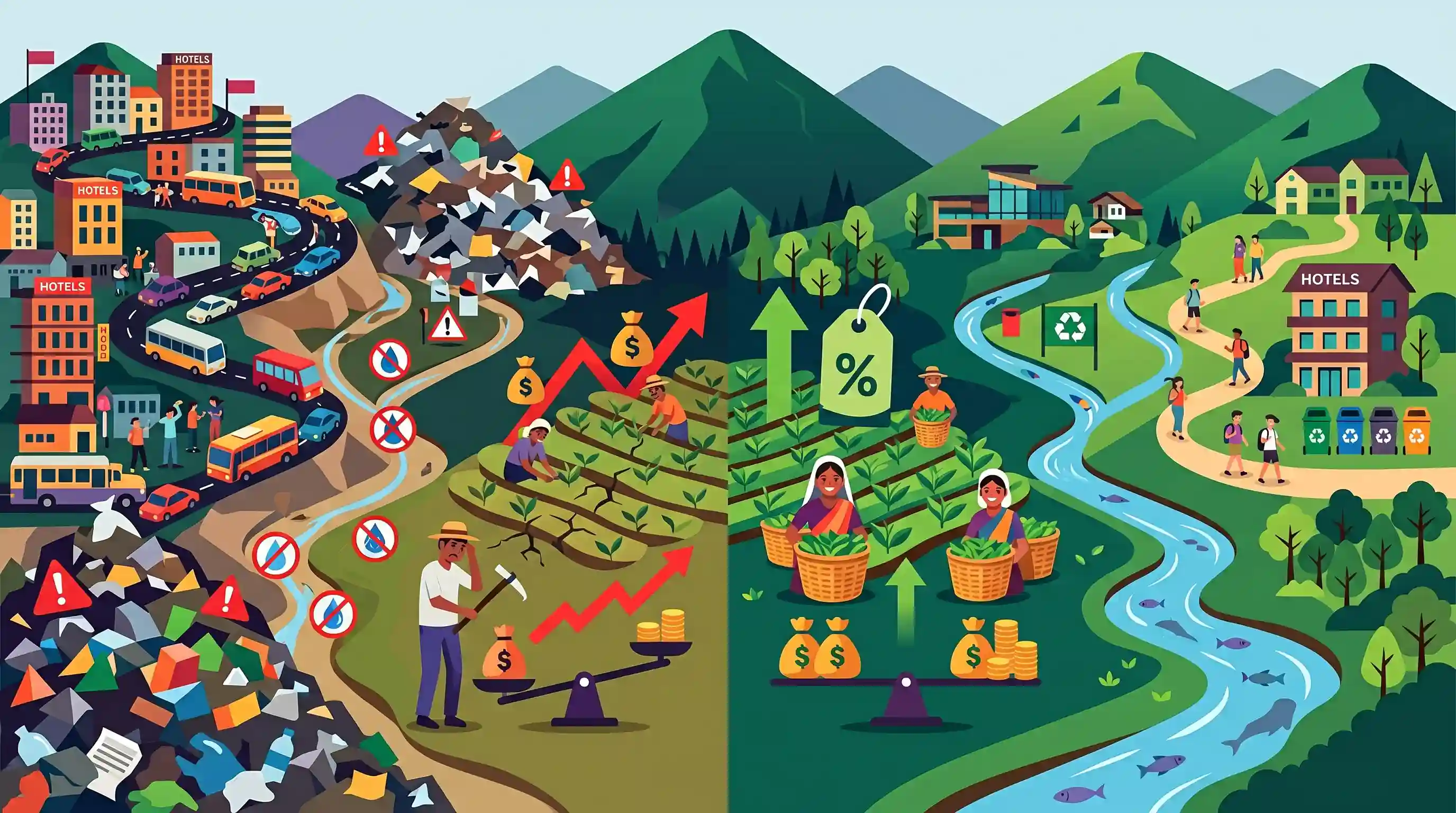
The challenges in Ooty provide a highly relevant case study for UPSC aspirants on the intersection of economy and environment. It exemplifies the practical realities of 'carrying capacity' in fragile ecosystems, the adverse impacts of unregulated tourism in hill stations, challenges in municipal solid waste management, and the ongoing agrarian distress leading to demands for Minimum Support Prices (MSP) among small and marginal cash-crop farmers.
Summary
The Ooty constituency in Tamil Nadu is grappling with twin crises ahead of the 2026 Assembly elections: ecological degradation caused by unregulated tourism and severe economic distress in the tea sector. The hill station's carrying capacity is heavily strained by over-tourism, leading to challenges in solid waste management, water scarcity, and unregulated urbanisation. Simultaneously, the region's vital tea industry is suffering as small tea growers face stagnant prices, rising input costs, and declining soil fertility. The situation highlights the urgent need for interventions such as implementing a Minimum Support Price (MSP) for tea leaves and enforcing sustainable tourism frameworks to protect the fragile mountain ecosystem.
Key Points
- Ooty's ecological carrying capacity is being severely tested by unregulated tourism, leading to infrastructure stress, water scarcity, and traffic congestion.
- The hill station faces a critical solid waste management crisis, with inadequate disposal infrastructure threatening local watersheds and the broader environment.
- The local tea sector is experiencing economic distress, as small tea growers struggle with stagnant green leaf prices and rising input costs.
- Farmers in the region are advocating for a Minimum Support Price (MSP) to ensure the economic viability of tea cultivation.
- There is a pressing need to balance economic dependence on tourism and agriculture with the ecological conservation of fragile mountain ecosystems.
Important Terms
Tea Board of India

A statutory body established under the Tea Act, 1953, functioning under the Ministry of Commerce and Industry. It regulates tea cultivation, production, and exports while providing financial/technical assistance.
UPSC context
GS Paper III: Statutory bodies and agricultural marketing. Tests knowledge of regulatory frameworks for plantation crops.
Carrying Capacity
The maximum number of individuals or level of human activity an ecosystem can support without causing irreversible environmental degradation or resource depletion.
UPSC context
GS Paper III: Environment and Ecology. Crucial for questions on sustainable development in fragile regions.
Minimum Support Price (MSP)
A government-mandated floor price for agricultural produce to protect growers against market volatility. Small tea growers in Tamil Nadu are currently demanding its implementation for green leaves.
UPSC context
GS Paper III: Agriculture and Farmers' Issues. Focuses on price realization and agrarian distress mechanisms.
Sustainable Tourism
Tourism that accounts for its current and future economic, social, and environmental impacts, focusing on resource conservation and maintaining the ecological integrity of the host community.
UPSC context
GS Paper I: Geography / GS Paper III: Environment. Relevant for hill-station urbanization and ecological conservation.
Small Tea Growers (STGs)
Growers with a plantation area typically less than 10 hectares. In India, they contribute 35-50% of total tea production but face high price volatility.
UPSC context
GS Paper III: Agriculture. Relevant for issues concerning unorganized sectors and value-chain dependencies.
Fragile Mountain Ecosystems
Highly sensitive regions characterized by steep slopes, high biodiversity, and vulnerability to climate change, land degradation, and unregulated human interference.
UPSC context
GS Paper I: Physical Geography. Tests understanding of geographical features and conservation of biological hotspots.
Prelims Trap
"Tea is included in the 22 mandated crops for which the Central Government announces a Minimum Support Price (MSP)."
Tea is a commercial plantation crop and is NOT covered under the MSP regime recommended by the CACP. Its pricing is primarily auction-based.
Static Concepts Connected
What is the regulatory framework for the Tea sector in India?
- Statutory Body: Regulated by the Tea Board of India, a statutory body established under the Tea Act, 1953.
- Nodal Ministry: Operates under the Ministry of Commerce and Industry, not the Ministry of Agriculture.
- Price Mechanism: Prices are primarily discovered through regulated public auctions and private sales, lacking a statutory minimum support price guarantee.
What defines 'Carrying Capacity' in mountain ecosystems?
- Core Definition: The maximum population or tourism footprint an environment can sustain without suffering irreversible ecological degradation or resource depletion.
- Western Ghats Context: Crucial for urban planning and Eco-Sensitive Zones (ESZs) in the Western Ghats, as frequently highlighted by the Gadgil and Kasturirangan committee reports.
Cross-Topic Patterns
Western Ghats Ecology + Plantation Agriculture
The Nilgiris crisis illustrates the ongoing friction between colonial-era cash-crop economies (tea plantations) and modern ecological limits within the Western Ghats.
MSP demands for non-mandated crops
Growing agrarian distress is prompting farmers of commercial and plantation crops (like tea and rubber) to demand statutory MSPs, challenging the traditional CACP framework.

Expect a 2026 Prelims question mixing CACP's MSP mandate exclusions (like tea) with the statutory functions of the Tea Board.
Linked PYQs · 5
Linked PYQs · 5
- 2019MainsGS1
How can the mountain ecosystem be restored from the negative impact of development initiatives and tourism?
- 2019MainsGS3
Define the concept of carrying capacity of an ecosystem as relevant to an environment. Explain how understanding this concept is vital while planning for sustainable development of a region.
- 2018MainsGS3
What do you mean by Minimum Support Price (MSP)? How will MSP rescue the farmers from the low income trap?
- 2018MainsGS3
What are the impediments in disposing the huge quantities of discarded solid wastes which are continuously being generated? How do we remove safely the toxic wastes that have been accumulating in our habitable environment?
- 2017MainsGS3
How do subsidies affect the cropping pattern, crop diversity and economy of farmers? What is the significance of crop insurance, minimum support price and food processing for small and marginal farmers?
