Supreme Court on Release of Undertrials Granted Bail
Source:The Hindu ↗
Why It Matters
It addresses critical issues regarding the implementation of bail orders, personal liberty under Article 21, and prison overcrowding in India.
Summary
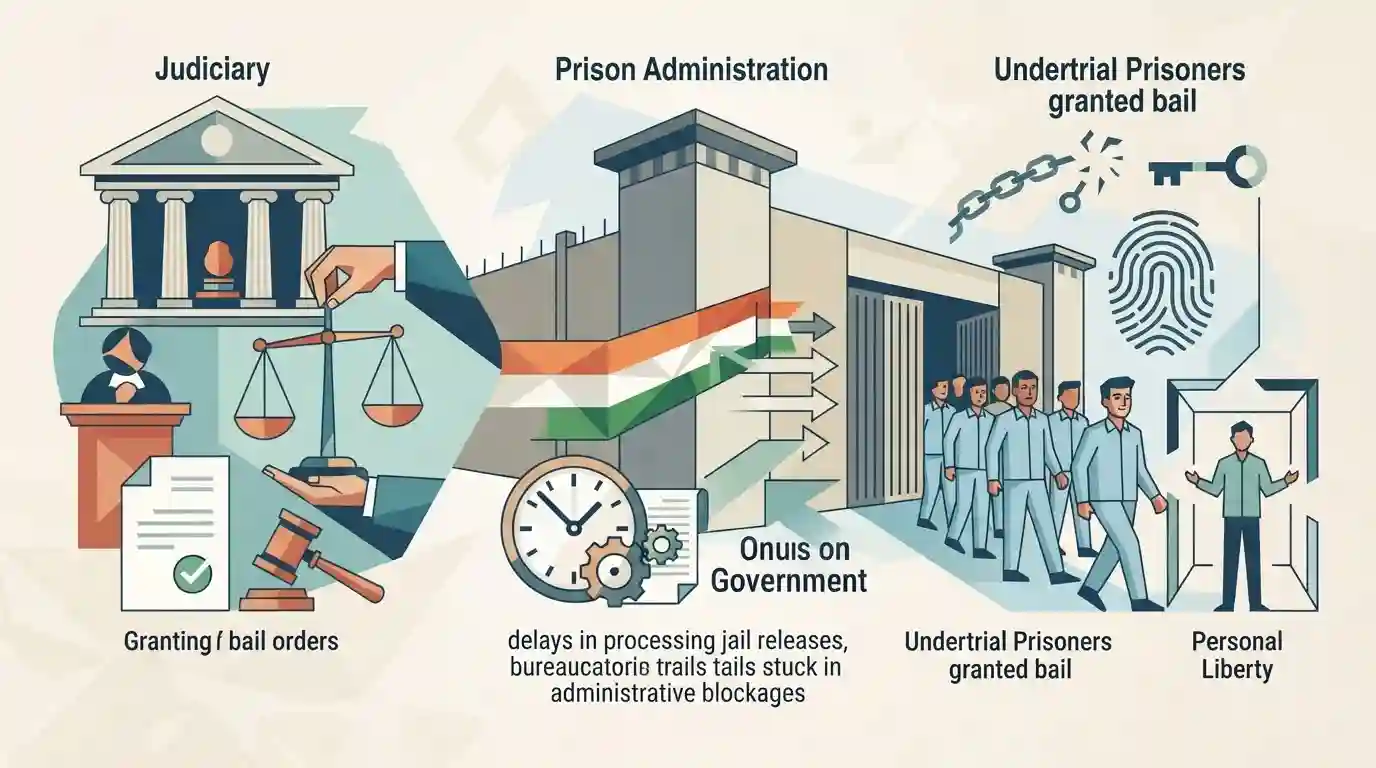
The Supreme Court stated that the onus is on the Uttar Pradesh government to ensure that undertrial prisoners granted bail are promptly released, highlighting delays in processing jail releases and safeguarding personal liberty.
Key Points
- The Supreme Court emphasized that the onus lies on the Uttar Pradesh government to ensure that undertrial prisoners who have been granted bail are actually released from custody.
- The Court's observation highlights systemic delays and bureaucratic apathy in processing bail orders, leading to continued incarceration despite judicial relief.
- This underscores broader issues in India's criminal justice system, such as prison overcrowding and the protection of personal liberty under Article 21.
Important Terms
Supreme Court

The apex judicial body of India, empowered under Article 143 and other constitutional provisions to protect fundamental rights and supervise the administration of justice across the country.
UPSC context
Crucial for GS Paper II (Indian Constitution, Judiciary, Separation of Powers) and understanding judicial review and enforcement of personal liberty.
Prelims Trap
Prisons and reformatory administration fall under the Concurrent List of the Seventh Schedule.
Aspirants often assume prison administration is a concurrent list subject because criminal law is concurrent. Prisons are solely a state subject.
Static Concepts Connected
What is the constitutional and statutory framework governing prisons and bail in India?
- Constitutional Placement: State Subject under Entry 4 of List II (State List) of the Seventh Schedule of the Constitution.
- Personal Liberty: Guaranteed under Article 21; prolonged incarceration post-bail violates the right to life and personal liberty.
- DLSA Mandate: Statutory body under the Legal Services Authorities Act, 1987, tasked with legal aid and prisoner assistance.
Cross-Topic Patterns
Prison Reforms + Federal Fiscal Architecture
Prison administration and overcrowding directly impact federal fiscal transfers and internal security ratings under the 15th Finance Commission grants.
Undertrial Rights + Digital Governance (ICJS)
Judicial delays in executing bail orders intersect with digital criminal justice platforms like ICJS and e-Prisons integration.

Article 21 personal liberty violations via undertrial incarceration + DLSA role is a high-yield prelims match-the-following topic.
Linked PYQs · 3
Linked PYQs · 3
- 2023PrelimsGS1
Consider the following statements: Statement-I: In India, prisons are managed by State Governments with their own rules and regulations for the day-to-day administration of prisons. Statement-II: In India, prisons are governed by the Prisons Act, 1894 which expressly kept the subject of prisons in the control of Provincial Governments. Which one of the following is correct in respect of the above statements?
- 2021PrelimsGS1
With reference to India, consider the following statements : 1. When a prisoner makes out a sufficient case, parole cannot be denied to such prisoner because it becomes a matter of his/her right. 2. State Governments have their own Prisoners Release on Parole Rules. Which of the statements given above is/are correct?
- 2021PrelimsGS1
With reference to India, consider the following statements : 1. Judicial custody means an accused is in the custody of the concerned magistrate and such accused is locked up in police station, not in jail. 2. During judicial custody, the police officer in charge of the case is not allowed to interrogate the suspect without the approval of the court. Which of the statements given above is/are correct?
