Chief Minister Confirms Uniform Civil Code Push in Madhya Pradesh
Source:freepressjournal ↗
Why It Matters
The Uniform Civil Code is a highly debated constitutional objective (Article 44). The intent of a state government to implement it touches upon federalism, concurrent list subjects, and constitutional law. MPPSC frequently asks questions on DPSP, state legislative initiatives, and state administration, making this current event directly relevant to GS2 Polity.
Summary
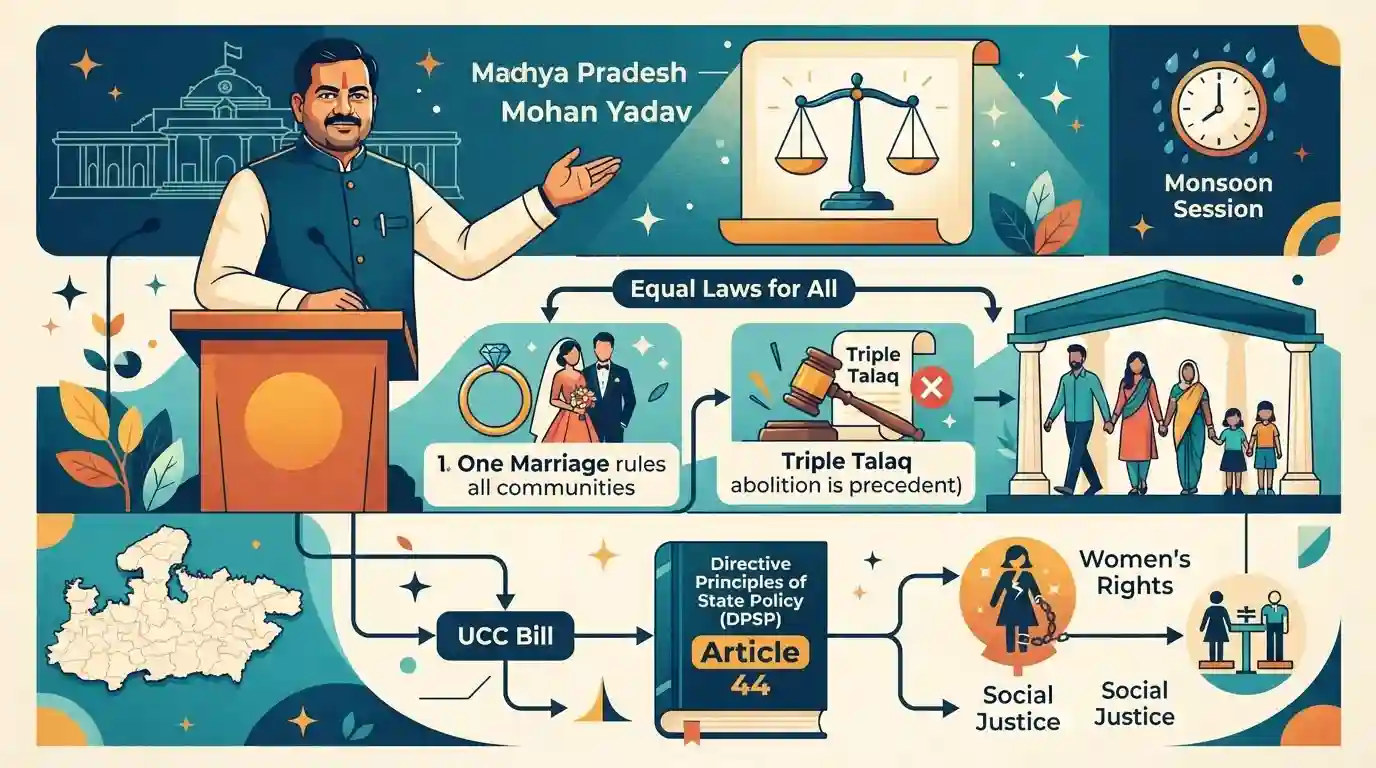
Madhya Pradesh Chief Minister Mohan Yadav has announced that the state government is preparing to introduce the Uniform Civil Code (UCC) Bill during the Monsoon Session of the Legislative Assembly. Speaking in Katni, Yadav stated that the state will enforce equal laws for all, particularly stressing that 'only one marriage' will be permitted. He cited the abolition of Triple Talaq as a precedent for such reforms. This move links closely with Article 44 of the Directive Principles of State Policy (DPSP) and forms a critical part of the state's legislative agenda, making it highly relevant for MPPSC state polity and constitution topics.
Key Points
- Madhya Pradesh Chief Minister Mohan Yadav confirmed that the state government will push for the Uniform Civil Code (UCC) Bill in the upcoming Monsoon Session of the State Assembly.
- Addressing a public gathering in Katni, CM Yadav asserted that only one marriage would be allowed in the state, emphasizing equal laws for all citizens.
- The CM highlighted the national abolition of Triple Talaq, positioning the UCC as a continued reform towards social justice and constitutional ideals.
- The UCC aims to standardize personal laws regarding marriage, divorce, and inheritance across different religious communities.
Important Terms
Uniform Civil Code (UCC) Bill

A proposed law to replace religion-specific personal laws governing marriage, divorce, inheritance, and adoption with a common set of civil laws for all citizens, irrespective of their faith.
UPSC context
Crucial for GS Paper 2 (Polity). Tests understanding of fundamental rights vs DPSP, equality, and secularism.
Article 44 of the Directive Principles of State Policy (DPSP)
A Directive Principle of State Policy (Part IV of the Constitution) stating the State shall endeavor to secure a Uniform Civil Code throughout the territory of India. It is non-justiciable.
UPSC context
Vital for GS Paper 2 (Constitutional provisions). Tests knowledge of DPSPs, constitutional goals, and their implementation challenges.
Triple Talaq
Also known as Talaq-e-Biddat, an Islamic practice where a husband could instantly and irrevocably divorce his wife by pronouncing the word 'talaq' three times. It was criminalized in India in 2019.
UPSC context
Important for GS Paper 1 (Society) and GS Paper 2 (Social Justice). Tests understanding of women's rights and personal law reform.
Prelims Trap
Goa was the first Indian state to draft and pass a Uniform Civil Code after independence.
Goa’s civil code is a colonial Portuguese legacy. Uttarakhand was the first state to independently draft and pass a UCC bill post-independence.
Static Concepts Connected
What is the constitutional framework governing personal laws and UCC in India?
- Article 44: Part IV directs the State to secure a Uniform Civil Code for all citizens throughout India.
- Concurrent List: Entry 5 of List III gives both Centre and States legislative competence over marriage, divorce, and inheritance.
Why does the implementation of UCC vary for Scheduled Tribes?
- Customary Protections: Articles 371A and 371G protect customary practices of states like Nagaland and Mizoram from external civil laws.
- Legislative Exclusions: Modern state UCC laws (e.g., Uttarakhand) explicitly exclude Scheduled Tribes to prevent violation of their distinct cultural rights.
Cross-Topic Patterns
UCC and asymmetric federalism
State-by-state UCC enactments create regional variations in civil laws, testing the balance between central uniformity and state legislative competence under the Concurrent List.
Gender rights vs religious freedom
Reconciling standardized civil laws under Article 44 with freedom of religion under Article 25 remains a contested area for judicial review and social reform.

A 2026 statement-based question is highly probable on the legislative jurisdiction of personal laws and tribal exclusions under state UCCs.
Linked PYQs · 3
Linked PYQs · 3
- 2023MPPSC_PRELIMSGS1
The Directive Principles of State Policy are explained in Part IV of the Indian Constitution. This system has been taken from the Constitution of which country ?
- 2023MPPSC_PRELIMSGS1
The functions of the National Commission for Women are Specified in:
- 2022MPPSC_PRELIMSGS1
Who among the following shall preside the meeting of Council of Ministers in Madhya Pradesh in the absence of the Chief Minister?
