ECI clarifies objective of voter list revision in Assam state
Source:The Hindu ↗
Why It Matters
This article illustrates the practical considerations and socio-political context the Election Commission of India must navigate when updating electoral rolls in sensitive regions like Assam, particularly balancing rigorous verification against avoiding undue public harassment after exercises like the NRC.
Summary
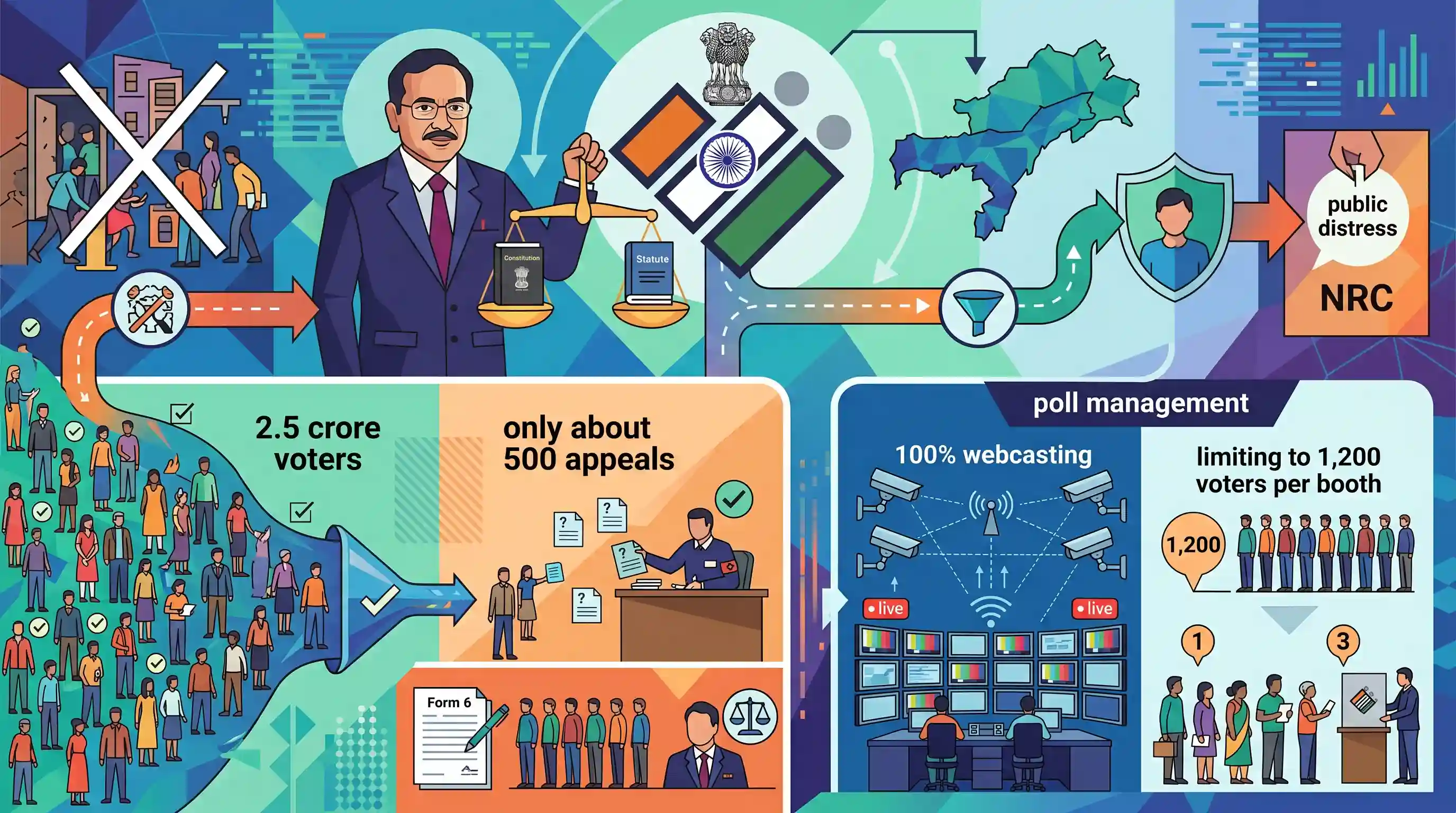
Chief Election Commissioner Gyanesh Kumar has clarified that the ongoing Special Revision of electoral rolls in Assam aims solely to ensure that eligible voters are included and ineligible individuals are excluded. Acknowledging the sensitive context of the previous National Register of Citizens (NRC) update in the state, the ECI opted against a Special Intensive Revision to prevent unnecessary public distress. Out of 2.5 crore voters, the commission received only about 500 exclusion appeals, indicating the process has been relatively smooth. Grievance redressal mechanisms remain available through Form 6 applications and appeals to election officials. Additionally, the ECI is focusing on poll management by planning 100% webcasting at polling booths and limiting each booth to 1,200 voters to facilitate the electorate.
Key Points
- The Election Commission of India (ECI) stated that the Special Revision of electoral rolls in Assam is strictly focused on including eligible voters and excluding ineligible ones.
- Mindful of the anxiety caused by the earlier National Register of Citizens (NRC) exercise, the ECI deliberately chose a Special Revision instead of a Special Intensive Revision (SIR).
- The ECI noted that out of 2.5 crore registered voters in Assam, only 500 appeals were filed regarding exclusion from the rolls.
- Citizens omitted from the electoral rolls can apply via Form 6, and any further grievances can be appealed to the District Election Officer or Chief Electoral Officer.
- To enhance transparency and smooth voting, the ECI will implement 100% webcasting at polling stations and limit the maximum number of voters per booth to 1,200.
Important Terms
Election Commission of India (ECI)

Permanent autonomous constitutional authority under Article 324, responsible for administering elections to Parliament, State Legislatures, and the offices of the President and Vice-President of India.
UPSC context
GS Paper II (Statutory/Constitutional Bodies); tests knowledge of constitutional mandates for free and fair elections.
National Register of Citizens (NRC)
An official register of legal Indian citizens. In Assam, it was updated (2013-2019) to identify illegal immigrants based on the 1951 register and 1971 legacy data.
UPSC context
GS Paper II (Citizenship/Polity) & III (Internal Security); relevant for demographic changes and legal-security frameworks.
Special Intensive Revision (SIR)
A comprehensive, house-to-house voter verification drive conducted by the ECI to cleanse voter lists of duplicates and deceased entries while ensuring inclusive enrollment of new voters.
UPSC context
GS Paper II (Electoral Reforms); tests administrative measures for maintaining electoral roll purity and democratic legitimacy.
Form 6
The statutory application form used by eligible Indian citizens for the inclusion of their names in the electoral roll for the first time or upon changing constituencies.
UPSC context
GS Paper II (Governance/Elections); tests procedural knowledge of voter registration and grievance redressal mechanisms.
Webcasting (Election Management)
Real-time live streaming of polling booth activities to monitoring centers to ensure transparency, deter malpractices, and provide irrefutable evidence of the conduct of polls.
UPSC context
GS Paper II (Electoral Reforms/ICT in Governance); tests the use of technology for transparency and accountability.
Electoral Roll
The official list (voter list) of individuals registered and eligible to vote in a specific constituency, maintained under the Representation of the People Act, 1950.
UPSC context
GS Paper II (Polity); central to questions on universal adult suffrage and the democratic process.
Prelims Trap
"A Special Intensive Revision of electoral rolls relies primarily on voluntary claims by voters rather than door-to-door enumeration."
An 'intensive' revision requires comprehensive house-to-house enumeration by BLOs from scratch. Standard or special revisions (like Assam's) rely on voluntary claims over existing drafts.
Static Concepts Connected
What is the statutory framework for preparing electoral rolls?
- Constitutional Mandate: Article 324 vests the ECI with the power of superintendence, direction, and control over the preparation of all electoral rolls.
- RPA 1950: The Representation of the People Act, 1950 governs the allocation of seats, delimitation, and the preparation/revision of electoral rolls.
- Registration Rules 1960: Details the procedural aspects of voter registration, mandating Form 6 for first-time voter inclusions and Form 7 for objections to existing names.
How does a Summary Revision differ from an Intensive Revision?
- Summary Revision: Conducted annually using the previously published roll as a draft, relying on citizens to voluntarily file claims and objections for updates.
- Intensive Revision: Done completely afresh through comprehensive house-to-house physical enumeration by Booth Level Officers, usually ordered when existing rolls have major discrepancies.
Cross-Topic Patterns
Voter Rolls vs. NRC Citizenship criteria
The ECI voter list operates under RPA 1950 for voting rights, whereas the NRC determines legal citizenship under the Citizenship Act, 1955. Inclusion in one does not automatically guarantee the other.
Technology scaling in election management
ECI's push for 100% webcasting reflects a transition from physical personnel deployment to real-time digital surveillance (alongside apps like cVIGIL) under Article 324 to ensure transparency.

Prelims 2026 may test the exact differences between RPA 1950 (electoral rolls) and RPA 1951 (election conduct) via multi-statement queries.
Linked PYQs · 4
Linked PYQs · 4
- 2022MainsGS2
Discuss the role of the Election Commission of India in the light of the evolution of the Model Code of Conduct.
- 2017MainsGS2
To enhance the quality of democracy in India the Election Commission of India has proposed electoral reforms in 2016. What are the suggested reforms and how far are they significant to make democracy successful?
- 2017PrelimsGS1
For election to the Lok Sabha, a nomination paper can be filed by
- 2017PrelimsGS1
Right to vote and to be elected in India is a
