Global Healthcare Infrastructure Deficits in Basic Sanitation
Source:The Hindu ↗
ఇది ఎందుకు ముఖ్యం
Highlights the severe infrastructural gaps in basic health and sanitation globally. For UPSC aspirants, this data is crucial for analyzing India’s own primary health infrastructure, the effectiveness of the WASH scheme, and the broader challenges of ensuring quality healthcare and preventing hospital-acquired infections.
సారాంశం
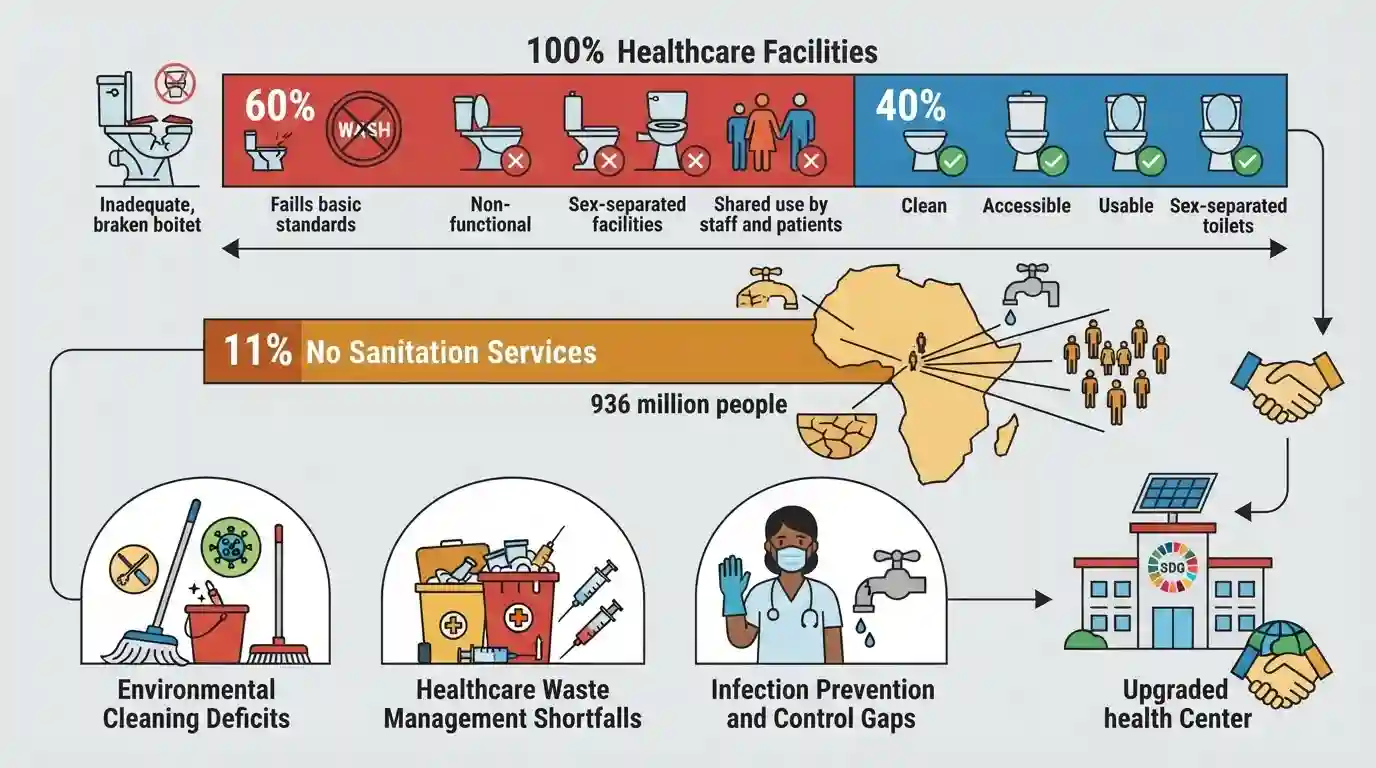
According to a joint report by the WHO and UNICEF, 60% of the world's healthcare facilities fail to meet basic sanitation standards, which require accessible, usable toilets including sex-separated and staff-dedicated facilities. An estimated 11% of health centers have no sanitation services at all, affecting 936 million people, predominantly in regions like sub-Saharan Africa. The report also sheds light on deficits in environmental cleaning and healthcare waste management, emphasizing the critical need to upgrade primary health infrastructure to prevent infections and ensure sustainable development globally.
ముఖ్య అంశాలు
- A joint report by the WHO and UNICEF highlights that only 40% of the world’s healthcare facilities meet basic sanitation standards.
- Around 11% of healthcare facilities globally, serving 936 million people, lack any sanitation services altogether.
- The basic sanitation standard requires at least one dedicated staff toilet, sex-separated toilets with menstrual hygiene facilities, and at least one accessible toilet for people with limited mobility.
- While 85% of facilities have basic water services and 72% have basic hygiene, only 59% meet basic environmental cleaning standards.
- Regional disparities are stark: only 23% of facilities in sub-Saharan Africa provide basic sanitation services compared to 55% in Central and Southern Asia.
- In least-developed nations, environmental cleaning standards are met by just 24% of healthcare facilities.
ముఖ్యమైన పదాలు
WASH (Water, Sanitation, and Hygiene)

A collective term representing the interrelated areas of clean water access, proper sanitation facilities, and hygiene promotion, essential for public health and human dignity.
UPSC context
GS Paper II: Social sector services relating to Health; GS Paper III: Sustainable Development Goals.
Sustainable Development Goal 6 (SDG 6)
One of the 17 UN Sustainable Development Goals, which aims to ensure universal and equitable access to safe drinking water and sanitation for all by 2030.
UPSC context
GS Paper III: Environmental conservation and sustainable development; GS Paper II: Health and social sector development.
WHO/UNICEF Joint Monitoring Programme (JMP)
The official United Nations mechanism responsible for maintaining global databases and monitoring progress toward household, school, and health facility water, sanitation, and hygiene (WASH) targets.
UPSC context
GS Paper II: Important International Institutions, reports, indices, and issues relating to development of Health and Sanitation.
World Health Organization (WHO)
A specialized agency of the United Nations, established in 1948 and headquartered in Geneva, responsible for directing international public health, setting standards, and responding to health emergencies.
UPSC context
GS Paper II: Important International Institutions, their structure, mandate, and role in global governance and public health.
UNICEF
A United Nations agency, established in 1946 and headquartered in New York, dedicated to protecting the rights, health, education, and developmental well-being of children globally.
UPSC context
GS Paper II: Welfare schemes for vulnerable sections; role of Important International Institutions in developmental sectors.
ప్రిలిమ్స్ ఉచ్చు
Basic sanitation in healthcare facilities is met as long as separate toilets are available for staff and patients, irrespective of mobility access.
Under the WHO/UNICEF JMP standards, basic sanitation in healthcare facilities is not just about having toilets; it strictly mandates sex-separation, menstrual hygiene facilities, staff-dedication, and accessibility for limited mobility.
అనుసంధానమైన స్థిర భావనలు
What is the WHO/UNICEF Joint Monitoring Programme (JMP)?
- Mandate & Origin: Jointly run by WHO and UNICEF since 1990, serving as the official UN mechanism to monitor global progress on SDG Target 6.1 and 6.2.
- Service Ladders: It introduced 'service ladders' (safely managed, basic, limited, unimproved, no service) to standardize and benchmark progress across households, schools, and health centers.
How does poor clinical sanitation accelerate Antimicrobial Resistance (AMR)?
- Pathogen transmission: Lack of basic hand hygiene and sanitised toilets drives up Healthcare-Associated Infections (HAIs), leading to elevated, often unnecessary clinical prescription of antibiotics.
- Waste effluent pathways: Untreated healthcare wastewater discharges active drug residues and resistant pathogens directly into municipal water bodies, facilitating horizontal gene transfer among environmental bacteria.
అంతర-అంశ నమూనాలు
WASH deficit as a gender barrier
Lack of sex-disaggregated toilets and menstrual hygiene infrastructure in primary clinics deters female health workers and compromises maternal healthcare outcomes, directly intersecting SDG 3, 5, and 6.
Sanitation failure driving AMR transmission
Inadequate clinical sanitation and waste management release active pathogens and drug residues into local ecosystems, accelerating the environmental cycle of Antimicrobial Resistance (AMR) under the One Health framework.

SDG 6 targets are highly likely to be tested via the specific WHO/UNICEF JMP definitions of 'basic' versus 'safely managed' services.
అనుసంధాన PYQలు · 3
అనుసంధాన PYQలు · 3
- 2017MainsGS2
To ensure effective implementation of policies addressing water, sanitation and hygiene needs the identification of the beneficiary segments is to be synchronized with the anticipated outcomes." Examine the statement in the context of the WASH scheme.
- 2021MainsGS2
“Besides being a moral imperative of a Welfare State, primary health structure is a necessary precondition for sustainable development.” Analyze.
- 2024MainsGS2
In a crucial domain like the public healthcare system the Indian State should play a vital role to contain the adverse impact of marketisation of the system. Suggest some measures through which the State can enhance the reach of public healthcare at the grassroots level.
