ONGC Operations in Venezuela and US Sanction Exemptions
Source:The Hindu ↗
Why It Matters
Demonstrates how geopolitical sanctions (like U.S. OFAC rules) impact global energy supply chains and how India navigates these constraints through diplomatic and corporate negotiations to secure its energy interests and protect its overseas investments.
Summary
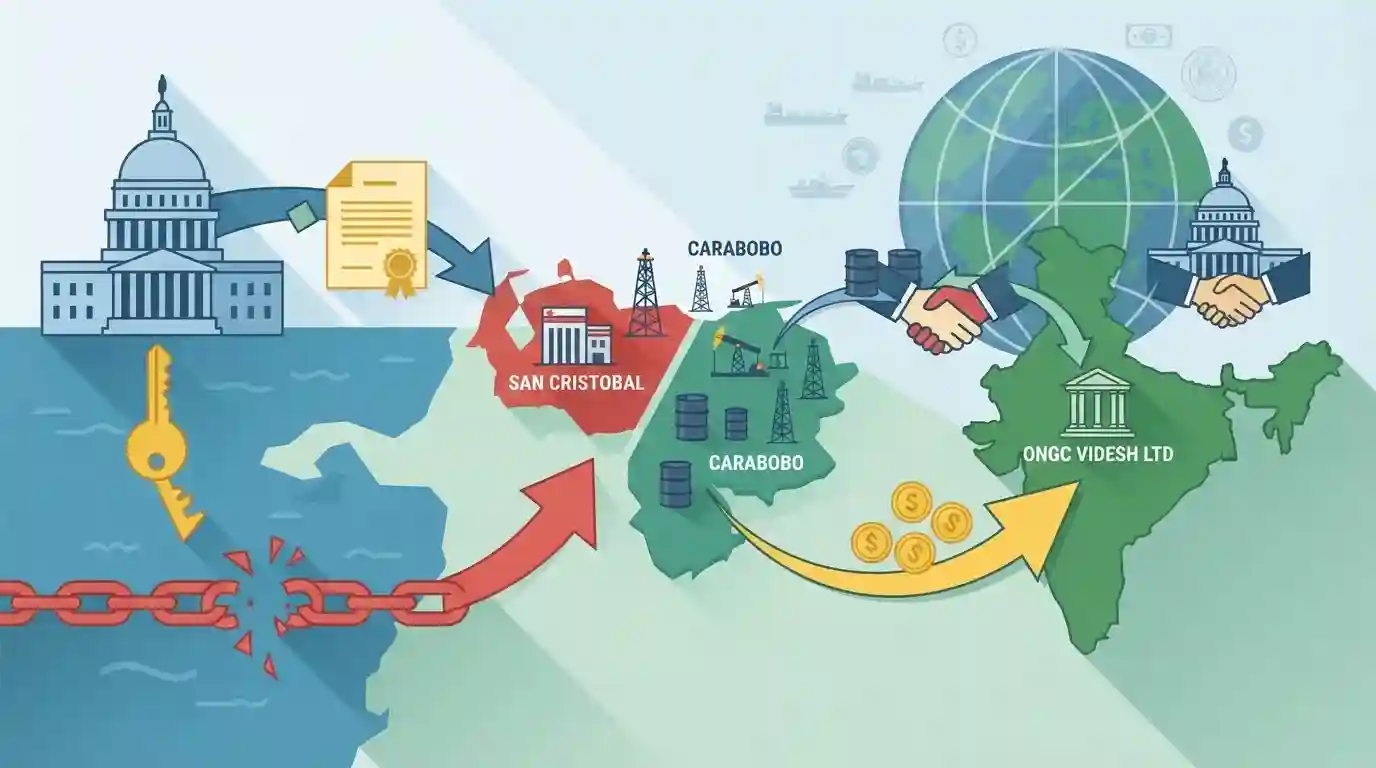
The U.S. Treasury's Office of Foreign Assets Control (OFAC) has granted ONGC Videsh Ltd (OVL) a licence to resume full operations at two joint-venture oil projects in Venezuela (San Cristobal and Carabobo). OVL is currently negotiating with Venezuela's national oil company, PdVSA, to assume operatorship of these projects. This operatorship would allow OVL to directly control crude exports and recover an estimated $600 million in pending dividends. The U.S. waiver highlights India's strategic manoeuvring to secure overseas energy resources and diversify crude supplies amidst complex geopolitical sanctions.
Key Points
- ONGC Videsh Ltd (OVL) has secured a special licence from the U.S. Treasury's OFAC to resume full operations and crude exports from two oil projects in Venezuela, bypassing broader U.S. sanctions.
- OVL is actively seeking operatorship of the San Cristobal and Carabobo fields from Venezuela's state-owned PdVSA to gain direct control over operations and exports.
- The move will help OVL recover approximately $600 million in pending dividends that have been trapped due to prolonged sanctions.
- Securing Venezuelan crude contributes to India's energy security by diversifying its oil import basket and asserting the economic viability of its overseas upstream assets.
Important Terms
ONGC Videsh Ltd (OVL)

The overseas investment arm of India's state-owned Oil and Natural Gas Corporation (ONGC). It explores and acquires international oil and gas assets to strengthen India's long-term energy security.
UPSC context
Important for GS Paper 3 (Energy Security) concerning India's strategic overseas investments and diversification of crude oil supply chains.
Petróleos de Venezuela, S.A. (PdVSA)
Venezuela's state-owned oil and natural gas company. It controls the country's vast hydrocarbon reserves, though its global operations and exports have been heavily restricted by U.S. economic sanctions.
UPSC context
Relevant to GS Paper 2 (International Relations) regarding global energy geopolitics, economic sanctions, and bilateral energy cooperation between India and Venezuela.
U.S. Treasury's Office of Foreign Assets Control (OFAC)
A financial enforcement agency of the U.S. Treasury Department that administers and enforces economic and trade sanctions based on U.S. national security and foreign policy goals.
UPSC context
Relevant for GS Paper 2 (International Relations) as its sanctions frequently impact India's geopolitical maneuvering and overseas energy trade.
Prelims Trap
OFAC licenses are mandated by the United Nations Security Council.
OFAC is a U.S. Treasury agency enforcing unilateral U.S. sanctions. It is not a UN body, nor are its secondary sanctions binding under international law.
Static Concepts Connected
How do secondary sanctions affect third-party countries?
- Primary sanctions: Prohibit U.S. citizens and domestic companies from doing business with a targeted country or entity.
- Secondary sanctions: Threaten foreign entities (like India's OVL) with exclusion from the U.S. financial system if they trade with the targeted nation.
- OFAC waivers: Specific permissions required for foreign entities to bypass U.S. secondary restrictions without facing severe financial penalties.
What characterizes the oil reserves in Venezuela's Orinoco Belt?
- Largest proven reserves: Venezuela holds the world's largest proven crude oil reserves, predominantly concentrated in this region.
- Extra-heavy crude: The oil is highly viscous extra-heavy crude, requiring specialized refining, upgrading, or blending to become commercially viable.
Cross-Topic Patterns
Strategic Autonomy vs Secondary Sanctions
This mirrors India's historical navigation of US sanctions, similar to the CAATSA waiver for the S-400 or past Chabahar exemptions, prioritizing strategic autonomy in energy and defence.
Refinery Complexity & Heavy Crude
Venezuela's heavy crude requires complex refineries. Indian refineries (like Jamnagar) have high Nelson Complexity Indices, making them uniquely equipped to process it profitably.

Expect a multi-statement question linking OFAC secondary sanctions, OVL's mandate, and the geographic location of the Orinoco oil belt.
Linked PYQs · 3
Linked PYQs · 3
- 2024PrelimsGS1
Consider the following statements : Statement-I : Recently, Venezuela has achieved a rapid recovery from its economic crisis and succeeded in preventing its people from fleeing/emigrating to other countries. Statement-II : Venezuela has the world's largest oil reserves. Which one of the following is correct in respect of the above statements?
- 2025MainsGS2
"Energy security constitutes the dominant kingpin of India's foreign policy, and is linked with India's overarching influence in Middle Eastern countries.” How would you integrate energy security with India's foreign policy trajectories in the coming years?
- 2017MainsGS2
The question of India's Energy Security constitutes the most important part of India's economic progress. Analyze India's energy policy cooperation with West Asian countries.
