Himachal Pradesh formulates new industrial policy with cheap power
Source:himachal-pr ↗
Why It Matters
The article provides crucial insights into the economic strategy of Himachal Pradesh, focusing on green energy transitions to counter revenue shortfalls caused by the GST regime. Furthermore, the mention of the 7.19% share in Chandigarh and relations with Punjab highlights significant historical and political inter-state issues relevant to HPAS examinations.
Summary
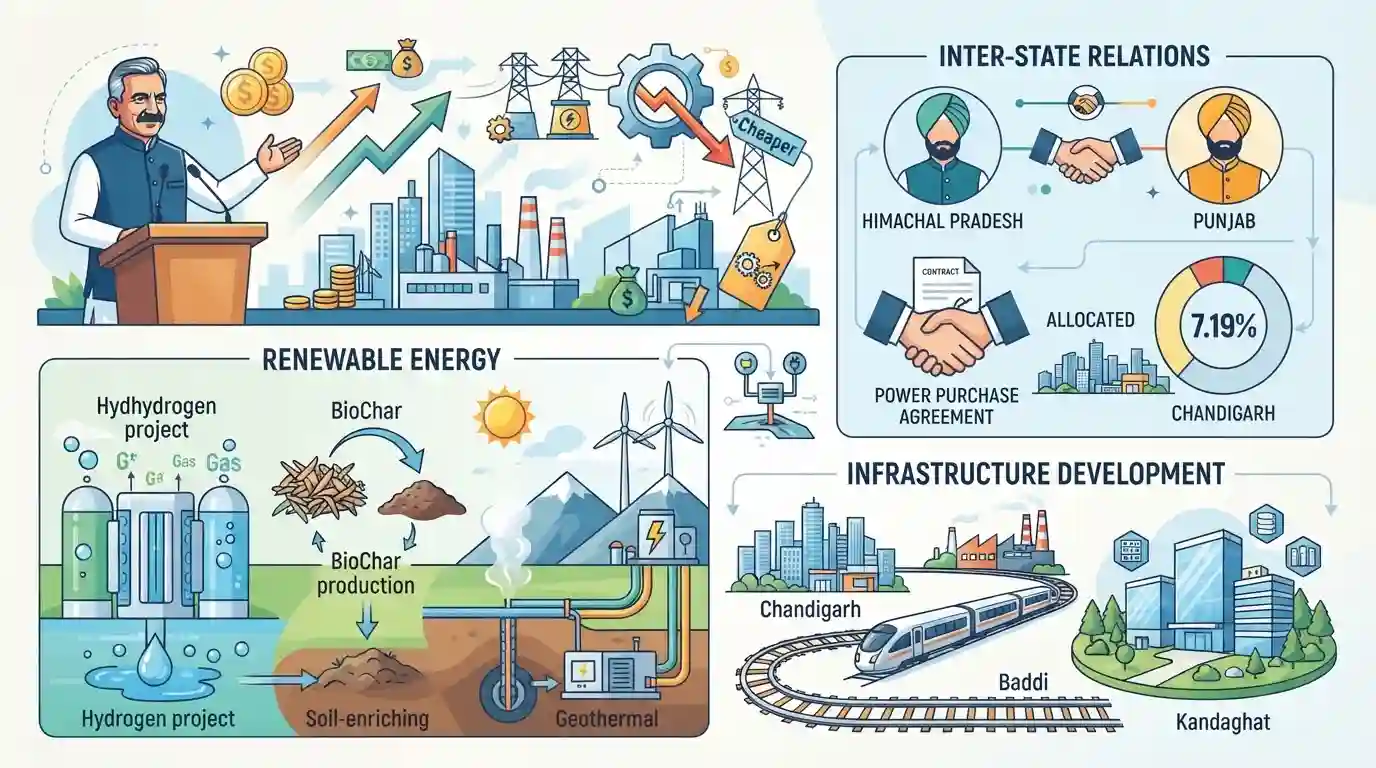
Chief Minister Thakur Sukhvinder Singh Sukhu announced a forthcoming industrial policy for Himachal Pradesh aimed at attracting investments by offering cheaper electricity. Emphasizing a transition to sustainable power, he highlighted green hydrogen projects, BioChar plants, and a geothermal setup in Kinnaur. The Chief Minister pointed out the drastic decline in industrial revenue post-GST and stressed the need for geographical-specific policies. He also underscored the state's ongoing inter-state dynamics with Punjab, noting a newly signed 3-year Power Purchase Agreement and the active pursuit of Himachal's 7.19 percent legitimate share in Chandigarh. Key infrastructure developments include the Chandigarh-Baddi railway line and a new IT park in Kandaghat.
Key Points
- A new industrial policy is underway in Himachal Pradesh that will offer reduced electricity tariffs to attract investments.
- The state is positioning itself as a leader in green energy with initiatives like green hydrogen production, BioChar plants, and a geothermal energy project in Kinnaur.
- To bolster infrastructure, an IT park is being developed in Kandaghat (Solan), and the state is bearing 50% of the cost for the Chandigarh-Baddi railway line, slated for completion in 3 years.
- The introduction of GST severely impacted the state's industrial revenue, dropping it from Rs. 4,000 crore to Rs. 150-200 crore.
- On inter-state relations, HP signed a 3-year Power Purchase Agreement (PPA) with Punjab and is actively pursuing its legitimate 7.19 percent share in Chandigarh.
Important Terms
New Industrial Policy

A state-level economic framework designed to attract investments by offering incentives like subsidized electricity and robust infrastructure. Himachal Pradesh’s upcoming policy focuses on IT, green energy, and region-specific industrial growth.
UPSC context
Vital for GS-3 (Economic Development), showcasing how state-led initiatives promote industrial growth and transition toward green energy sectors.
Goods and Services Tax (GST)
A comprehensive indirect tax levied nationwide on goods and services. Its implementation altered fiscal federal dynamics, causing substantial drops in localized industrial tax revenue for states like Himachal Pradesh.
UPSC context
Crucial for GS-3 (Economy) and GS-2 (Federalism), testing knowledge on indirect taxation, state revenue shortfalls, and cooperative federalism.
Power Purchase Agreement (PPA)
A long-term legal contract between an electricity generator and a buyer. It guarantees market access for power-surplus entities—like Himachal Pradesh supplying Punjab—ensuring revenue stability and uninterrupted grid supply.
UPSC context
Highly relevant for GS-3 (Infrastructure/Energy), testing knowledge of energy markets, grid management, and inter-state power distribution frameworks.
TiE Chandigarh
A regional chapter of The Indus Entrepreneurs (TiE), a global non-profit organization dedicated to fostering entrepreneurship. It serves as a vital networking forum connecting investors, startups, and state policymakers.
UPSC context
Touches on GS-3 (Growth & Development), highlighting the role of industry associations in mobilizing private investments and entrepreneurship.
Prelims Trap
GST benefits manufacturing states by increasing their tax collections due to its origin-based structure.
GST is a destination-based consumption tax. Tax revenue goes to the consuming state, causing manufacturing-heavy states to lose the origin-based tax revenues they previously enjoyed.
Static Concepts Connected
How does the destination-based principle of GST affect manufacturing states?
- Destination principle: Tax revenue accrues to the state where final consumption happens, completely bypassing the state where goods were actually manufactured.
- Fiscal impact: Producing states lose out on origin-based revenues like the Central Sales Tax (CST), structurally reducing their independent industrial revenue.
Where are the major geothermal energy hotspots located in India?
- Himalayan Belt: Includes prominent sites like Puga Valley (Ladakh), Manikaran, Tattapani and Kinnaur (Himachal Pradesh), and Tapovan (Uttarakhand).
- Peninsular India: Includes Tattapani (Chhattisgarh), the Cambay Graben (Gujarat), and the Godavari Basin (Telangana/Andhra Pradesh).
Cross-Topic Patterns
GST & Fiscal Federalism
Himachal's revenue plunge post-GST exemplifies the structural tension for producing states, a critical issue for fiscal federalism now that the GST compensation period has ended.
State Reorganization Legacies
HP's pursuit of a 7.19% share in Chandigarh stems from the 1966 Punjab Reorganization Act, mirroring ongoing inter-state asset and border disputes across India.

Prelims 2026 may pair geothermal locations (Kinnaur, Puga) with state-level Green Hydrogen initiatives in a multi-statement energy question.
Linked PYQs · 4
Linked PYQs · 4
- 2025HPAS_PRELIMSGS1
Consider the following statements : (1) The first step in rural electrification was taken on January 14, 1958 when lights were switched on at Sundernagar. (2) At the time of electrification of Sundernagar in Mandi district, its population was nearly 12,000 when its 20 nearby villages in fertile Balh Valley were given electrification. (3) The electrification programme in the state was divided into two parts (i) Local power generation was proposed in high valleys remote from the district headquarters (ii) The lower belts of the state near Punjab were to get electricity from the Nangal and Uhl river feeder. (4) The Shanan powerhouse is currently under the control of Punjab State Electricity Board and whole of the revenue goes to Punjab Government. Select the correct answer given below :
- 2017HPAS_PRELIMSGS1
Renewable source of energy is :
- 2025HPAS_PRELIMSGS1
Match List I with List II : | List-I (Place) | List-II (Industry) | |---|---| | (a) Phagwara | (i) Silk Textile Industry | | (b) Gokak | (ii) Woollen Textile Industry | | (c) Kullu | (iii) Sugar Industry | | (d) Mandya | (iv) Cotton Textile Industry | Choose the correct answer from the options given below : Code: (a) (b) (c) (d)
- 2025HPAS_PRELIMSGS1
Read the following statements : Statement I : Share of agriculture in total GSDP of Himachal Pradesh has declined from about 75 percent in 1950-51 to little above 20 percent in 2023-24. Statement II : As per economic survey 2024-25 of the state, however, in terms of employment still 54 percent of the state population is engaged in primary sector. In the light of the above statements, choose the most appropriate answer from the options given below :
