Implementation Challenges in New Criminal Laws and Infrastructure
Source:Indian Express ↗
Why It Matters
UPSC Mains consistently asks questions on the efficacy of the criminal justice system, police modernization, and judicial reforms. Understanding the practical challenges in implementing the new criminal laws provides vital fodder for GS2 (Governance/Constitution) and GS3 (Internal Security/Technology) answers.
Summary
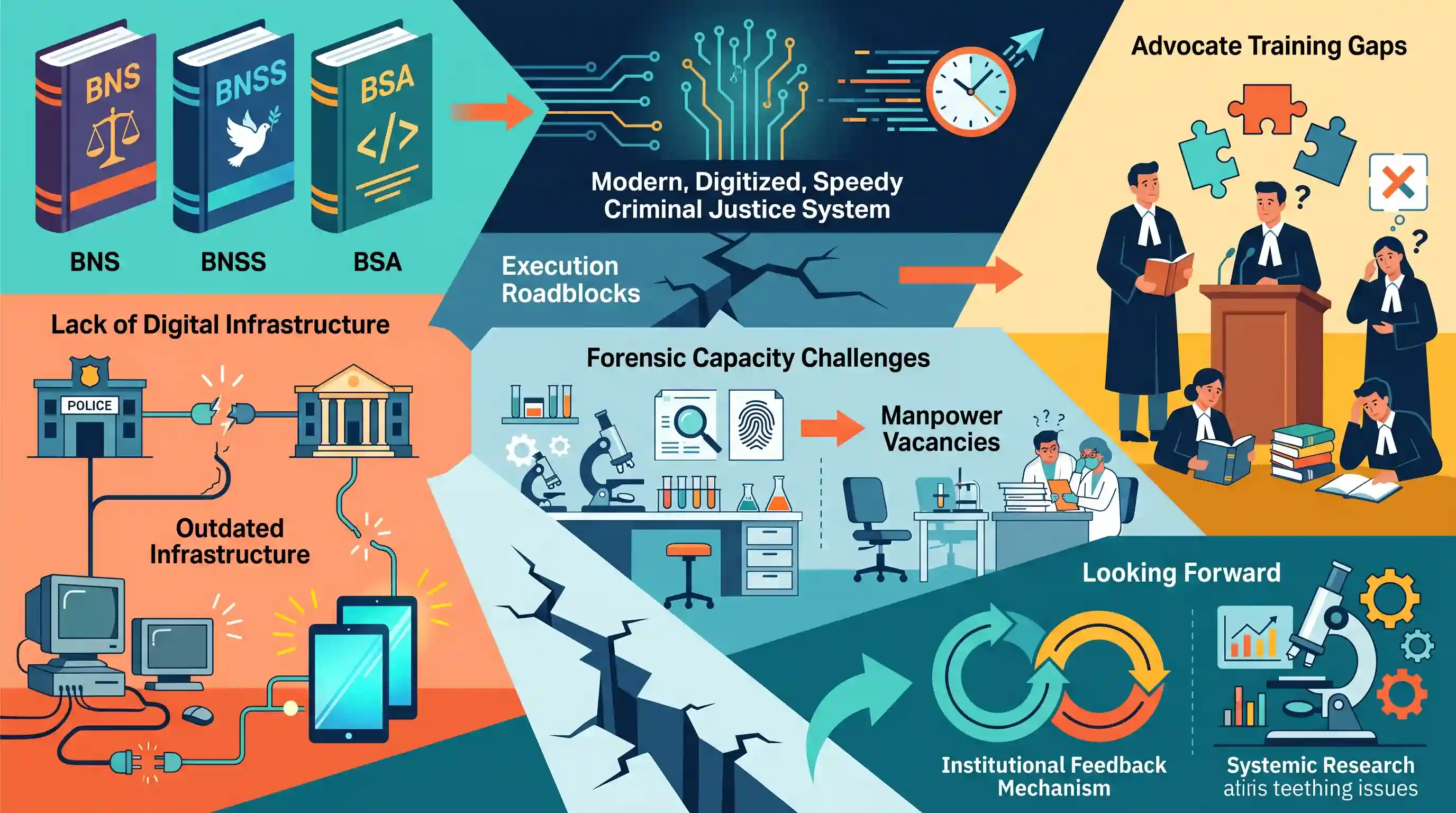
The article evaluates the first year of implementing India's new criminal laws: the Bharatiya Nyaya Sanhita (BNS), Bharatiya Nagarik Suraksha Sanhita (BNSS), and Bharatiya Sakshya Adhiniyam (BSA). While the legislation intends to create a modern, digitized, and speedy criminal justice system, ground-level execution has faced substantial roadblocks. Key challenges include a lack of digital infrastructure in police stations and courts, significant manpower vacancies in forensic laboratories, and a lack of standardized training for practicing advocates. The piece calls for establishing an institutional feedback mechanism and conducting systemic research to address teething issues and ensure the smooth translation of legislative intent into administrative reality.
Key Points
- While the new criminal laws (NCLs) aim to modernize and digitize the criminal justice system, real-world implementation is hindered by severe infrastructural deficits, such as inadequate internet connectivity in remote police stations and courtrooms lacking facilities for virtual hearings.
- A significant reliance on digital evidence and forensic investigations under the BNSS and BSA is hampered by massive manpower shortages, including 47% administrative and 49% scientific vacancies in forensic departments.
- Mandated training programs were organized for police, prosecutors, and the judiciary, but practicing advocates and lawyers largely lacked institutional training, causing friction in everyday court proceedings.
- There is an urgent need to institutionalize an implementation stocktaking and feedback mechanism to communicate real-time challenges from stakeholders to policymakers.
- Systematic research is recommended to pre-emptively identify and address potential legal, procedural, and systemic challenges as cases recorded under the new regime move toward the appellate stages.
Important Terms
Bharatiya Nyaya Sanhita (BNS)

Substantive criminal code replacing the IPC (1860) as of July 1, 2024. It emphasizes restorative justice, introduces community service for petty offenses, and formally codifies terrorism and organized crime.
UPSC context
GS Paper II: Governance/Polity. Tests knowledge of legal reforms, decolonization of laws, and new offense categories like mob lynching.
Bharatiya Nagarik Suraksha Sanhita (BNSS)
Procedural law replacing the CrPC (1973) as of July 1, 2024. It mandates forensic evidence for serious crimes, sets strict trial timelines, and institutionalizes digital processes like e-FIRs.
UPSC context
GS Paper II: Polity/Governance. Evaluates procedural efficiency, digital judiciary (e-Courts), and police accountability through video-recorded searches.
Bharatiya Sakshya Adhiniyam (BSA)
Evidence law replacing the Indian Evidence Act (1872) as of July 1, 2024. It grants digital and electronic records the status of primary evidence and simplifies admissibility rules for technological proofs.
UPSC context
GS Paper II: Polity. Relevant for digital evidence standards, technological adaptation in courts, and modern evidentiary frameworks.
Forensic Science Laboratories (FSL)
Specialized facilities for scientific evidence analysis. Under the BNSS, forensic visits are mandatory for serious crimes, making laboratory infrastructure and manpower vacancies critical bottlenecks in implementing new laws.
UPSC context
GS Paper II/III: Governance/Security. Tests understanding of structural challenges in the justice system and forensic roles in investigations.
Indian Penal Code (IPC)
Colonial-era substantive criminal code enacted in 1860. It served as the primary law for criminal offenses in India until being replaced by the Bharatiya Nyaya Sanhita (BNS) in 2024.
UPSC context
GS Paper II: Polity. Crucial for comparing old and new legal frameworks and the evolution of Indian criminal jurisprudence.
Code of Criminal Procedure (CrPC)
The 1973 law that provided the procedure for investigation, arrest, and trial in India. Replaced by BNSS to address systemic delays through mandatory technology use.
UPSC context
GS Paper II: Polity/Governance. Essential for analyzing the procedural shift toward citizen-centric and technology-driven criminal justice.
Prelims Trap
All pending criminal trials instituted before the new laws immediately transition to the procedures under BNSS and BSA.
Article 20(1) blocks retrospective substantive criminal laws. Further, Section 531 of BNSS explicitly saves ongoing trials and appeals, meaning they continue under the old CrPC.
Static Concepts Connected
What is the Constitutional protection against retrospective criminal laws?
- Article 20(1): Prohibits the state from enacting ex post facto laws; no one can be convicted for an act that was not an offence when committed.
- Substantive vs Procedural: The prohibition strictly applies to substantive laws (like BNS). Procedural changes (like BNSS) can be retrospective, but are usually restricted via "savings clauses" to prevent administrative chaos.
What is the Inter-operable Criminal Justice System (ICJS)?
- Integration Goal: A national platform enabling seamless data and record exchange across the five pillars: police (CCTNS), e-Courts, e-Prisons, forensics, and prosecution.
- Nodal Agency: It is implemented by the National Crime Records Bureau (NCRB) with technical assistance from the National Informatics Centre (NIC).
Cross-Topic Patterns
E-Courts Phase III and the digital divide
BNSS's mandate for virtual hearings and digitized forensics clashes with rural infrastructural realities, directly linking to the delayed implementation of BharatNet and the e-Courts Phase III infrastructure targets.
State capacity in forensics vs cybercrime
The BSA relies heavily on electronic evidence, exposing a 49% forensic vacancy rate. This connects directly to GS3 internal security themes regarding India's readiness to tackle cyber-fraud and deepfakes.

Expect a 2026 GS2 Mains question evaluating the administrative, digital, and infrastructural bottlenecks in implementing the BNS, BNSS, and BSA.
Linked PYQs · 3
Linked PYQs · 3
- 2020MainsGS2
The judicial systems in India and UK seem to be converging as well as diverging in recent times. Highlight the key points of convergence and divergence between the two nations in terms of their judicial practices.
- 2020MainsGS3
Discuss different types of cyber crimes and measures required to be taken to fight the menace.
- 2023MainsGS2
“Constitutionally guaranteed judicial independence is a prerequisite of democracy.” Comment.
