Modi Trudeau G7 Meeting Offers Opening in Strained India Canada Ties
Source:Indian Express ↗
Why It Matters
The ongoing India-Canada diplomatic row represents a significant foreign policy and security challenge. It is critical for UPSC aspirants to understand how diaspora politics in developed nations can conflict with India's internal security interests (like Khalistani extremism), and how multilateral platforms are utilized for diplomatic ice-breaking.
Summary
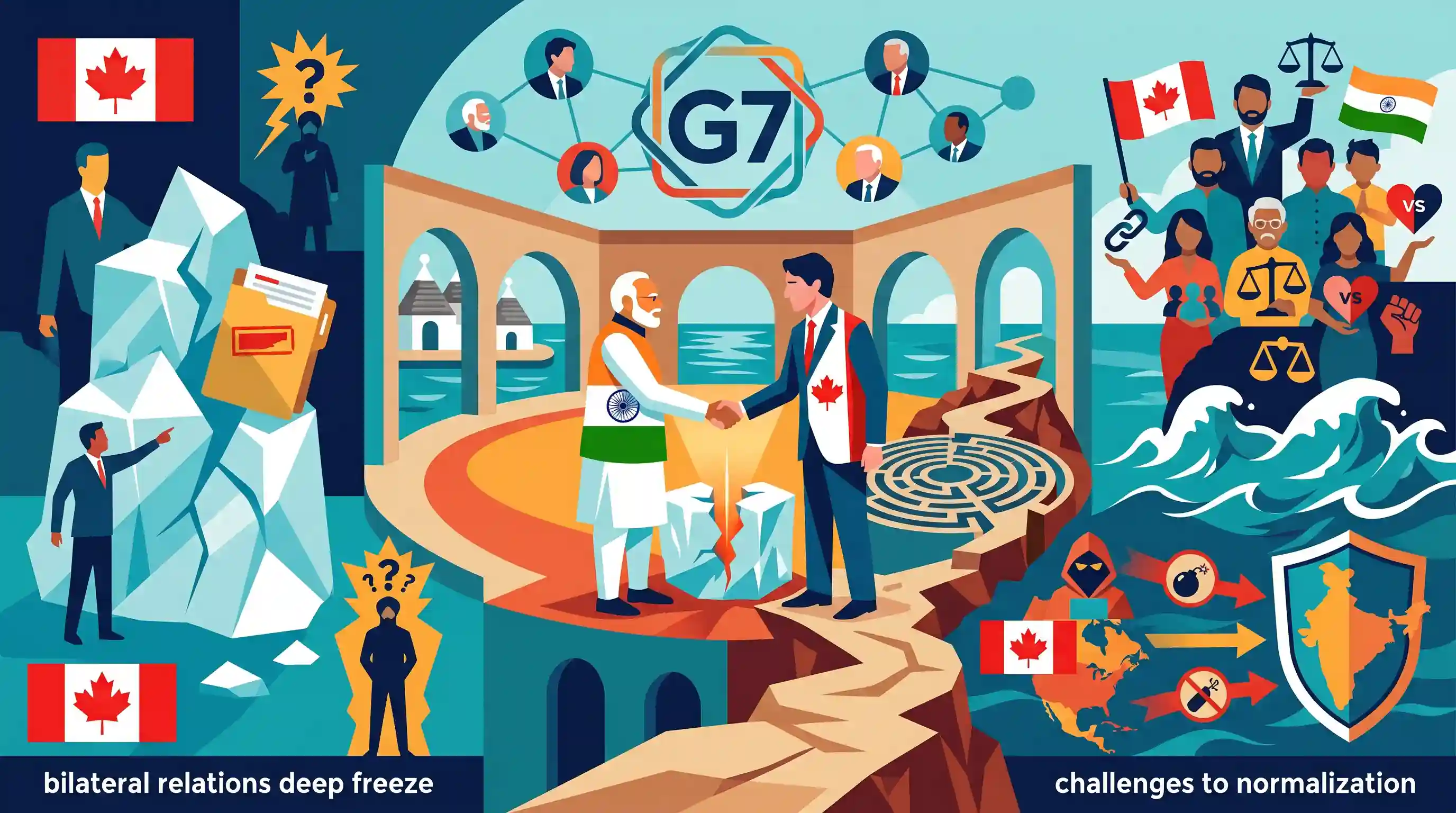
The article discusses the interaction between Indian Prime Minister Narendra Modi and Canadian Prime Minister Justin Trudeau on the sidelines of the G7 Summit in Apulia, Italy. This brief encounter is seen as a crucial first step in thawing bilateral relations, which were frozen following Canada's allegations of Indian involvement in the killing of a Khalistani separatist. The meeting underscores the importance of global multilateral platforms in facilitating backdoor diplomacy and breaking deadlocks. However, a complete normalization of ties will require navigating complex issues surrounding diaspora politics and India's security concerns regarding extremism originating from foreign soil.
Key Points
- A brief interaction between PM Modi and Canadian PM Justin Trudeau on the sidelines of the G7 summit in Apulia provided a much-needed opening to mend strained diplomatic ties.
- India-Canada relations hit a historic low following Canadian allegations of Indian involvement in the assassination of Khalistani separatist Hardeep Singh Nijjar.
- The meeting highlights the utility of multilateral forums like the G7 in offering a neutral ground for leaders to break the ice and restart dialogue without the pressure of formal state visits.
- The core challenge remains balancing the political influence of the Indian diaspora in Western nations with India's strict internal security concerns regarding separatist extremism operating from foreign soil.
Important Terms
G7 (Group of Seven)

An informal bloc of seven advanced economies—Canada, France, Germany, Italy, Japan, the UK, and the US—formed in 1975 to coordinate global economic and security policies.
UPSC context
GS Paper II: International Relations. Relevant for global groupings affecting India’s interests and India’s role as an invited 'outreach' partner.
Khalistan Movement
A separatist movement seeking to establish an independent Sikh homeland (Khalistan) in the Punjab region. It remains a major point of diplomatic friction between India and Canada.
UPSC context
GS Paper III: Internal Security. Tests knowledge on the role of external state and non-state actors in challenging India’s sovereignty.
Indian Diaspora
The global community of persons of Indian origin (PIOs) and Non-Resident Indians (NRIs). In Canada, they number over 1.8 million and influence both domestic politics and bilateral ties.
UPSC context
GS Paper II: International Relations. Focuses on the impact of the diaspora on India's interests and foreign policy.
Backdoor Diplomacy
Informal, unofficial, or secret communication between states conducted outside of formal diplomatic channels to resolve sensitive issues or bypass public scrutiny.
UPSC context
GS Paper II: International Relations. Important for understanding conflict resolution and the mechanics of diplomatic thaws in strained relationships.
G7 Outreach
A mechanism where non-member countries (like India) are invited to G7 summits to represent the Global South and discuss global issues like AI, energy, and climate.
UPSC context
GS Paper II: International Relations. Significant for India's strategic positioning as a bridge between the West and developing nations.
Transnational Repression
Aggressive interference where a state or its proxies target, intimidate, or harm individuals or communities beyond its borders, often cited in modern diplomatic disputes.
UPSC context
GS Paper II: International Relations. An emerging term in international law regarding state sovereignty and foreign interference allegations.
Prelims Trap
"India holds permanent guest status at the G7 due to its strategic position in the Global South."
India is not a member, nor does the G7 have official "permanent guests". India is invited annually at the host country's discretion as an "Outreach Country".
Static Concepts Connected
What is the G7 and how is it structured?
- Informal Bloc: Formed in 1975 to address global economic crises, it operates as an intergovernmental political forum without a formal charter or permanent secretariat.
- Core Membership: Comprises the US, UK, France, Germany, Italy, Canada, and Japan. Russia was suspended in 2014 following its annexation of Crimea.
- Outreach & EU: The EU is a 'non-enumerated' member. Host nations often invite "Outreach Countries" (like India) to ensure broader representation on global issues.
How does India tackle foreign-based extremist non-state actors?
- Extradition Treaties: Bilateral agreements allowing the formal surrender of fugitives for criminal prosecution, such as the 1987 India-Canada Extradition Treaty.
- MLATs: Mutual Legal Assistance Treaties (MLATs) facilitate formal cooperation in sharing criminal intelligence, gathering evidence, and executing cross-border investigations.
- Interpol & UAPA: The NIA utilizes Interpol Red Notices and the Unlawful Activities (Prevention) Act (UAPA) to designate individuals as terrorists, targeting their global mobility and finances.
Cross-Topic Patterns
Diaspora: Soft power vs Security
The shift of diaspora elements from a cultural asset to a complex diplomatic liability directly links GS2 (Diaspora politics) with GS3 (Internal security threats by non-state actors).
Sideline diplomacy at Multilaterals
Groupings like G7 and G20 are increasingly valuable for offering neutral ground to break bilateral deadlocks, circumventing the friction and optics of formal state visits.

Expect a 2026 Mains question linking GS2 (diaspora politics in Western democracies) with GS3 (cross-border extremism threats).
Linked PYQs · 3
Linked PYQs · 3
- 2023MainsGS2
Indian diaspora has scaled new heights in the West. Describe its economic and political benefits for India.
- 2020MainsGS2
Indian diaspora has a decisive role to play in the politics and economy of America and European Countries'. Comment with examples.
- 2021MainsGS3
Analyse the multidimensional challenges posed by external state and non-state actors, to the internal security of India. Also discuss measures required to be taken to combat these threats.
