Himachal Orders Probe into Kasauli Water Project Claims
Source:thenewshimachal ↗
Why It Matters
This case highlights structural challenges in public administration, such as overlapping schemes, duplicate project claims, and the imperative for cross-departmental coordination in implementing rural development schemes. For HPAS Prelims, it underscores the importance of legislative tools like Question Hour in ensuring executive accountability, the dynamics of external agency funding (like JICA) in the state, and the governance frameworks of rural water infrastructure.
Summary
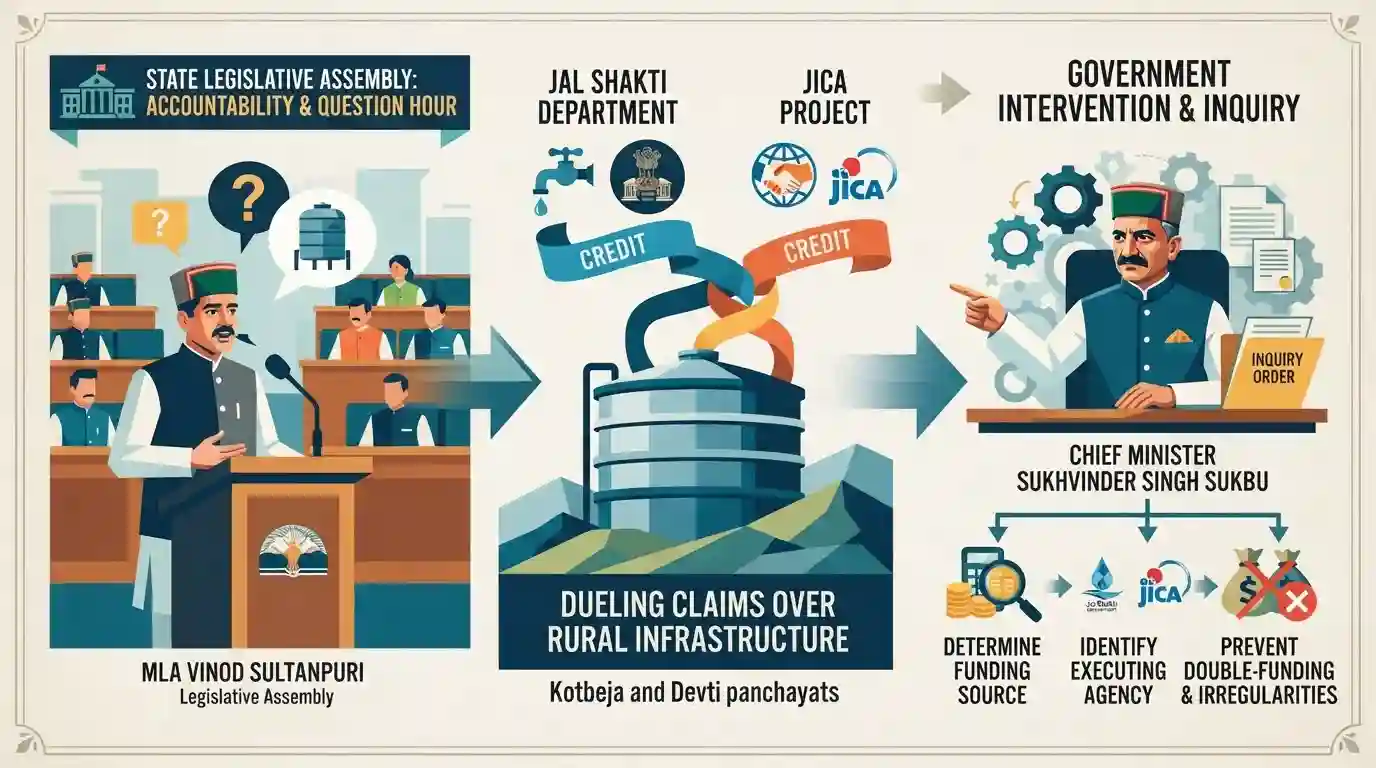
Himachal Pradesh Chief Minister Sukhvinder Singh Sukhu has ordered an inquiry into a water storage tank project in the Kasauli constituency of Solan district. The probe was initiated after Kasauli MLA Vinod Sultanpuri revealed in the Legislative Assembly's Question Hour that both the Jal Shakti Department and a JICA project have claimed credit for building the same water tank in Kotbeja and Devti panchayats. The investigation aims to determine the exact source of funding, identify the executing agency, and rule out any financial irregularities or double-funding.
Key Points
- Chief Minister Sukhvinder Singh Sukhu ordered an official inquiry into the construction of a water storage tank in Kasauli constituency (Solan district) following claims of dual credit.
- Both the state's Jal Shakti Department and a JICA (Japan International Cooperation Agency) project reportedly claimed responsibility and credit for constructing the same water storage tank in Kotbeja and Devti panchayats.
- The issue was highlighted during the Question Hour in the Himachal Pradesh Vidhan Sabha by Kasauli MLA Vinod Sultanpuri, who sought a detailed probe into the source of funding and the executing agency to prevent duplicate billing or scheme overlapping.
- The Chief Minister stated that while the executing agency can sometimes differ from the funding department, any evidence of actual duplicate funding or financial irregularity would invite strict action against the guilty parties.
- This case brings to the forefront critical governance issues in Himachal Pradesh, emphasizing the need for coordinated project monitoring, digital tracking, and inter-departmental transparency for rural development projects.
Important Terms
Jal Shakti Department

The HP government department (formerly Irrigation and Public Health) responsible for managing water resources, delivering safe drinking water, implementing sanitation projects, and developing irrigation infrastructure across the state.
UPSC context
GS-2 (Government Policies) and GS-3 (Infrastructure); tests understanding of state departments implementing water and rural development projects in HP.
Japan International Cooperation Agency (JICA)
A Japanese governmental agency providing Official Development Assistance (ODA) that funds key developmental initiatives in Himachal Pradesh, including crop diversification, forestry, and rural water infrastructure.
UPSC context
GS-2 (Bilateral Relations, Foreign Aid) and GS-3 (HP Economy); tests role of external agencies in state infrastructure.
Himachal Pradesh Legislative Assembly (Vidhan Sabha)
The unicameral state legislature of Himachal Pradesh, consisting of 68 members, which acts as the supreme law-making body and ensures executive accountability through parliamentary tools.
UPSC context
GS-2 (State Legislature); tests knowledge of legislative procedures, parliamentary accountability, and local political systems in Himachal Pradesh.
Jal Jeevan Mission
A centrally sponsored scheme implemented in Himachal Pradesh with the goal of providing safe, adequate drinking water through individual household tap connections to all rural households.
UPSC context
GS-2 (Welfare Schemes) and GS-3 (Rural Development); tests knowledge of centrally funded infrastructure programs and water governance.
Prelims Trap
The JICA-supported Crop Diversification Promotion Project (HPCDP) has covered all 12 districts of Himachal HP since its initial Phase I launch.
Phase I (2011-2020) was limited to five pilot districts. Only Phase II (2021-2029) was scaled up to cover all 12 districts of Himachal Pradesh.
Static Concepts Connected
What distinguishes Question Hour from Zero Hour in the Himachal Pradesh Assembly?
- Question Hour: Held first during session; requires prior notice for starred or unstarred questions seeking formal ministerial replies.
- Zero Hour: Introduced in HP in Sept 2024; runs from 12:30-1:00 PM for raising urgent public matters without prior notice.
What are the structural features of the JICA-assisted HPCDP Phase II?
- Timeline & Budget: Runs from 2021 to 2029 with an outlay of ₹1,010.13 crore.
- Executing Agency: Implemented by Himachal Pradesh Agriculture Development Society (HPADS) based in Hamirpur.
- Targeted Footprint: Expanded state-wide to cover all 12 districts of Himachal Pradesh.
Cross-Topic Patterns
External Aid + Local Audit
Multi-agency funding from JICA and Jal Jeevan Mission requires GIS-linked asset mapping at the Panchayat level to prevent duplicate billing.
Assembly Scrutiny + Rural Infrastructure
Legislative oversight tools like Question Hour act as critical checks against administrative overlap in massive rural drinking water schemes.

HP's JICA crop diversification phases and assembly procedural changes (Zero Hour introduction) likely combined in GS state-specific MCQ.
Linked PYQs · 2
Linked PYQs · 2
- 2022HPAS_PRELIMSGS1
What do you understand by 'Zero Hour' in the Indian Parliamentary Procedure?
- 2022HPAS_PRELIMSGS1
Which of the following statements about 'Jal-Jeevan-Mission' is not correct ? (i) In H.P. it is targeted to include every rural household in providing 'Functional Household Tap Connection (FHTC) to every family by June, 2022. (ii) Out of 17.28 lakh households, 15.80 lakh were provided FHTC upto December, 2021. (iii) In Himachal Pradesh 91% of the households have been provided with domestic connection against a national average of 45.50 percent. (iv) Himachal Pradesh places at 8th position in the country for providing FHTC.
