Rajasthan Cabinet Approves One State One Election for Local Bodies
Source:udaipurtimes ↗
Why It Matters
The decision marks a significant reform in state electoral dynamics by adopting simultaneous local elections ('One State-One Election') and formally incorporating OBC quotas in local self-governance. It highlights the functional powers of the State Election Commission and the evolving provisions of the 73rd and 74th Amendments.
Summary
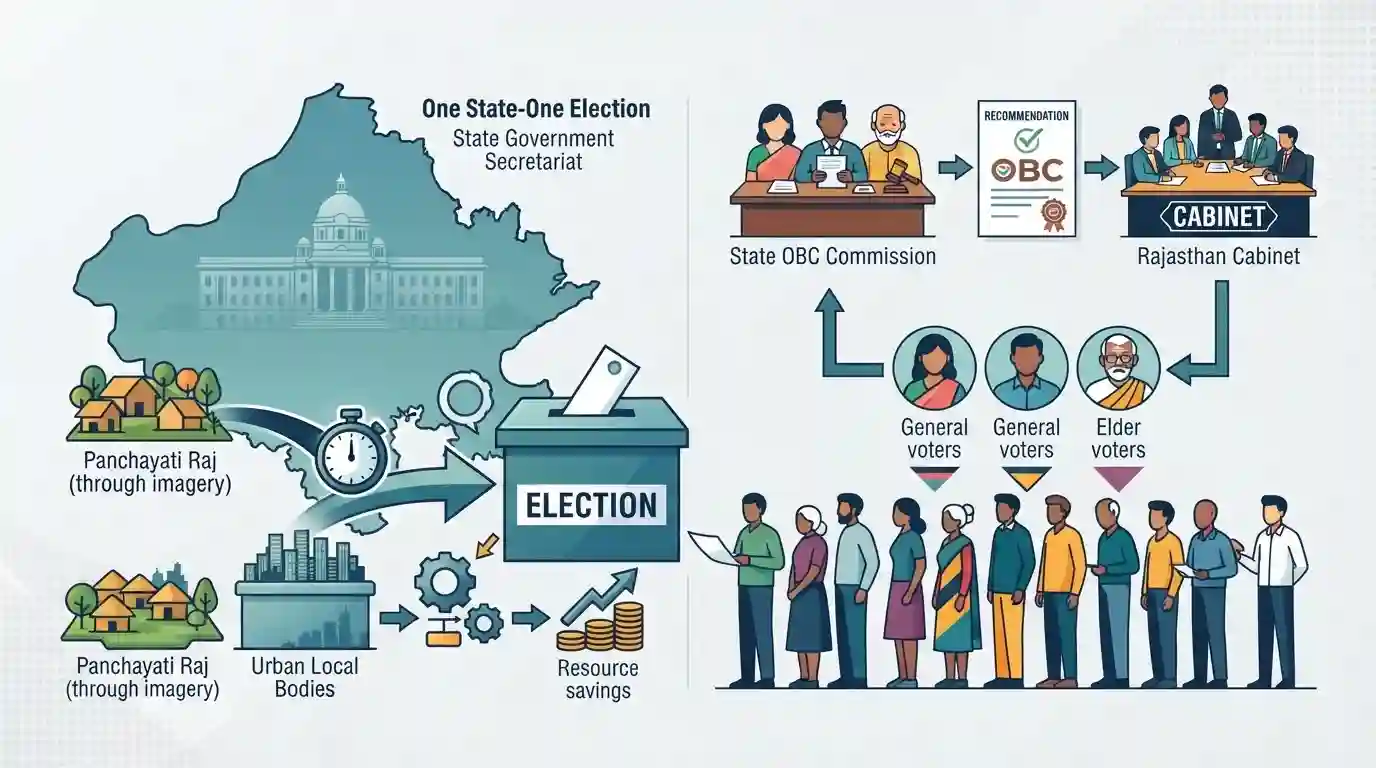
The Rajasthan Cabinet has approved holding Panchayati Raj and Urban Local Body elections simultaneously under the 'One State-One Election' framework to streamline administrative processes and save resources. Furthermore, the Cabinet approved the implementation of OBC reservations in these local elections based on the State OBC Commission's recommendations.
Key Points
- The Rajasthan Cabinet approved the conduct of Panchayati Raj and Urban Local Body elections under the 'One State-One Election' framework to conserve financial and administrative resources.
- This move fulfills the commitment made by Chief Minister Bhajan Lal Sharma in the State Budget 2024-25.
- The Cabinet also approved the recommendations of the Rajasthan State OBC Commission to include OBC reservation provisions within the Urban Local Bodies and Panchayati Raj Acts.
- With the introduction of OBC reservations alongside existing SC/ST provisions, the state will soon initiate the lottery process for reserving local body seats.
Important Terms
One State-One Election

A framework to conduct simultaneous elections for all tiers of local self-government (panchayats and urban local bodies) within a state, aiming to save financial resources, reduce administrative burden, and ensure uninterrupted development work.
UPSC context
GS Paper 2 (Elections). Tests understanding of electoral reforms, administrative efficiency, and local governance synchronization.
Panchayati Raj Act
State legislation enacted under the 73rd Constitutional Amendment to decentralize power, establishing a three-tier local self-governing structure at the village, block, and district levels, detailing their functions and election mechanisms.
UPSC context
GS Paper 2 (Panchayati Raj). Evaluates knowledge of democratic decentralization and constitutional mandates for rural local self-government.
Urban Local Bodies Act
State-level legislation, aligned with the 74th Constitutional Amendment, governing the constitution, powers, and administration of municipal bodies to facilitate grassroots urban planning, civic administration, and democratic representation.
UPSC context
GS Paper 2 (Local Administration). Tests comprehension of urban governance, the 74th Amendment, and devolution of municipal powers.
State Other Backward Classes (Political Representation) Commission
A state-level commission tasked with conducting empirical surveys on the backwardness of OBC communities to recommend proportional political representation and reservation matrices for local body and panchayat elections.
UPSC context
GS Paper 2 (Statutory Bodies). Important for questions on local election reservations, empirical data for affirmative action, and representation.
Prelims Trap
The Constitution mandates reservation of seats for Other Backward Classes in all Panchayats and Municipalities.
Articles 243D(6) and 243T(6) merely *empower* state legislatures to provide OBC reservations. It is completely discretionary, unlike the mandatory reservations for SCs, STs, and women.
Static Concepts Connected
What is the Constitutional framework governing the State Election Commission (SEC)?
- Constitutional Mandate: Established under Article 243K (Panchayats) and 243ZA (Municipalities) to superintend, direct, and control local elections.
- Independence: Appointed by the Governor but has security of tenure; can only be removed in the same manner and on the same grounds as a High Court judge.
- Conditions of Service: Cannot be varied to the SEC's disadvantage after their appointment, ensuring functional autonomy from the state government.
What is the Supreme Court's 'Triple Test' for OBC reservation in local body elections?
- Empirical Data: Set up a dedicated state commission to conduct a rigorous empirical inquiry into the nature and implications of backwardness in local bodies.
- Specify Proportion: Specify the proportion of reservation required to be provisioned local body-wise based on the commission's recommendations.
- 50% Ceiling: Ensure that the total reservation (SC + ST + OBC) does not breach the 50% aggregate ceiling for reserved seats.
Cross-Topic Patterns
Kovind Panel on Simultaneous Elections
The High-Level Committee recommended adding Article 324A to synchronize local body elections with Lok Sabha and State Assembly elections, which would require ratification by 50% of Indian states.
Part IX Mandatory vs Discretionary Provisions
UPSC frequently tests the boundary between mandatory PRI rules (like 5-year terms and women's quotas) and discretionary ones (like OBC quotas, financial devolution, and MLA/MP representation in Panchayats).

Expect a tricky prelims statement contrasting the mandatory SC/ST/women quota in local bodies with the discretionary OBC quota and Triple Test.
Linked PYQs · 4
Linked PYQs · 4
- 2016RPSC_PRELIMSGS1
The State Election Commission of Rajasthan is
- 2023RPSC_PRELIMSGS1
Consider the following statements regarding the State Election Commission of Rajasthan: (i) It was constituted in July 1994 under Article 243 T of the Constitution of India. (ii) It is a one-member commission headed by the State Election Commissioner.
- 2023RPSC_PRELIMSGS1
By which amendment Act was 'Gram Sevak' replaced by 'Gram Vikas Adhikari'?
- 2018RPSC_PRELIMSGS1
Which of the following Act/Rule provides for joint meetings of Gram Sabhas in Rajasthan?
