Joint Parliamentary Committee Deliberations on Simultaneous Elections
Source:Indian Express ↗
Why It Matters
It highlights the functional dynamics of Parliamentary Committees and high-stakes electoral reforms like 'One Nation, One Election', which have profound implications for Indian federalism and democratic polity.
Summary
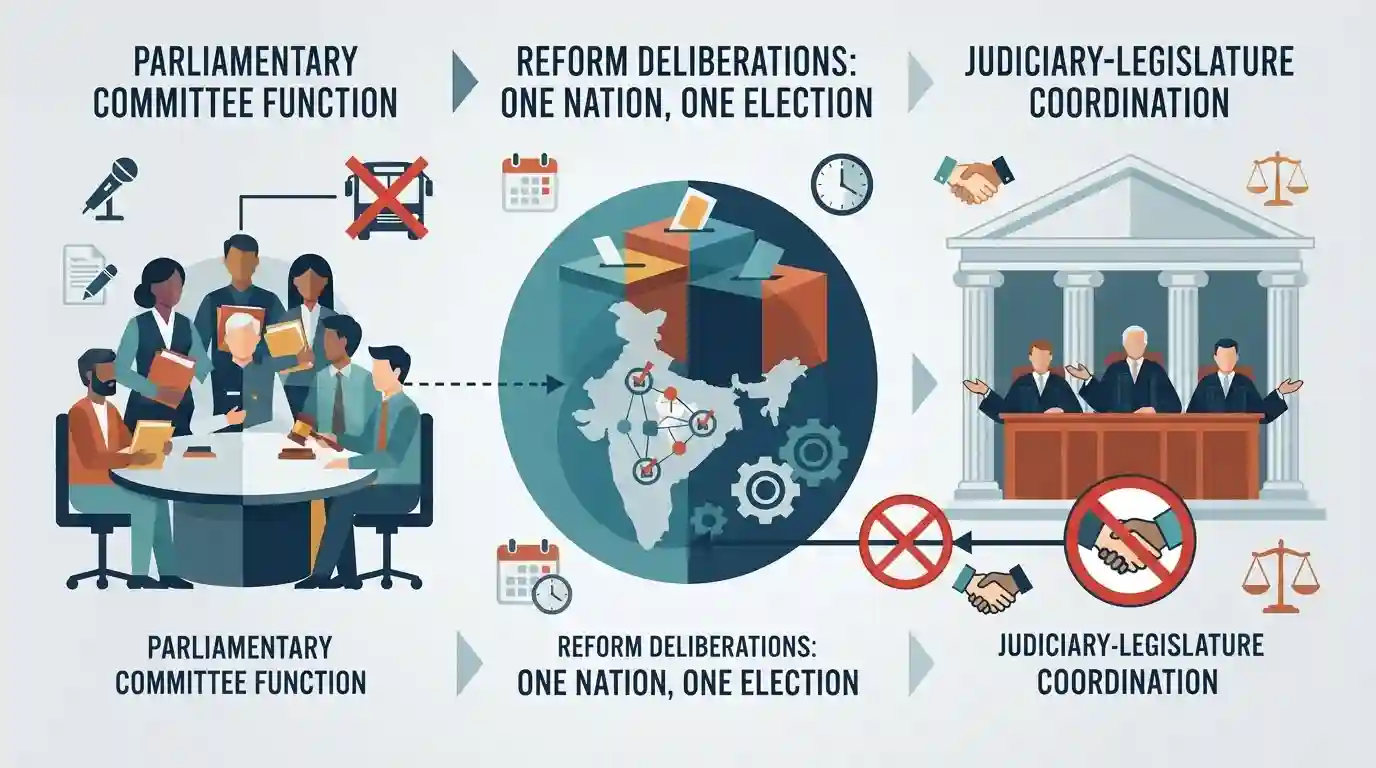
The article discusses the cancellation of a Joint Parliamentary Committee (JPC) visit to the Supreme Court, which was part of deliberations surrounding the 'One Nation, One Election' proposal. This touches upon institutional coordination, parliamentary committee functions, and major electoral reforms.
Key Points
- A proposed visit by a Joint Parliamentary Committee (JPC) to the Supreme Court regarding the 'One Nation, One Election' initiative was cancelled.
- The development highlights the ongoing legislative-judicial interactions and oversight regarding major electoral reforms in India.
- 'One Nation, One Election' remains a major topic of debate concerning simultaneous polls, federal structure, and electoral expenditure.
Important Terms
One Nation One Election

A proposal to synchronize Lok Sabha and State Legislative Assembly elections across India to reduce governance costs, curb policy paralysis, and streamline electoral processes.
UPSC context
GS Paper II (Polity & Governance - Electoral Reforms, Representation of the People Act, Federalism). Tests understanding of structural electoral changes.
Joint Parliamentary Committee (JPC)
An ad hoc parliamentary committee constituted by Parliament for detailed scrutiny and deliberation on specific legislative bills, comprising members from both Houses.
UPSC context
GS Paper II (Parliament and State Legislatures - Structure, Functioning, and Conduct of Business). Tests knowledge of legislative oversight mechanisms.
Supreme Court of India
The apex constitutional court of India, serving as the guardian of the Constitution, guarantor of fundamental rights, and final court of appeal.
UPSC context
GS Paper II (Judiciary, Separation of Powers, Judicial Review). Tests institutional roles and independence of the judiciary.
Prelims Trap
JPCs possess constitutional powers to summon the judiciary for consultations on pending legislative amendments.
Aspirants often assume that Joint Parliamentary Committees (JPCs) have a constitutional mandate and can compel any constitutional authority, including the Supreme Court, to testify or engage on proposed bills.
Static Concepts Connected
What are the key constitutional features and powers of Joint Parliamentary Committees (JPCs) in India?
- Temporary Body: Ad-hoc nature: JPCs are temporary bodies set up for a specific bill or policy issue, dissolved after submitting their report.
- Dual Representation: Composition: Joint committees comprise members from both Lok Sabha (double the strength) and Rajya Sabha, chosen by Parliament.
- Evidence Gathering: Summoning power: They can gather evidence from experts, public bodies, and associations, but lack judicial enforcement authority over independent organs.
Cross-Topic Patterns
Simultaneous Elections and Indian Federalism
The debate over synchronizing elections directly impinges upon federal autonomy and state-level legislative cycles protected under the basic structure doctrine.
Judiciary-Legislature Relations and Parliamentary Oversight
Institutional friction between parliamentary panels and the apex court tests the boundaries of constitutional separation of powers.

Simultaneous elections + JPC powers + separation of powers will likely feature as a multi-statement conceptual prelims question.
Linked PYQs · 3
Linked PYQs · 3
- 2024MainsGS2
Examine the need for electoral reforms as suggested by various committees with particular reference to "one nation one election" principle.
- 2017MainsGS2
Simultaneous election to the Lok Sabha and the State Assemblies will limit the amount of time and money spent in electioneering but it will reduce the government's accountability to the people." Discuss.
- 2023MainsGS2
Explain the structure of the Parliamentary Committee system. How far have the financial committees helped in the institutionalisation of Indian Parliament?
