Simultaneous Elections Committee Visit and Institutional Protocols
Source:Indian Express ↗
हे का महत्त्वाचे आहे
It touches upon the institutional dynamics between Parliament committees and constitutional organs like the Supreme Court, alongside the broader debate on simultaneous elections.
सारांश
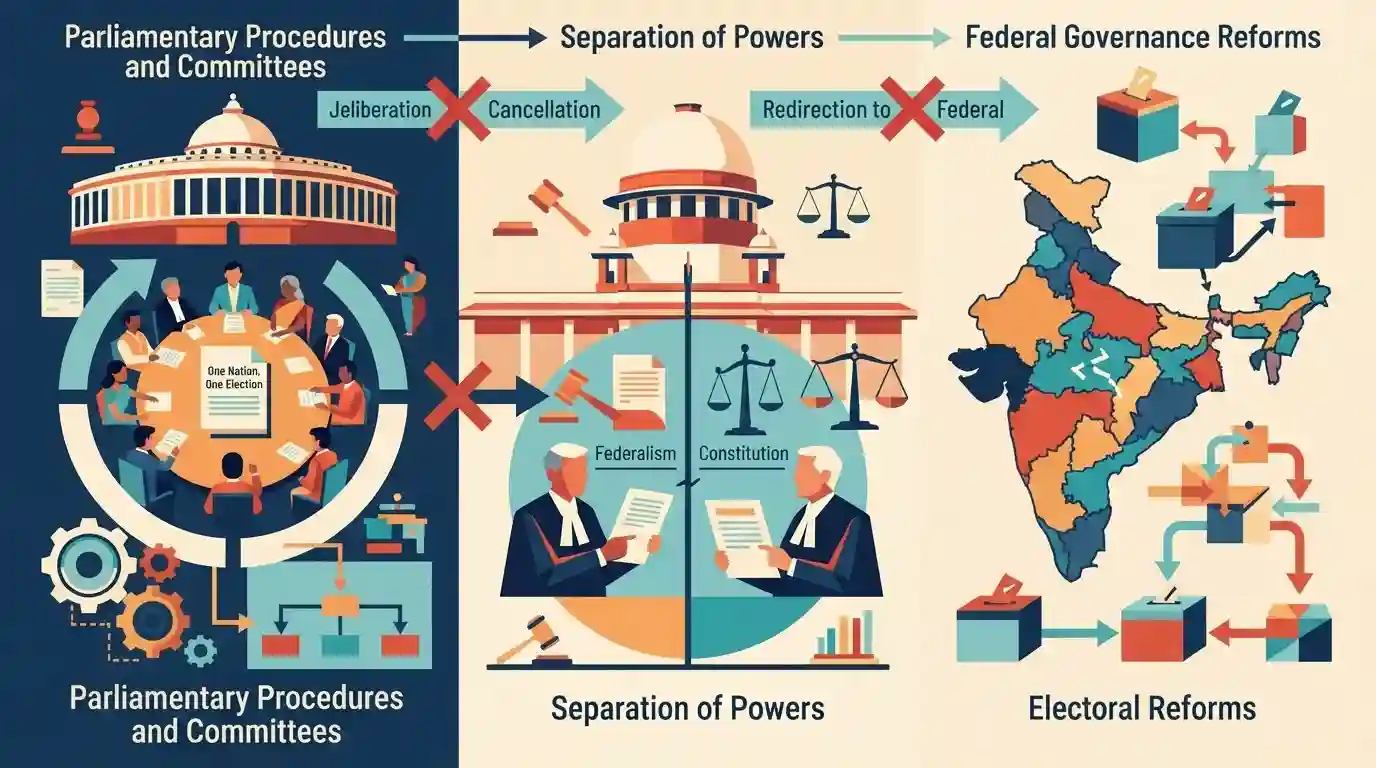
The cancellation of the Joint Parliamentary Committee (JPC) on 'One Nation, One Election' visit to the Supreme Court underscores key institutional interactions in India's democracy, touching upon parliamentary procedures, committee deliberations, and federal governance reforms.
मुख्य मुद्दे
- A planned visit by the Joint Parliamentary Committee (JPC) on 'One Nation, One Election' to the Supreme Court of India was cancelled.
- The cancellation highlights ongoing legislative-judicial interactions and institutional protocols regarding parliamentary committees seeking inputs or visiting judicial bodies.
- The concept of simultaneous elections ('One Nation, One Election') remains a major electoral reform debate in India concerning federalism and constitutional amendments.
महत्त्वाच्या संज्ञा
One Nation One Election

A proposed electoral reform in India to synchronize elections for the Lok Sabha and State Legislative Assemblies across the country, aiming to reduce poll expenses and policy paralysis.
UPSC context
GS Paper II (Polity & Governance) - Electoral Reforms, Federalism, and Separation of Powers.
Joint Parliamentary Committee (JPC)
An ad-hoc parliamentary committee formed by members from both Houses of Parliament to examine specific bills or matters of national importance in depth.
UPSC context
GS Paper II (Parliament and State Legislatures - Structure, Functioning, and Conduct of Business).
Supreme Court of India
The apex judicial body in India under the Constitution, serving as the ultimate interpreter of the Constitution and protector of the doctrine of separation of powers.
UPSC context
GS Paper II (Structure, Organization, and Functioning of the Judiciary).
पूर्वपरीक्षा सापळा
Joint Parliamentary Committees are permanent constitutional bodies established under Article 118 of the Constitution.
Aspirants often assume JPCs are standing constitutional committees, but they are ad-hoc bodies created for a specific purpose or bill.
संबंधित स्थिर संकल्पना
What are the key constitutional and procedural features of Joint Parliamentary Committees (JPCs)?
- Establishment: Ad-hoc bodies set up by a motion passed in one House and concurred by the other, or jointly by both Houses.
- Tenure: They dissolve automatically after submitting their report to Parliament on the specific bill or subject referred to them.
- Powers: Empowered to summon witnesses, demand public documents, and record evidence from experts, ministries, and stakeholders.
आंतर-विषय नमुने
Simultaneous Elections and Indian Federalism
Simultaneous polls require amending multiple constitutional articles touching federal structures, similar to debates around GST council consensus and fiscal federalism.
Parliamentary Committees and Separation of Powers
Committee visits and interactions with judicial bodies test the boundaries of institutional comity and the doctrine of separation of powers.

Simultaneous elections + constitutional amendment process + JPC powers frequently appear as a multi-statement UPSC Prelims question.
संबंधित PYQ · 2
संबंधित PYQ · 2
- 2020MainsGS2
Indian Constitution exhibits centralising tendencies to maintain unity and integrity of the nation. Elucidate in the perspective of the Epidemic Diseases Act, 1897; The Disaster Management Act, 2005 and recently passed Farm Acts.
- 2020MainsGS2
Judicial Legislation is antithetical to the doctrine of separation of powers as envisaged in the Indian Constitution. In this context justify the filing of large number of public interest petitions praying for issuing guidelines to executive authorities.
