Impact of One Nation One Election on India Federal Polity
Source:The Hindu ↗
Why It Matters
This article encapsulates multiple core areas of the UPSC GS Paper II and Paper I syllabus. It connects high-yield constitutional debates on the federal compact (ONOE) with operational details of electoral administration (ECI's transparency, voter deletion under SIR), fundamental and statutory rights (franchise and citizenship proof), and the socio-political implications of the upcoming 2027 Census on seat delimitation and women's reservation.
Summary
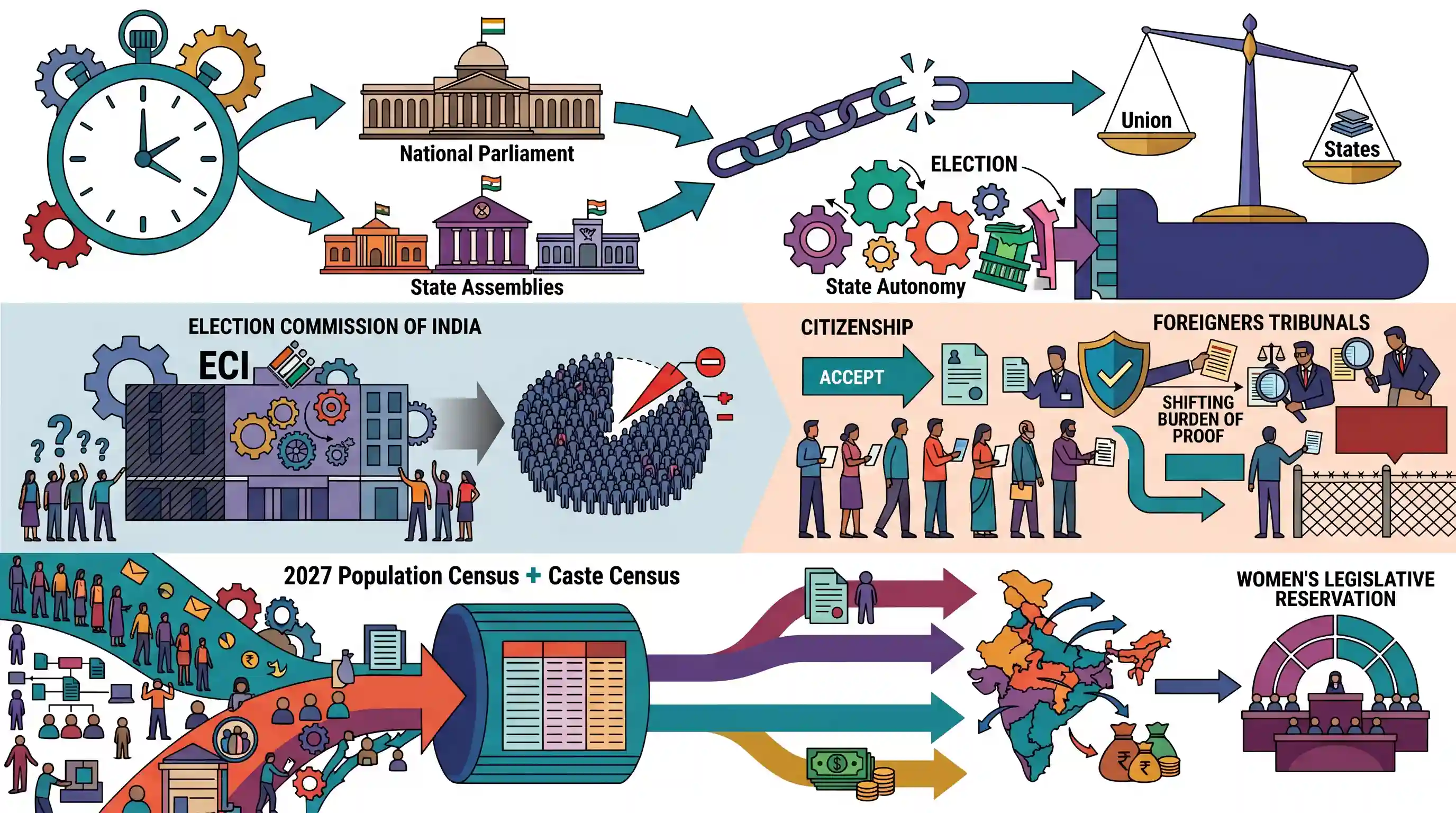
At a conclave on 'One Nation, One Election: Federalism and Citizenship' held on July 4, 2026, in New Delhi, eminent civil society members and former officials strongly criticized the proposed 'One Nation, One Election' (ONOE) model for threatening India's federal structure. The conclave highlighted critical challenges including the disenfranchisement of nearly 16 crore voters during the Special Intensive Revision (SIR) of electoral rolls, the shifting burden of proving citizenship, and the systemic lack of transparency in the Election Commission of India's operations. Speakers also emphasized the immense policy and political stakes of the upcoming 2027 Population Census and caste census, noting they will determine the parameters of future delimitation, women's legislative reservation, and welfare distribution.
Key Points
- Eminent citizens, including retired bureaucrats, judges, and civil society members, rejected the 'One Nation, One Election' (ONOE) initiative, warning that it would fracture the country's federal compact and curtail the autonomy of State Assemblies to run their own affairs.
- Former Election Commissioner Ashok Lavasa raised concerns over the Special Intensive Revision (SIR) of electoral rolls, claiming that nearly 16 crore voters have been disenfranchised, with a lack of transparent, public-facing data distinguishing between ineligible and migrated voters.
- Conclave participants criticized the lack of transparency in the Election Commission of India (ECI), noting its resistance to making public critical records such as Form 17C, CCTV camera footage, and presiding officer diaries.
- Speakers raised concerns about the shifting burden of proving citizenship onto citizens and the degradation of the Indian Passport to 'a mere travel document', causing anxiety over citizenship status alongside the Supreme Court's four-week directive to the ECI regarding referrals to Foreigners Tribunals.
- Former Union Home Secretary G.K. Pillai highlighted that the 2027 Population Census is a highly consequential demographic exercise that will shape delimitation, women's reservation, welfare resource allocation, and caste politics, requiring wider public consultation and transparency.
Important Terms
One Nation One Election

A proposed constitutional reform to synchronize the electoral cycles of the Lok Sabha, state legislative assemblies, and local bodies, aiming to hold them simultaneously.
UPSC context
GS II: Polity and Elections. Tests understanding of federalism, democratic stability, and constitutional amendments.
Special Intensive Revision of electoral rolls
An extraordinary administrative exercise conducted by the Election Commission of India involving door-to-door verification and enumeration to clean, update, and validate voter lists.
UPSC context
GS II: Representation of People Act. Tests knowledge of electoral reforms, voter rights, and technology-driven democratic inclusion.
2027 Population Census
India's upcoming 16th national population count (8th since independence), featuring its first-ever digital census framework, including self-enumeration portals and mobile-based data collection.
UPSC context
GS I: Demography; GS II: Welfare Policies. Tests understanding of demographic trends, federal planning, and digital governance.
Caste Census
The systematic collection of data on the caste identities of individuals during a census, providing crucial socio-demographic insights for affirmative action and social justice planning.
UPSC context
GS I: Social Issues; GS II: Social Justice. Examines affirmative action, political representation, and targeted welfare distribution.
Foreigners Tribunals
Quasi-judicial bodies established in India (governed under citizenship and foreigners acts) to determine whether a person is a foreigner or a citizen of India.
UPSC context
GS II: Citizenship; GS III: Internal Security. Evaluates judicial determination of citizenship, illegal immigration, and human rights.
Form 17C
A statutory document under the Conduct of Elections Rules, 1961, that records the detailed account of votes cast at each individual polling station.
UPSC context
GS II: Electoral Reforms. Tests understanding of democratic transparency, electoral integrity, and the legal framework of voting.
Prelims Trap
The Election Commission is statutorily mandated to publish Form 17C (account of votes) online under the Conduct of Elections Rules, 1961.
Rule 49S(2) only mandates providing signed physical copies of Form 17C to polling agents. No provision requires the ECI to publish these forms online.
Static Concepts Connected
What constitutional amendments are required to implement 'One Nation, One Election'?
- Legislative Terms: Requires amending Article 83 (duration of Lok Sabha) and Article 172 (duration of State Legislative Assemblies) to synchronize legislative terms.
- Dissolution Clauses: Requires changes to Article 85 and Article 174, which govern the President's and Governors' powers to dissolve legislatures prematurely.
- President's Rule: Amendments to Article 356 are necessary to handle cases of government collapse in states without disrupting the synchronized electoral cycle.
What is the 'reverse burden of proof' under Section 9 of the Foreigners Act, 1946?
- Statutory Shift: Section 9 shifts the entire onus of proving citizenship status onto the accused, departing from standard criminal jurisprudence rules.
- Evidence Act Departure: This provision overrides standard rules in the Indian Evidence Act, 1872, where the state usually carries the burden of proving an accusation.
- Tribunal Application: This reverse burden governs all fact-finding proceedings before the quasi-judicial Foreigners Tribunals established under the 1964 Order.
Cross-Topic Patterns
Delimitation, Census, and Federal representation
The 2027 Census and subsequent delimitation link demographic shifts (GS1) directly to federal power-sharing (GS2), as population-based seat reallocation may alter the balance between northern and southern states.
Electoral cleansing vs. Human security
Special Intensive Revisions and citizenship verifications demonstrate how administrative data cleanup (GS2) can inadvertently spark human rights and statelessness anxieties (GS3/Internal Security).

The distinction between administrative voter exclusion (SIR) and permanent loss of citizenship under Act of 1955 is a prime 2026 MCQ target.
Linked PYQs · 2
Linked PYQs · 2
- 2024MainsGS2
Examine the need for electoral reforms as suggested by various committees with particular reference to "one nation one election" principle.
- 2017MainsGS2
Simultaneous election to the Lok Sabha and the State Assemblies will limit the amount of time and money spent in electioneering but it will reduce the government's accountability to the people." Discuss.
