ICMR NIN Study Highlights Vitamin B1 Deficiency in Northeast Women
Source:The Hindu ↗
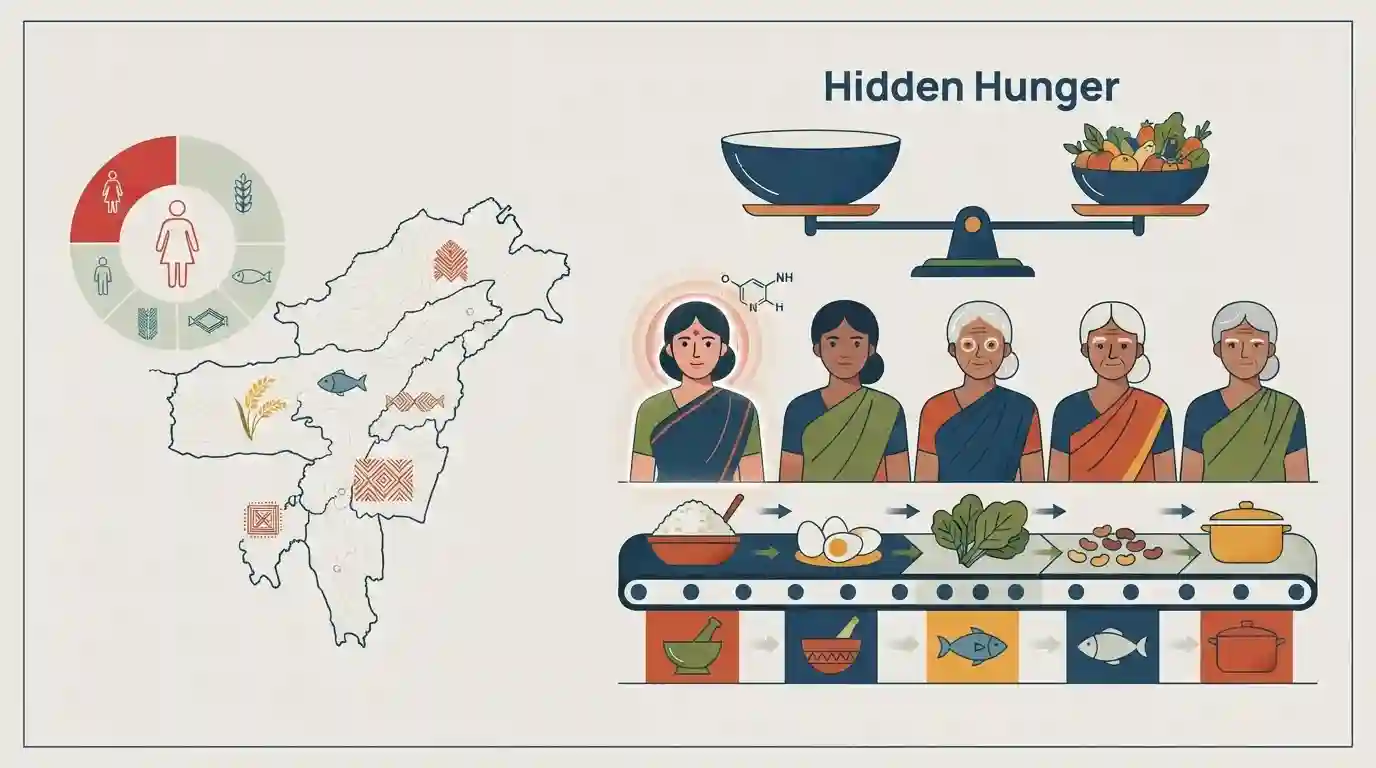
Why It Matters
The article sheds light on micronutrient deficiencies (hidden hunger) in specific regions of India, which is critical for understanding public health challenges, nutritional security, and regional health disparities addressed under GS Paper III.
Summary
A study by the ICMR-National Institute of Nutrition (NIN) found that approximately one in five women in parts of Northeast India suffers from vitamin B1 (thiamine) deficiency. This highlights critical regional public health concerns regarding hidden hunger and micronutrient deficiencies, necessitating targeted nutritional strategies.
Key Points
- An ICMR-NIN study revealed that one in five women in parts of Northeast India is deficient in vitamin B1 (thiamine).
- Vitamin B1 deficiency can lead to severe neurological and cardiovascular complications, including beriberi and nervous system disorders.
- The findings highlight regional health disparities and the need to address micronutrient and hidden hunger issues beyond routine macronutrient security.
- Targeted nutritional interventions and dietary diversification are crucial for vulnerable populations in remote and hilly areas.
Important Terms
Vitamin B1 (Thiamine)

An essential water-soluble vitamin (vitamin B1) crucial for energy metabolism and nervous system function. Deficiency causes beriberi, which remains a public health concern in parts of Northeast India due to polished rice diets.
UPSC context
GS Paper II (Health & Public Welfare) and GS Paper III (Food Security); tests knowledge of micronutrient deficiencies and maternal-child health vulnerabilities.
Indian Council of Medical Research (ICMR)
India's premier apex body for biomedical research, formulating, coordinating, and promoting health research nationwide under the Ministry of Health and Family Welfare.
UPSC context
GS Paper II (Governance and Institutional Frameworks); important for questions on public health policy, scientific research bodies, and disease surveillance.
National Institute of Nutrition (NIN)
A premier nutrition research institute under the ICMR located in Hyderabad, tasked with generating evidence on dietary standards, food safety, and public health nutrition challenges in India.
UPSC context
GS Paper II & III (Health, Poverty, and Developmental Issues); tests understanding of nutritional science institutions addressing hidden hunger in India.
Beriberi
A neurological and cardiovascular disease caused by severe thiamine (vitamin B1) deficiency, historically linked to monotonous diets of polished white rice and re-emerging in certain vulnerable regional pockets.
UPSC context
GS Paper III (Food Security and Public Health); relevant for questions on nutritional disorders, hidden hunger, and regional health disparities.
Prelims Trap
Achieving food security through PDS automatically eradicates hidden hunger and vitamin deficiencies across all regions.
Aspirants often assume food security schemes like NFSA guarantee micronutrient sufficiency, but hidden hunger involves specific vitamin deficiencies like thiamine despite adequate calories.
Static Concepts Connected
What are the key physiological roles and deficiency diseases associated with Water-Soluble Vitamins?
- Thiamine (B1):: Vitamin B1 (Thiamine) deficiency causes beriberi, affecting the nervous and cardiovascular systems, often linked to diets high in polished rice.
- Niacin (B3):: Vitamin B3 (Niacin) deficiency causes pellagra, characterized by the '4 Ds': dermatitis, diarrhea, dementia, and death.
- Cobalamin (B12):: Vitamin B12 (Cobalamin) deficiency leads to megaloblastic anemia and neurological disorders; it is primarily found in animal-source foods.
Cross-Topic Patterns
Hidden Hunger vs Caloric Security
Hidden hunger shifts focus from mere caloric sufficiency to micronutrient density, directly testing SDG 2 (Zero Hunger) targets in remote, hilly geographies.
Socio-Cultural Practices and Nutritional Health
Dietary habits like heavy rice-washing and betel nut consumption show how regional socio-cultural practices intersect with public health outcomes.

ICMR findings on regional hidden hunger and micronutrient deficiencies will likely feature in a statement-based Prelims question.
Linked PYQs · 2
Linked PYQs · 2
- 2024MainsGS3
Explain the role of millets for ensuring health and nutritional security in India.
- 2017PrelimsGS1
Which of the following are the objectives of 'National Nutrition Mission'? 1. To create awareness relating to malnutrition among pregnant women and lactating mothers. 2. To reduce the incidence of anaemia among young children, adolescent girls and women. 3. To promote the consumption of millets, coarse cereals and unpolished rice. 4. To promote the consumption of poultry eggs. Select the correct answer using the code given below:
