Uttarakhand STF Arrests Suspect for Digital Radicalization
Source:prashantnews ↗
Why It Matters
This case underscores the vulnerability of domestic youth to online radicalization via social media and highlights how non-traditional security states like Uttarakhand are increasingly facing threats from digitally operated, foreign-linked extremist modules. It emphasizes the importance of state-level specialized units like the STF in handling cross-border intelligence and cyber-security threats.
Summary
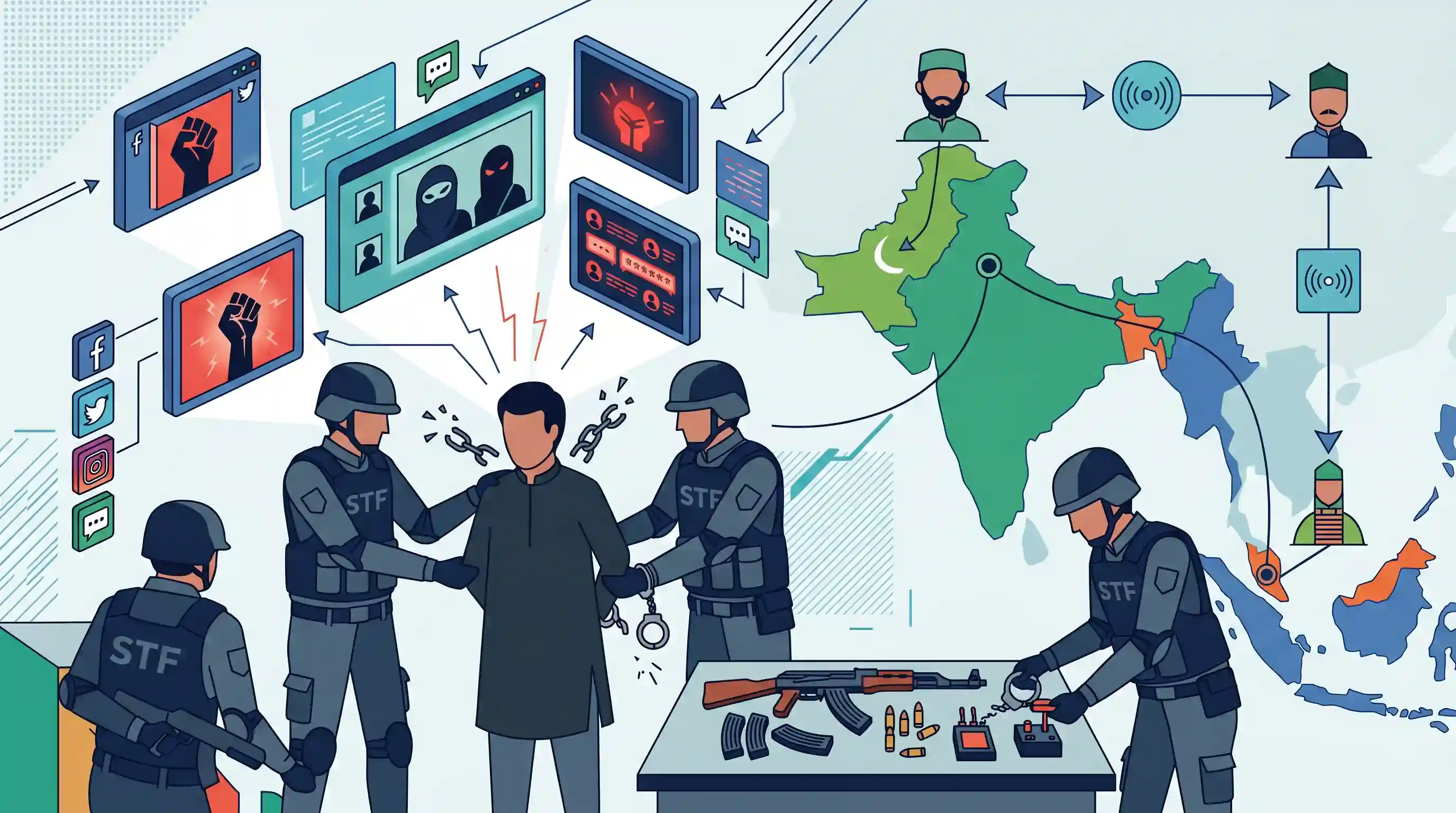
The Special Task Force (STF) of Uttarakhand Police apprehended Mohd. Salauddin in Udham Singh Nagar district for allegedly disseminating extremist content and promoting radicalization through social media platforms. The accused, who was in touch with handlers in Malaysia and Pakistan, was found in possession of arms and detonators, exposing a localized digital radicalization threat with cross-border linkages.
Key Points
- The Special Task Force (STF) of Uttarakhand Police arrested Mohd. Salauddin in Gadarpur, Udham Singh Nagar district, for promoting radical ideology and anti-national activities.
- Preliminary investigations revealed that the accused was in contact with cross-border handlers based in Malaysia and Pakistan, managing cyber-radicalization networks.
- The suspect allegedly used various social media and digital platforms to target, influence, and radicalize local youth by disseminating extremist content.
- An intelligence-led interrogation led to the recovery of an English-made pistol, five live cartridges, four detonators, and two AK-47 rifle cartridges.
- The STF is actively examining seized electronic devices and communication channels to identify further associates and expose the depth of the network.
Important Terms
Special Task Force (STF)

An elite, state-level specialized police unit in India constituted to counter complex internal security threats, organized crime syndicates, and terrorist activities beyond the capacity of regular district police.
UPSC context
GS Paper III (Internal Security); tests understanding of the mandate and roles of various state-level security forces and agencies.
Cyber Radicalization
The process of indoctrinating individuals into extremist ideologies through digital media, encrypted applications, and social networking platforms, presenting decentralized security risks.
UPSC context
GS Paper III (Internal Security); tests awareness of online propaganda channels, social media security challenges, and cybersecurity strategies.
Cross-Border Terror Networks
Transnational coordination and communication channels used by foreign handlers and extremist operatives to direct, finance, and facilitate domestic terror attacks from external territories.
UPSC context
GS Paper III (Internal Security); tests understanding of external state and non-state actors initiating threat networks against India's sovereignty.
De-radicalization
Structured ideological, psychological, and socio-economic interventions designed to dissuade, rehabilitate, and reintegrate individuals who have embraced or been exposed to extremist narratives.
UPSC context
GS Paper III (Internal Security); evaluates capability to devise comprehensive, non-coercive counter-insurgency and preventive policy measures.
Prelims Trap
The Indian Cyber Crime Coordination Centre (I4C) is an executive agency under the Ministry of Electronics and Information Technology (MeitY).
I4C is an attached office under the Ministry of Home Affairs (MHA), not MeitY. Examiners exploit the 'cyber' keyword to trick candidates into choosing the tech ministry.
Static Concepts Connected
What is Section 66F of the IT Act, 2000?
- Target: Criminalizes cyber terrorism threatening the unity, integrity, security, or sovereignty of India.
- Penalty: Prescribes a maximum penalty of life imprisonment for violators of this section.
What is the Multi-Agency Centre (MAC)?
- Nodal Agency: Functions under the Intelligence Bureau (IB) as India's main intelligence-fusion platform.
- Integration: Coordinates counter-terrorism and cyber threat data across 28 central and state organizations.
Cross-Topic Patterns
Cyber-radicalization & Border Management
Digital recruitment bypasses physical border infrastructure, shifting national security priorities from conventional fencing to cognitive firewalling.
Security vs. Intermediary Liability
Monitoring encrypted radicalization networks tests the limits of safe-harbour protections for social media platforms under India's IT Act.

MHA's PRAHAAR strategy and Section 66F of the IT Act will likely be combined to test India's cyber-defense framework in 2026.
Linked PYQs · 1
Linked PYQs · 1
- 2024UKPSC_PRELIMSGS1
In March 2024, who made it to history as the first woman sniper of the Border Security Force ?
