Socioeconomic Impact of Extreme Heat and Mortality Vulnerability
Source:The Hindu ↗
Why It Matters
Provides crucial statistical data on the socio-economic impacts of climate change in India. The disparity between state-level mortality burdens and economic capacity is highly relevant for GS-3 answers on climate vulnerability, disaster risk assessment, and equitable allocation of climate adaptation funds.
Summary
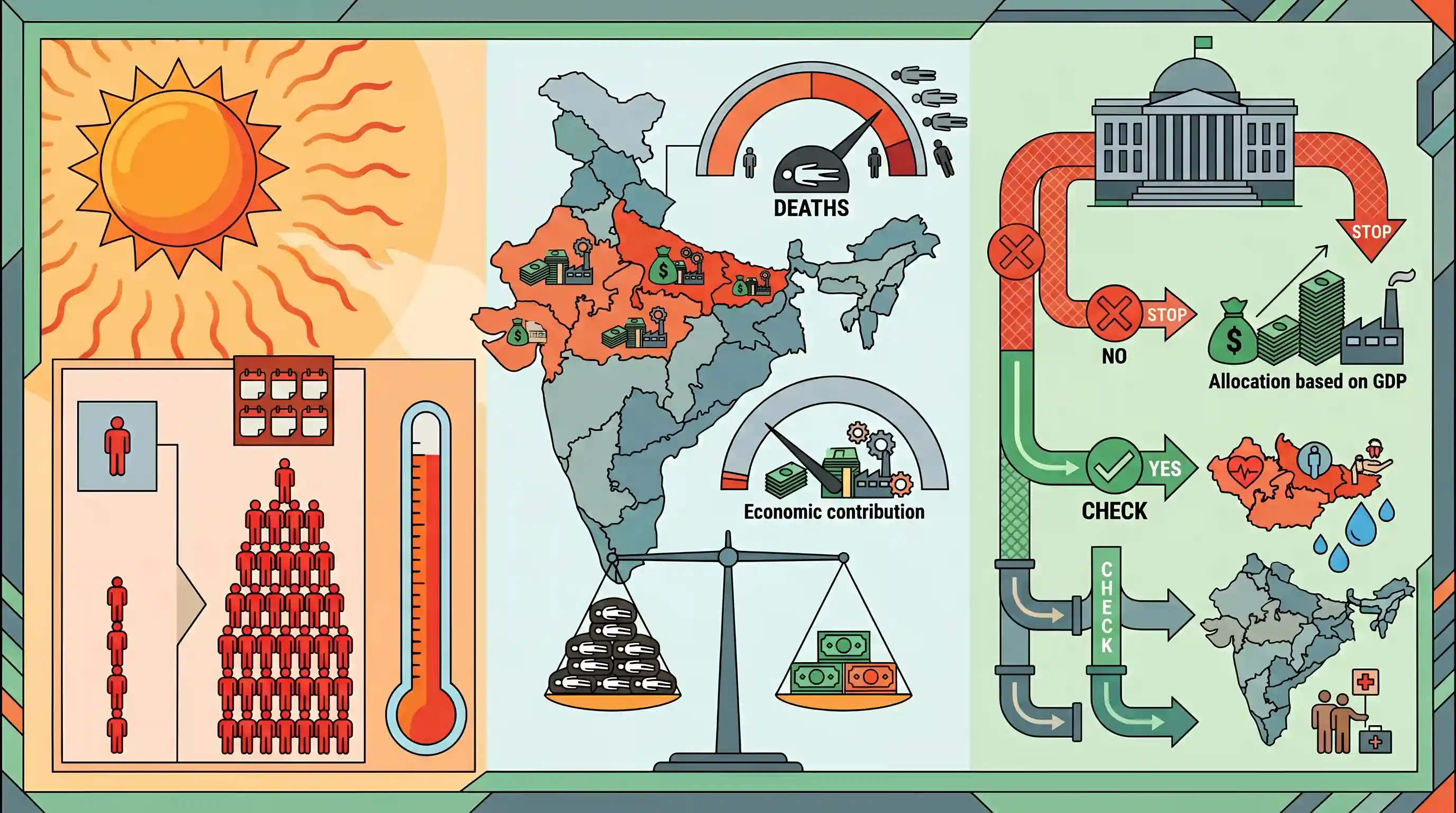
A new study estimates that extreme heat causes roughly 3,400 excess deaths per day in India, scaling up to 30,000 deaths during a five-day heatwave. The research reveals a severe geographical and economic disparity: 66% of these excess deaths occur in just five states (UP, Bihar, MP, Rajasthan, and Gujarat), which collectively generate only 29% of India's GDP. This highlights a critical vulnerability gap, prompting calls for federal adaptation frameworks—like the NDMA and the National Action Plan on Climate Change—to allocate funding based on mortality risk and regional vulnerability rather than economic capacity.
Key Points
- A single day of extreme heat causes approximately 3,400 excess deaths in India, while a five-day heatwave leads to nearly 30,000 fatalities.
- Five states (Uttar Pradesh, Bihar, Madhya Pradesh, Rajasthan, and Gujarat) account for 66% of India's excess heat deaths despite contributing only 29% to the national GDP.
- Uttar Pradesh faces the highest mortality burden, with roughly 8,100 excess deaths estimated during a five-day heatwave.
- The study highlights a 2.3-fold disproportion between mortality burden and economic capacity, highlighting severe regional climate vulnerability.
- Researchers urge that federal climate adaptation investments, such as through the NDMA and NAPCC, should prioritize high-burden, low-GDP states rather than linking funding to economic capacity.
Important Terms
National Disaster Management Authority (NDMA)

Statutory apex body for disaster management, established under the Disaster Management Act, 2005. Chaired by the Prime Minister, it mandates policies, guidelines, and coordination for disaster mitigation and response.
UPSC context
GS Paper 3 (Disaster Management); tests knowledge of institutional frameworks for managing hazards like heatwaves.
National Action Plan on Climate Change (NAPCC)
Launched in 2008, this framework includes eight national missions (e.g., Solar, Water, Sustainable Habitat) to address climate change through adaptation and mitigation while ensuring sustainable development.
UPSC context
GS Paper 3 (Environment); core to India’s national strategy for climate resilience and international commitments.
Heat Action Plans (HAPs)
Localized strategies involving early warning systems, inter-agency coordination, and public awareness to reduce mortality during extreme heat events. Ahmedabad launched India’s first HAP in 2013.
UPSC context
GS Paper 3 (Disaster Management); relevant for urban planning, healthcare preparedness, and climate adaptation strategies.
Excess Mortality
The difference between the observed number of deaths during a period (e.g., a heatwave) and the expected number based on historical trends, capturing unrecorded climate-related fatalities.
UPSC context
GS Paper 2 (Health) & GS Paper 3 (Environment); tests data interpretation and the health-climate nexus.
Vulnerability Gap
The socioeconomic disparity where regions with the highest climate risk (e.g., heat-burdened states) possess the least financial and administrative capacity to fund adaptation and resilience.
UPSC context
GS Paper 3 (Environment/Economics); critical for discussions on climate justice and federal fiscal federalism in disaster funding.
IMD Heatwave Criteria
Specific temperature thresholds (e.g., 40°C in plains) or departures from normal maximum temperatures (e.g., 4.5°C to 6.4°C) used to officially declare a heatwave hazard.
UPSC context
Prelims/GS Paper 3; tests technical definitions of climatic hazards and institutional triggers for disaster response.
Prelims Trap
"Heatwaves are explicitly listed as a Notified National Disaster under the Disaster Management Act, 2005."
Heatwaves are NOT officially notified national disasters under the DMA 2005. States currently manage them using a 10% flexi-fund window under the SDRF allocated for "local disasters."
Static Concepts Connected
What are the IMD's threshold criteria for declaring a heatwave in India?
- Plains: Maximum temperature of a station must reach at least 40°C.
- Hilly Regions: Maximum temperature must reach at least 30°C.
- Coastal Regions: Maximum temperature must reach at least 37°C.
- Departure condition: Departure from normal must be 4.5°C to 6.4°C, or an absolute recorded temperature of ≥45°C.
How is the State Disaster Response Fund (SDRF) constituted and utilized?
- Statutory Backing: Constituted under Section 48 (1)(a) of the Disaster Management Act, 2005. Center contributes 75% (general states) and 90% (special category states).
- Notified Disasters: Covers 12 notified disasters (e.g., cyclone, drought, earthquake, fire, flood, cold wave). Heatwave is notably excluded from this central list.
- Flexi-fund Provision: States can use up to 10% of their SDRF allocation for state-specific "local disasters" (which is how states currently fund heatwave response).
Cross-Topic Patterns
Climate Justice and Fiscal Federalism
The mortality (66%) vs GDP (29%) disparity in states like UP and Bihar strengthens the demand for Finance Commissions to integrate climate vulnerability indices into horizontal tax devolution formulas.
Wet-bulb temperatures and Informal Labor
High mortality isn't just about absolute heat; it is fundamentally linked to rising wet-bulb temperatures (humidity) making outdoor labor fatal in agrarian and informal economies.

Expect a multi-statement Prelims question merging IMD heatwave criteria, SDRF notified disasters (excluding heatwaves), and NDMA mandate.
Linked PYQs · 5
Linked PYQs · 5
- 2019MainsGS3
Vulnerability is an essential element for defining disaster impacts and its threat to people. How and in what ways can vulnerability to disasters be characterized? Discuss different types of vulnerability with reference to disasters.
- 2013MainsGS3
How important are vulnerability and risk assessment for pre-disaster management ? As an administrator, what are key areas that you would focus on in a Disaster Management System.
- 2017MainsGS3
'Climate change' is a global problem. How India will be affected by climate change? How Himalayan and coastal states of India will be affected by climate change?
- 2014MainsGS3
Drought has been recognized as a disaster in view of its spatial expanse, temporal duration, slow onset and lasting effects on vulnerable sections. With a focus on the September 2010 guidelines from the National Disaster Management Authority (NDMA), discuss the mechanisms for preparedness to deal with likely El Niño and La Niña fallouts in India.
- 2013MainsGS1
Bring out the causes for the formation of heat islands in the urban habitat of the world.
