Legal Framework for Emergency Content Blocking on OTT Platforms
Source:The Hindu ↗
Why It Matters
It provides a concrete case study on the invocation of emergency executive powers for content moderation on OTT platforms, balancing national security and public order against freedom of expression under Article 19(1)(a).
Summary
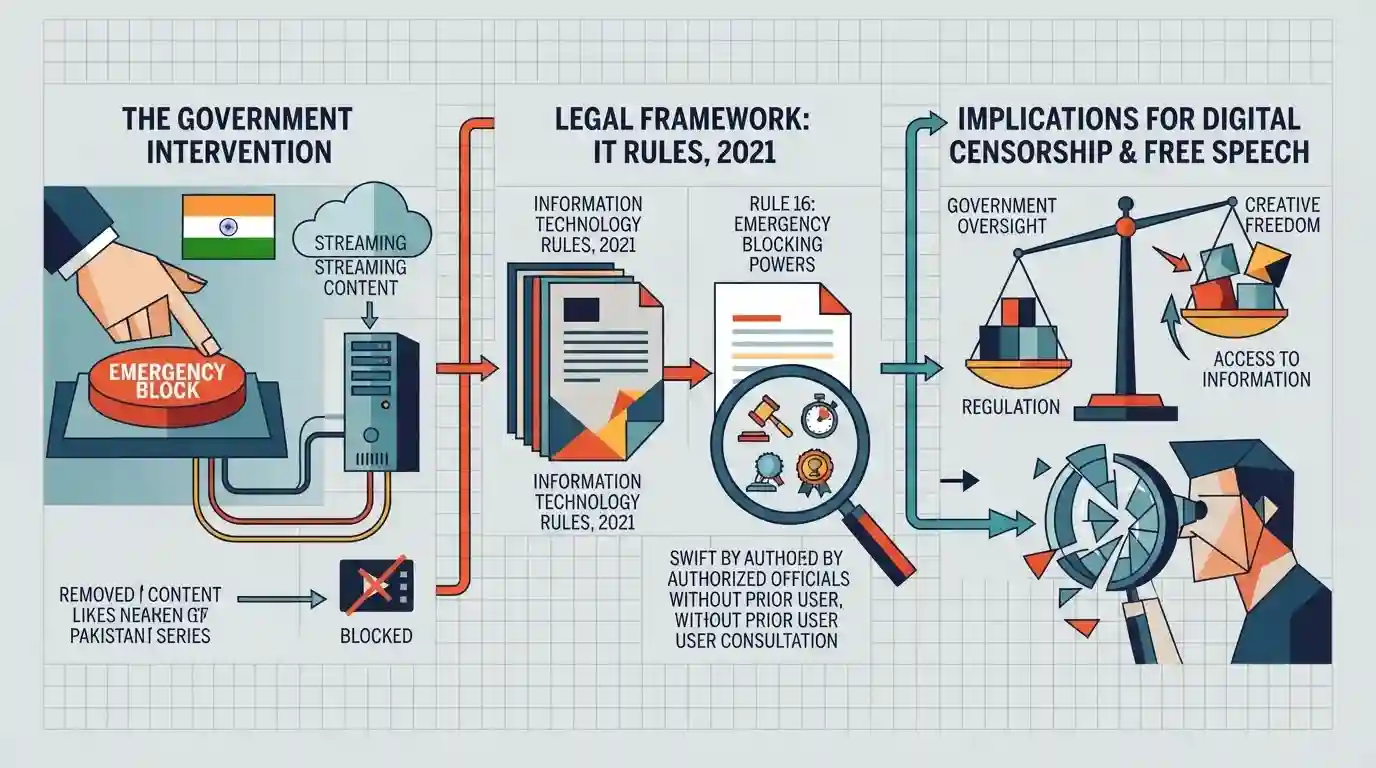
An explanation of the legal framework utilized by the Indian government to block a Pakistani series on Netflix, focusing on emergency blocking powers under Rule 16 of the Information Technology (Intermediary Guidelines and Digital Media Ethics Code) Rules, 2021, and its implications for digital censorship and free speech.
Key Points
- The Central Government blocked a Pakistani streaming series on Netflix using emergency blocking powers under Rule 16 of the IT Rules 2021.
- Rule 16 permits the Ministry of Information and Broadcasting to block content in emergency situations without giving an opportunity for a hearing to the publisher or intermediary.
- Under normal circumstances, content blocking follows a multi-tier grievance redressal mechanism and committee review under the IT Rules.
- The action highlights the tension between sovereign interests, public order, and freedom of expression on digital OTT platforms.
Important Terms
IT Intermediary Guidelines and Digital Media Ethics Code Rules 2021

Rules framed under the IT Act, 2000, regulating intermediaries and digital media. Rule 16 grants the government extraordinary emergency powers to block online content immediately without a prior hearing.
UPSC context
UPSC GS Paper II (Polity & Governance) - Tests regulatory frameworks, delegated legislation, executive overreach, and freedom of expression.
Information Technology Act 2000
The foundational legislation governing cyber law and e-commerce in India. Section 69A empowers the Centre to block public access to digital information in the interest of sovereignty, security, and public order.
UPSC context
UPSC GS Paper II/III - Tests legal frameworks for cyberspace, national security, statutory powers, and digital rights.
Ministry of Information and Broadcasting
The Union government ministry responsible for the formulation and administration of rules, regulations, and laws relating to information, broadcasting, and digital media ethics code in India.
UPSC context
UPSC GS Paper II (Polity & Governance) - Tests the role and executive powers of central ministries in media regulation.
Prelims Trap
Rule 16 permits unilateral blocking without any mandatory review mechanism.
Aspirants often assume Rule 16 emergency blocking orders are final and require no post-decisional review, whereas the rules mandate review by an inter-departmental committee within 48 hours.
Static Concepts Connected
What are the constitutional grounds and procedural safeguards for placing reasonable restrictions on Freedom of Speech under Article 19(2)?
- Exhaustive Grounds: Restrictions must be explicitly anchored to one of the eight grounds enumerated under Article 19(2), such as sovereignty, security, and public order.
- Proportionality Test: Judicial review tests whether restrictions satisfy the doctrine of proportionality, ensuring the measure is the least restrictive alternative.
- Statutory Nexus: Subordinate legislation like IT Rules must operate strictly within the statutory limits of the parent IT Act, 2000.
Cross-Topic Patterns
Delegated Legislation vs Fundamental Freedoms
Emergency executive powers under delegated legislation are increasingly scrutinized for balancing executive privilege against fundamental freedoms under Article 19(2).

Emergency blocking under IT Rules 2021 + Article 19(2) reasonable restrictions will likely feature in a polity statement-based MCQ.
Linked PYQs · 1
Linked PYQs · 1
- 2014MainsGS2
What do you understand by the concept "freedom of speech and expression"? Does it cover hate speech also ? Why do the films in India stand on a slightly different plane from other forms of expression ? Discuss.
