Parliamentary opposition obstructionism and legislative accountability
Source:Indian Express ↗
Why It Matters
The functioning of the Parliament and the role of the Opposition are central to the GS2 syllabus. A decline in constructive debate and an increase in parliamentary disruptions undermine the legislature's ability to hold the executive accountable, making this a critical theme for analysis in democratic governance.
Summary
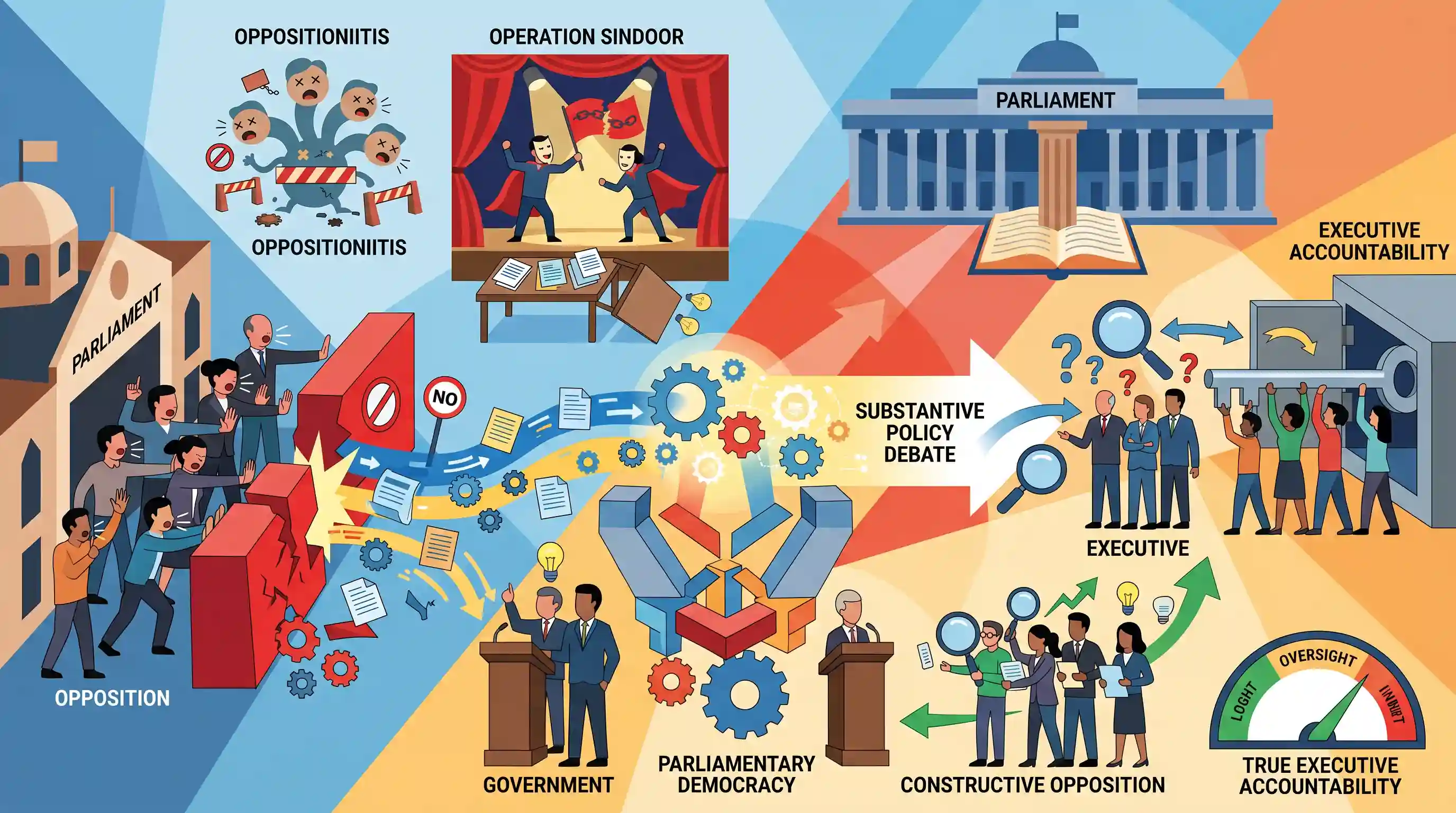
This opinion piece critically examines the current state of political discourse in India, using the coined term "oppositioniitis" to describe the Opposition's tendency toward reflexive obstructionism. Through the lens of political dramas termed as "Operation Sindoor," the author illustrates how substantive policy debates are frequently derailed by political posturing. The article emphasizes that for a parliamentary democracy to function effectively, the Opposition must move beyond mere disruption and engage constructively to ensure true executive accountability and uphold democratic institutions.
Key Points
- The article critiques "oppositioniitis," a term describing the reflexive and often obstructionist opposition to government actions without engaging in substantive policy debate.
- Refers to political dramatizations (like "Operation Sindoor") where political posturing overshadows constructive legislative engagement.
- Highlights the deteriorating quality of parliamentary debates and the tendency of political parties to focus on optics rather than holding the executive accountable through reasoned critique.
- Underscores that a healthy parliamentary democracy requires a robust, constructive Opposition to maintain effective checks and balances on the executive.
Important Terms
Parliament of India

The supreme legislative body of India, comprising the President and two Houses (Lok Sabha and Rajya Sabha). It serves as the primary forum for law-making and holding the government accountable.
UPSC context
GS Paper II: Parliament and State Legislatures—structure, functioning, conduct of business, powers & privileges.
Political Parties (Opposition)
Political groups that do not form the government but provide a formal check on the ruling party. They scrutinize policies, represent dissent, and offer alternative governance visions.
UPSC context
GS Paper II: Role of the Opposition in a democracy; challenges in parliamentary functioning.
Executive Accountability
A constitutional principle (Article 75) ensuring the government is answerable to the legislature for its actions, decisions, and policies to prevent arbitrary exercise of power.
UPSC context
GS Paper II: Fundamental to the 'Checks and Balances' system in Indian Polity.
Parliamentary Democracy
The system of government where the executive branch is part of and responsible to the legislature. It emphasizes collective responsibility and the fusion of legislative and executive powers.
UPSC context
GS Paper II: Comparing the Indian constitutional scheme with other countries; Salient features of the Constitution.
Collective Responsibility
The constitutional doctrine (Article 75(3)) that the Council of Ministers is jointly responsible to the Lok Sabha. If a ministry loses confidence, the entire government must resign.
UPSC context
GS Paper II: Key parliamentary principle tested in questions on the Council of Ministers.
Legislative Oversight
The process by which the legislature monitors and reviews the actions of the executive branch and its agencies to ensure laws are implemented as intended.
UPSC context
GS Paper II: Functioning of Parliamentary Committees and the effectiveness of legislative scrutiny.
Operation Sindoor
A May 2025 Indian tri-service military strike against terrorist infrastructure in Pakistan-occupied regions, used in political discourse to debate the role of consensus in national security.
UPSC context
GS Paper III: Security challenges and their management in border areas; role of political consensus in external security.
Prelims Trap
The office of the Leader of Opposition and its 10% seat requirement are explicitly mentioned in the Constitution of India.
The LoP is a statutory post under a 1977 Act, not a constitutional one. The 10% seat criterion stems from the Mavalankar rule (parliamentary convention), not constitutional text.
Static Concepts Connected
How is the Leader of the Opposition (LoP) recognized and empowered in India?
- Statutory backing: Defined under the Salary and Allowances of Leaders of Opposition in Parliament Act, 1977.
- Selection committees: The LoP sits on high-powered panels to appoint the CBI Director, CVC, CIC, Lokpal, and NHRC chairperson.
- Quorum rule: By convention (Mavalankar rule), a party must secure at least 10% of the total strength of the House to claim the LoP post.
What are the key procedural tools used by the Opposition to ensure Executive accountability?
- Question Hour: The first hour of a sitting where MPs ask questions to hold ministers directly accountable for the functioning of their ministries.
- No-Confidence Motion: Introduced exclusively in the Lok Sabha with the support of 50 members, used to test the government's majority and force a debate.
- Adjournment Motion: Draws the House's attention to a definite matter of urgent public importance, requiring 50 members' support to disrupt normal business.
Cross-Topic Patterns
Parliamentary decline fuels judicial activism
As Parliament loses sitting days to obstructionism and debate quality declines, policy vacuums are increasingly filled by the Supreme Court, skewing the constitutional separation of powers.
Westminster Shadow Cabinet vs Indian opposition
UPSC often contrasts the UK's institutionalized 'Shadow Cabinet'—which actively prepares alternative policies—with India's fragmented opposition model that relies more on floor protests and disruption.

Expect a GS-2 question linking the sharp decline in DRSC bill referrals to reduced executive accountability and parliamentary disruptions.
Linked PYQs · 1
Linked PYQs · 1
- 2021MainsGS2
To what extent, in your view, the Parliament is able to ensure accountability of the executive in India?
