Constructive Parliamentary Debate and Opposition Dynamics
Source:Indian Express ↗
Why It Matters
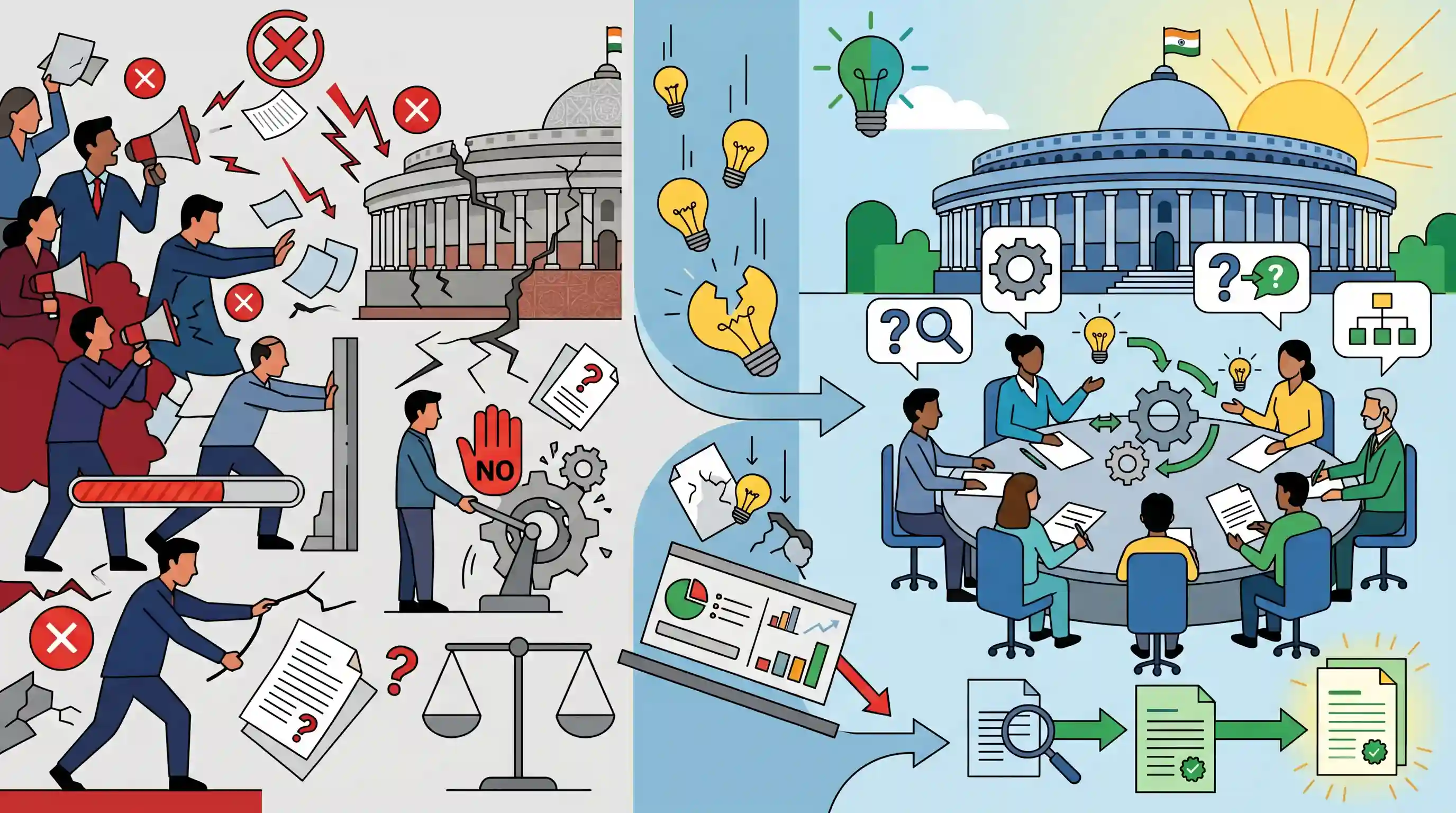
A robust opposition is fundamental to a vibrant democracy. Constantly disrupting or reflexively opposing government actions without substantive debate undermines legislative institutions, weakens executive accountability, and diminishes the overall quality of democratic governance.
Summary
The article reflects on the current dynamics of India's parliamentary democracy, critiquing the opposition's habit of reflexive and indiscriminate resistance to government initiatives—a phenomenon termed 'oppositioniitis.' Using 'Operation Sindoor' to illustrate its point, the piece argues that healthy democratic functioning relies on constructive criticism and substantive debates rather than constant obstruction. It underscores the necessity for political parties to engage meaningfully in the legislative process instead of reducing parliamentary business to mere political posturing, thereby preventing the decline in the quality of national discourse.
Key Points
- The article critiques the reflexive tendency of the political opposition to reject or disrupt government actions, terming this behavior 'oppositioniitis'.
- Using 'Operation Sindoor' as a contextual anchor, the author highlights how political polarization often eclipses substantive legislative debates.
- A functioning parliamentary democracy requires an opposition that offers constructive criticism rather than resorting to constant obstructionism.
- Frequent disruptions and the decline in the quality of parliamentary debates undermine democratic institutions and accountability.
Important Terms
Parliamentary Democracy

A system of government where the executive is responsible to the legislature, ensuring collective responsibility and oversight through elected representatives.
UPSC context
Core concept for GS Paper II; tests understanding of India's Westminster-style governance and executive-legislative relations.
Opposition Parties
Political parties not in government that act as watchdogs, scrutinizing executive actions and providing alternative policy perspectives to ensure accountability.
UPSC context
GS Paper II: Functioning of Parliament. Tests knowledge of democratic checks and balances and the 'Shadow Cabinet' concept.
Leader of Opposition (LoP)
A statutory position held by the leader of the largest opposition party (with at least 1/10th seats), enjoying the status of a Cabinet Minister.
UPSC context
GS Paper II: Statutory posts. Crucial for understanding parliamentary appointments and the institutionalized role of dissent.
Constructive Opposition
A democratic ideal where the opposition provides evidence-based critiques and viable alternatives rather than reflexive obstruction of all government policies.
UPSC context
Relevant for Polity and Ethics (GS II & IV); tests the quality of legislative debates and democratic ethics.
Parliamentary Committees
Smaller groups of MPs (e.g., Public Accounts Committee) that provide detailed scrutiny of government spending, policies, and legislative bills.
UPSC context
GS Paper II: Parliament functioning. Key mechanism for legislative oversight and opposition participation in governance.
Operation Sindoor
A 2025 Indian military operation involving precision strikes on terror targets in Pakistan/PoK following the Pahalgam attack; used to analyze political unity.
UPSC context
Current Affairs/Internal Security. Illustrates the intersection of national security and domestic political discourse in Parliament.
Oppositioniitis
A satirical term for 'reflexive opposition,' where political parties habitually resist government initiatives regardless of merit, often hindering productive debate.
UPSC context
Essay/Polity. Critiques the decline in legislative productivity and the shift from deliberation to political posturing.
Prelims Trap
The "Shadow Cabinet" is a recognized institutional mechanism in the Indian parliamentary system for ensuring executive accountability.
India lacks an institutionalized Shadow Cabinet. It is a unique feature of the British Westminster system; India only recognizes the statutory role of the Leader of the Opposition.
Static Concepts Connected
Which key selection committees mandate the inclusion of the Leader of the Opposition (LoP)?
- CBI and CVC: The LoP is a crucial member of the selection panels for the CBI Director and Central Vigilance Commissioner.
- Lokpal and NHRC: The LoP's presence balances executive dominance in appointing members to the Lokpal and the National Human Rights Commission.
- Election Commission: Under the 2023 Act, the LoP (or leader of the single largest opposition party) is included in the selection of the Chief Election Commissioner.
How do Parliamentary Committees act as a safeguard against legislative disruptions?
- Expert Scrutiny: They provide a non-partisan, closed-door platform for thorough clause-by-clause scrutiny away from the politically charged floor of the House.
- Consensus Building: They mitigate the effects of 'oppositioniitis' by enabling consensus-building and ensuring continuity of legislative work despite frequent parliamentary adjournments.
Cross-Topic Patterns
Hasty legislation and Judicial Review
The sharp drop in Bills referred to committees (under 13% in 17th LS) often leads to poorly drafted laws, shifting the burden of scrutiny to the Judiciary and straining the separation of powers.
National Security vs. Political Consensus
Cross-border military actions like Operation Sindoor frequently trigger intense domestic polarization, testing the delicate balance between demanding executive accountability and maintaining bipartisanship on national security.

Expect a multi-statement question on the Leader of Opposition's statutory role across CBI, Lokpal, and ECI selection panels in 2026.
Linked PYQs · 2
Linked PYQs · 2
- 2019MainsGS2
Individual Parliamentarian's role as the national law maker is on a decline, which in turn, has adversely impacted the quality of debates and their outcome. Discuss.
- 2023MainsGS2
Discuss the role of Presiding Officers of state legislatures in maintaining order and impartiality in conducting legislative work and in facilitating best democratic practices.
