Judicial Independence and NCERT Textbook Controversy Debate
Source:Indian Express ↗
Why It Matters
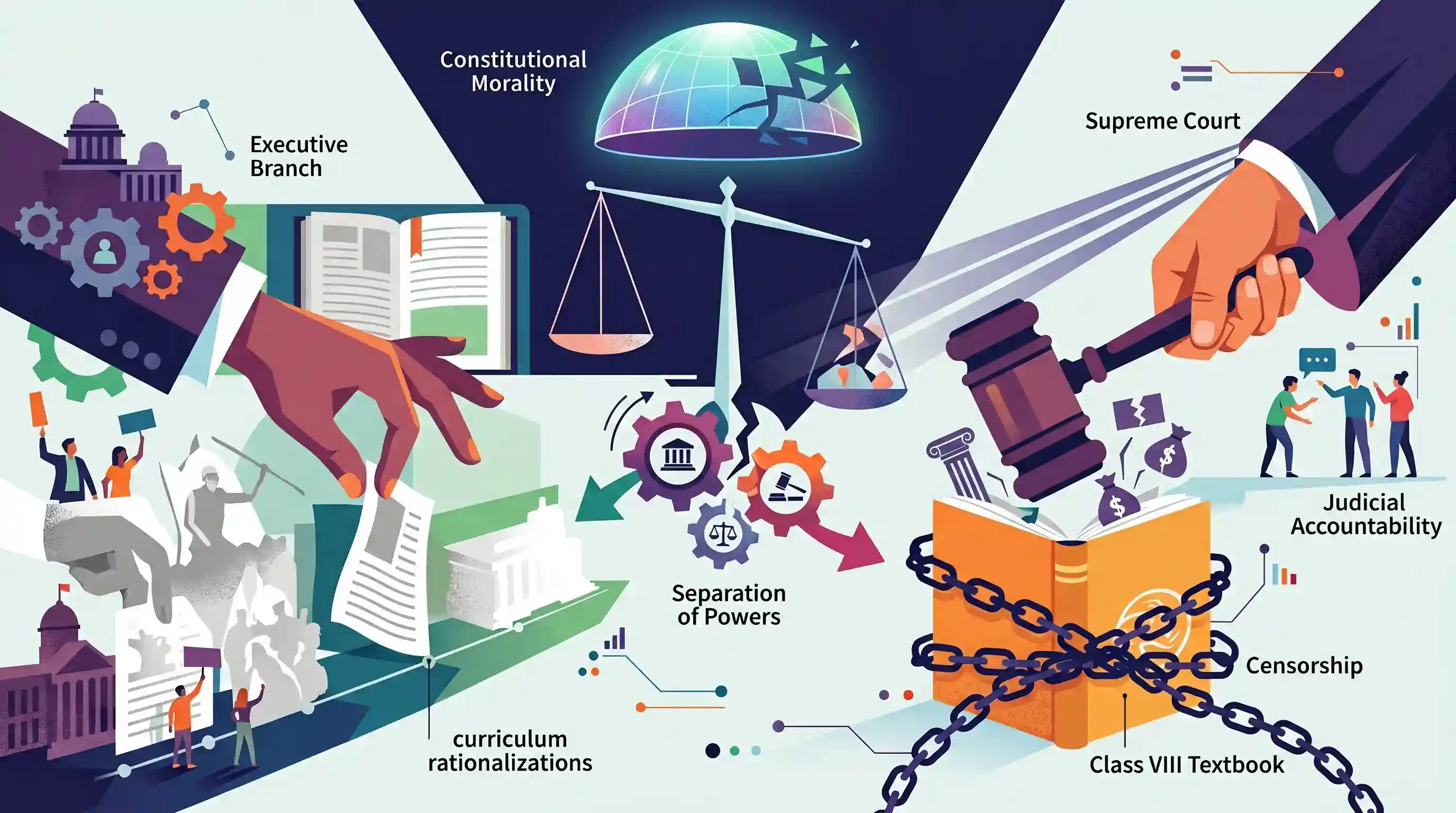
This case serves as a contemporary example of the tension between judicial independence and judicial accountability, a core theme in UPSC GS2. It also touches on the limits of judicial intervention (overreach versus checks and balances) and highlights the ongoing controversies surrounding educational curriculum design (NCERT rationalization) and its implications for free speech.
Summary
The article critiques the Supreme Court's aggressive reaction to an NCERT Class VIII textbook that included references to 'judicial corruption.' While acknowledging that a middle-school textbook might not be the best platform for such sweeping allegations, the editorial argues that the Court's response—issuing contempt notices and threatening to ban the book—is disproportionate and resembles censorship. It places this incident within the broader context of ongoing, politically motivated curriculum 'rationalizations' by the Executive, which have erased critical historical events from textbooks. Ultimately, the piece emphasizes the delicate balance between protecting judicial independence and accountability, asserting that contempt powers should not be used to suppress educational content or infringe upon the separation of powers.
Key Points
- The Supreme Court strongly objected to an NCERT Class VIII textbook mentioning 'judicial corruption,' issuing contempt notices and demanding the book's withdrawal.
- While introducing sweeping claims of corruption to middle-schoolers might be poor pedagogy, the Court's heavy-handed use of contempt powers borders on censorship and judicial overreach.
- The incident highlights a tension between safeguarding institutional reputation (judicial probity) and respecting the fundamental right to free expression.
- This judicial intervention occurs against a backdrop of politically contentious 'rationalizations' by NCERT, where the Executive has systematically deleted topics like the Gujarat riots, Mughal history, and caste discrimination from curricula.
- The episode raises significant questions regarding the separation of powers and the extent to which the judiciary should intervene in academic or executive functions like curriculum design.
Important Terms
Contempt of Courts Act, 1971

A 1971 law defining powers to punish for civil (disobedience of orders) or criminal (scandalizing the court) contempt. It balances judicial dignity with freedom of speech.
UPSC context
GS Paper II: Judiciary. Tests knowledge of judicial independence, Article 129/215, and reasonable restrictions on free speech under Article 19(2).
Supreme Court of India
India's apex judicial body and a 'Court of Record' under Article 129. It acts as the final interpreter of the Constitution and protector of Fundamental Rights.
UPSC context
GS Paper II: Structure and functioning of the Judiciary. Vital for understanding separation of powers and judicial review.
National Council of Educational Research and Training (NCERT)
An autonomous government organization established in 1961 to advise on school education and develop the National Curriculum Framework and model textbooks.
UPSC context
GS Paper II: Issues relating to Education. Relevant for discussions on curriculum 'rationalization' and executive influence on educational content.
Suo Motu Cognizance
The court's power to initiate legal proceedings on its own motion without a formal petition from an aggrieved party.
UPSC context
GS Paper II: Judicial Activism. Tests understanding of the court's proactive role in addressing public interest or institutional threats.
Separation of Powers
The principle that the three branches of government (Legislative, Executive, Judiciary) have separate powers and stay within their constitutional boundaries.
UPSC context
GS Paper II: Constitutional Morality. Tests the ability to analyze overlaps or friction between the Judiciary and the Executive.
Prelims Trap
The Constitution of India defines both civil and criminal contempt of court under Article 129.
Articles 129 and 215 grant the SC and HCs the power to punish for contempt, but the exact definitions are found only in the Contempt of Courts Act, 1971.
Static Concepts Connected
How is 'Contempt of Court' regulated under Indian law?
- Constitutional Backing: Articles 129 (SC) and 215 (HCs) declare them courts of record with the inherent power to punish for their contempt.
- Free Speech Restriction: Article 19(2) explicitly lists contempt of court as a ground for reasonable restriction on the freedom of speech and expression.
- Statutory Definition: The Contempt of Courts Act, 1971 defines and categorizes contempt into civil (willful disobedience) and criminal (scandalizing the court).
What is Judicial Overreach?
- Definition: When the judiciary crosses its constitutional limits and usurps the functions assigned to the executive or legislature.
- Policy Interference: Interfering in executive policy matters like textbook design or curriculum, which do not inherently violate fundamental rights, is often cited as overreach.
- Basic Structure Violation: It violates the Separation of Powers, which is a recognized part of the Basic Structure of the Indian Constitution.
Cross-Topic Patterns
Judicial Overreach vs. Activism
SC dictating school curricula transitions from judicial activism (protecting rights) to overreach (usurping executive policy functions), a frequent GS-II Mains theme.
Education as an Ideological Tool
NCERT curriculum 'rationalizations' tie into GS-I Post-Independence history and GS-II governance, highlighting vulnerabilities in statutory educational bodies to political narratives.

A 2026 GS-II Mains question will likely test the boundary between judicial activism and overreach using contempt powers.
Linked PYQs · 4
Linked PYQs · 4
- 2025MainsGS2
"Constitutional morality is the fulcrum which acts as an essential check upon the high functionaries and citizens alike...." In view of the above observation of the Supreme Court, explain the concept of constitutional morality and its application to ensure balance between judicial independence and judicial accountability in India.
- 2019MainsGS2
Do you think that Constitution of India does not accept principle of strict separation of powers rather it is based on the principle of 'checks and balance'? Explain.
- 2025MainsGS4
"Constitutional morality is not a natural sentiment but a product of civil education and adherance of the rule of law." Examine the significance of constitutional morality for public servant highlighting the role in promoting good governance and ensuring accountability in public administration.
- 2020MainsGS2
Judicial Legislation is antithetical to the doctrine of separation of powers as envisaged in the Indian Constitution. In this context justify the filing of large number of public interest petitions praying for issuing guidelines to executive authorities.
