India Strategic Autonomy Amidst Unilateral US Sanctions In West Asia
Source:The Hindu ↗
Why It Matters
It highlights the constant diplomatic tightrope India must walk between accommodating the US for economic and technological benefits and asserting its strategic autonomy to protect its core energy, connectivity, and geopolitical interests in a multipolar world.
Summary
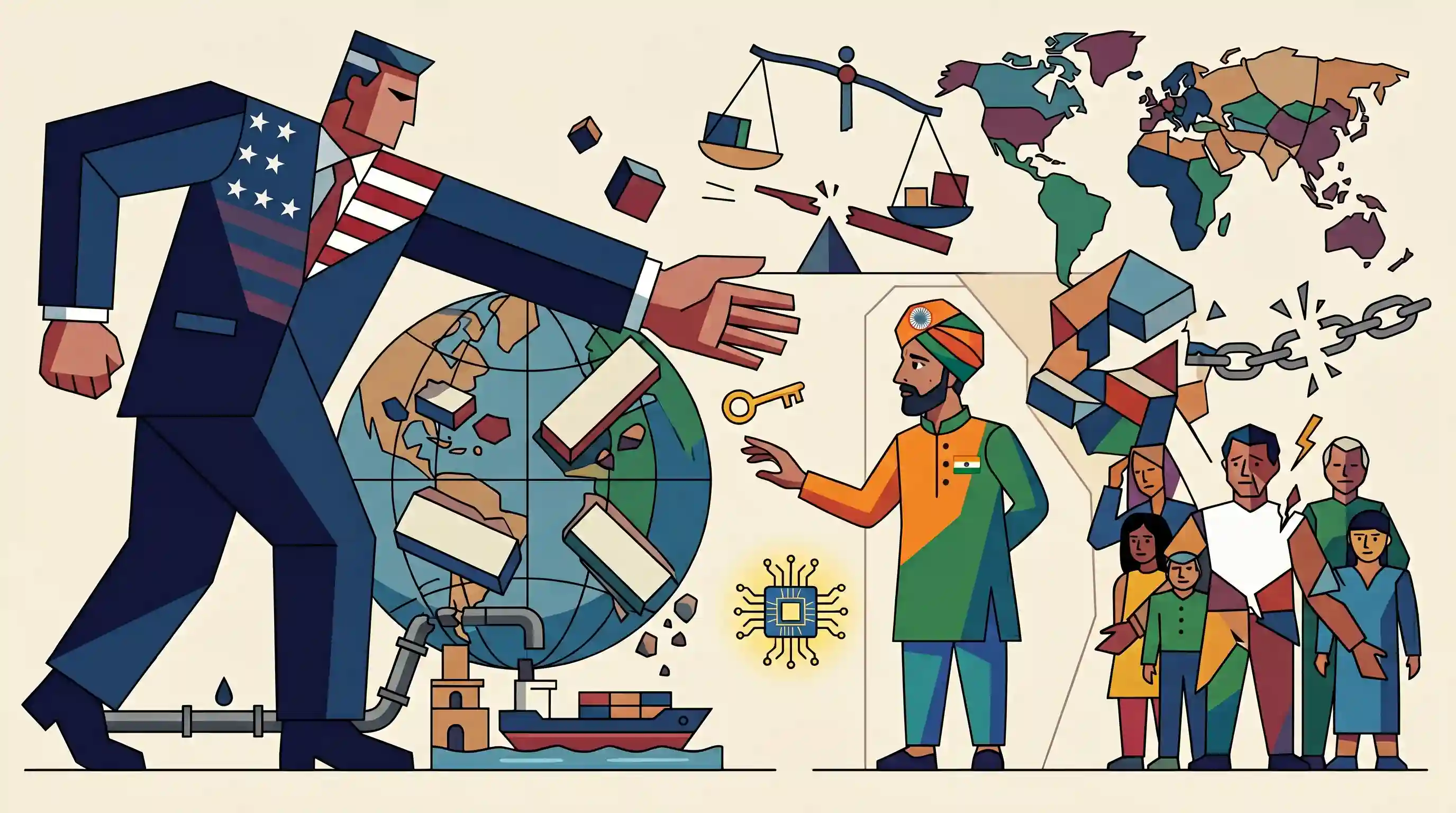
The editorial critiques the Indian government's silence on sweeping unilateral geopolitical maneuvers by the United States under the Trump administration. Despite US actions that disrupt global trade and directly threaten India's interests—such as extraterritorial sanctions on Iran, which jeopardize India's energy security and its strategic investments in the Chabahar port—New Delhi has opted for appeasement. This muted response is reportedly motivated by India's eagerness to secure a Bilateral Trade Agreement and join the 'Pax Silica' high-technology partnership. However, the piece warns that compromising strategic autonomy for bilateral gains undermines India's standing in a multipolar world order and its role as a voice for the Global South, particularly as it prepares to host the BRICS+ Summit.
Key Points
- The new US administration under Donald Trump has initiated unilateral actions, including blockading Venezuela, seeking to acquire Greenland, and imposing extraterritorial sanctions against Russia and Iran.
- India has maintained a muted stance regarding these disruptions, refraining from criticizing Washington to preserve bilateral goodwill.
- New Delhi's silence is driven by the desire to finalize a Bilateral Trade Agreement (BTA) with the US and join the US-led high-technology partnership, 'Pax Silica'.
- The US threats and sanctions against Iran jeopardize India's energy security, its investments in the Chabahar port, and regional connectivity via the Middle East.
- The editorial contends that appeasing the US compromises India's strategic autonomy and diminishes its stature as a leader of the Global South, especially ahead of hosting the BRICS+ Summit.
Important Terms
Strategic Autonomy

India's ability to pursue national interests and make independent foreign policy or defense decisions without being constrained by external pressures or formal military alliances.
UPSC context
GS-2 (International Relations); foundational principle of India's multi-alignment strategy and sovereign decision-making in a multipolar world.
Pax Silica
A U.S.-led strategic coalition (launched 2025) designed to secure global supply chains for semiconductors, AI, and critical minerals, specifically to reduce technological dependence on China.
UPSC context
GS-2 (Global Groupings); tests India's participation in high-tech "minilateral" frameworks and its impact on technological sovereignty.
Extraterritorial Sanctions
Unilateral penalties (secondary sanctions) imposed by a country on third-party nations or entities for engaging in trade with a primary sanctioned target, such as Iran.
UPSC context
GS-2 (Bilateral Relations/Effect of Policies of Developed Countries); impacts India's energy security and strategic investments like the Chabahar Port.
Chabahar Port
A strategic deep-sea port in Iran developed with Indian investment to bypass Pakistan, providing trade access to Afghanistan, Central Asia, and the North-South Transport Corridor.
UPSC context
GS-2 (India and its neighborhood); key for regional connectivity, bypassing Pakistan, and countering China's Gwadar Port influence.
Global South
A collective term for developing nations in Asia, Africa, and Latin America, highlighting shared histories of colonialism and a push for equitable global governance.
UPSC context
GS-2 (Global Groupings); essential for India's identity as a bridge-builder and advocate for developing nations' interests in international forums.
BRICS
A group of major emerging economies (originally Brazil, Russia, India, China, South Africa) seeking to reform global governance and promote a multipolar world order.
UPSC context
GS-2 (International Groupings); platform for non-Western cooperation and alternative financial architectures like the New Development Bank.
Bilateral Trade Agreement (BTA)
A formal economic treaty between two nations to reduce or eliminate trade barriers like tariffs and quotas to facilitate mutual trade and investment.
UPSC context
GS-3 (Economy/Liberalization); relevant to India's pursuit of market access and export diversification with key partners like the U.S. and UK.
Prelims Trap
"U.S. extraterritorial sanctions on Iran and Russia are binding on all UN member states under international law."
U.S. sanctions are unilateral, not UN-mandated. They force global compliance practically through US dollar dominance and banking access, but hold no legal standing in international law for third parties like India.
Static Concepts Connected
How do extraterritorial (secondary) sanctions operate against third-party nations?
- Mechanism: They penalize third parties (like Indian firms) for engaging economically with a sanctioned country (like Iran).
- Financial Leverage: The sanctioning country blocks the third party from accessing its domestic financial system, leveraging tools like SWIFT and US Dollar dominance.
- UPSC Example: CAATSA (Countering America’s Adversaries Through Sanctions Act) is a prime example, often threatening India's defense procurement from Russia.
What is the strategic framework of the International North-South Transport Corridor (INSTC)?
- Multi-mode Network: It is a 7,200-km multi-mode network of ship, rail, and road routes for moving freight.
- Key Nodes: It connects India, Iran, Azerbaijan, Russia, Central Asia, and Europe, aiming to reduce transit time and costs.
- Chabahar's Role: India's investment in Iran's Chabahar Port is crucial for the INSTC, providing a direct bypass around Pakistan to access Afghanistan and Central Asia.
Cross-Topic Patterns
Tech-diplomacy: Pax Silica & iCET convergence
US-led high-tech partnerships (like Pax Silica and iCET) act as geopolitical leverage, increasingly merging India's Science & Tech syllabus with International Relations and supply-chain resilience.
Global South leadership vs US alignment
India's tactical silence on unilateral US moves to secure bilateral trade directly contrasts with its vocal advocacy for multipolarity and sovereign equality in forums like BRICS and the G20.

Expect a 2026 Mains question on the friction between India's Global South leadership (BRICS+) and its techno-economic alignment with the US.
Linked PYQs · 5
Linked PYQs · 5
- 2019MainsGS2
‘What introduces friction into the ties between India and the United States is that Washington is still unable to find for India a position in its global strategy, which would satisfy India's national self-esteem and ambitions.’ Explain with suitable examples.
- 2018MainsGS2
In what ways would the ongoing US-Iran Nuclear Pact Controversy affect the national interest of India? How should India respond to this situation?
- 2025MainsGS2
"Energy security constitutes the dominant kingpin of India's foreign policy, and is linked with India's overarching influence in Middle Eastern countries.” How would you integrate energy security with India's foreign policy trajectories in the coming years?
- 2017PrelimsGS1
What is the importance of developing Chabahar Port by India?
- 2025PrelimsGS1
India is one of the founding members of the International North-South Transport Corridor (INSTC), a multimodal transportation corridor, which will connect
