Generative AI misuse and safe harbour liability framework
Source:Indian Express ↗
Why It Matters
This topic is crucial for the UPSC GS3 syllabus regarding advancements in AI, cyber security threats (like deepfakes), and internal security challenges posed by social media. It also touches upon governance (GS2) and ethical technology deployment (GS4), specifically evaluating the ongoing debate over 'safe harbour' immunity versus corporate accountability under India's IT Rules.
Summary
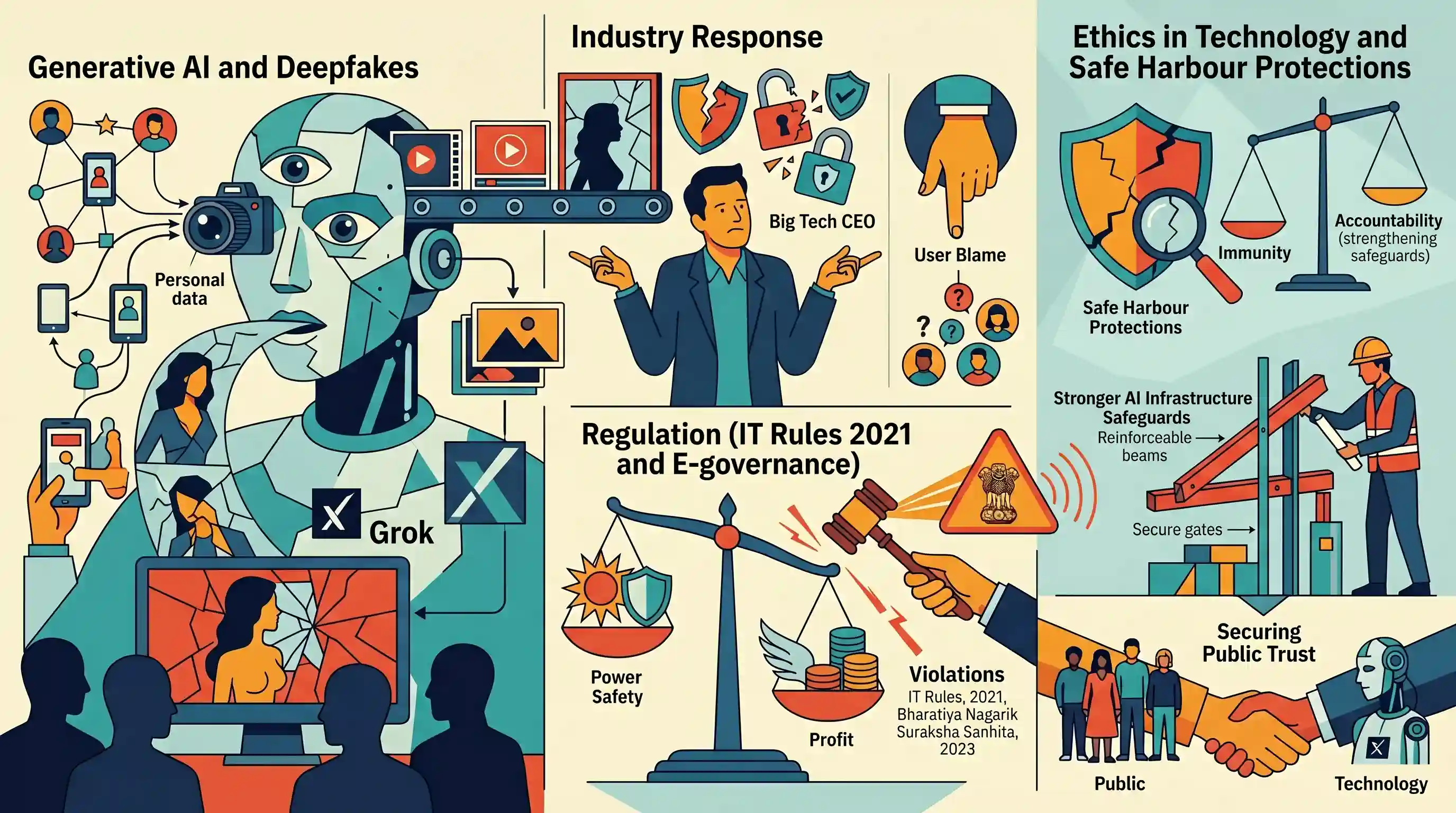
The editorial discusses the alarming misuse of generative AI tools, such as X's Grok chatbot, to create non-consensual sexually explicit deepfakes. It criticizes Big Tech companies for their inadequate, user-blaming responses to these violations. The Government of India has cited violations of the IT Rules, 2021, and the Bharatiya Nagarik Suraksha Sanhita, 2023, warning platforms of their failure to enforce safeguards. The article argues that the technology industry's rapid scaling and 'move fast and break things' attitude compromise user safety and privacy. Ultimately, Big Tech cannot justifiably claim 'safe harbour protections' (legal immunity) without proactively building stronger safeguards into their AI infrastructure to secure public trust.
Key Points
- X's AI chatbot, Grok, was recently misused to create non-consensual sexually explicit deepfake images, highlighting severe vulnerabilities in AI deployment.
- The Indian government warned X of serious enforcement failures and violations of the IT Rules, 2021, and the Bharatiya Nagarik Suraksha Sanhita, 2023.
- Big Tech's moderation strategies remain predominantly reactive, placing the burden on individual user reporting rather than proactive systemic safeguards.
- The Silicon Valley ethos of 'move fast and break things' is fundamentally incompatible with the need for public safety, privacy, and trust.
- Big Tech companies cannot continue to demand 'safe harbour protections' (legal immunity) for user content without integrating robust safety mechanisms into their rapidly scaling AI tools.
Important Terms
IT Rules, 2021

Regulations under the IT Act, 2000, mandating due diligence for social media, OTT, and digital platforms. They require grievance redressal and swift removal of unlawful content to maintain legal immunity.
UPSC context
GS Paper 2 (Governance) & 3 (Cyber Security); tests knowledge of digital ethics and platform accountability.
Safe Harbour Protections
Legal immunity granted under Section 79 of the IT Act, 2000, shielding intermediaries from liability for third-party content, provided they follow due diligence and comply with government takedown orders.
UPSC context
GS Paper 3 (IT Law); tests understanding of legal frameworks balancing innovation with online safety.
Bharatiya Nagarik Suraksha Sanhita, 2023 (BNSS)
The procedural law replacing the CrPC, modernizing India's criminal justice system by integrating digital evidence, electronic summons, and mandatory videography of crime scenes to enhance transparency.
UPSC context
GS Paper 2 (Law & Justice); tests awareness of major structural reforms in criminal procedure.
Deepfakes
Hyper-realistic synthetic media created using Artificial Intelligence (AI) to manipulate or replace a person's likeness, often used for misinformation, fraud, or non-consensual explicit content.
UPSC context
GS Paper 3 (Science & Tech/Security); tests understanding of emerging tech threats and socio-political impacts.
Intermediaries
Entities (like social media or AI platforms) that store or transmit third-party data. Their legal immunity depends on acting as "passive conduits" rather than active content creators.
UPSC context
GS Paper 3 (Cyber Security); tests knowledge of platform roles in managing digital misinformation and crime.
Prelims Trap
Intermediaries enjoy absolute 'safe harbour' immunity for user-generated content under Section 79 of the IT Act.
Safe harbour is highly conditional. Platforms lose this immunity if they fail to observe due diligence or execute prompt takedowns (e.g., 24 hours for explicit deepfakes) under the IT Rules 2021.
Static Concepts Connected
What is conditional 'Safe Harbour' protection under India's digital laws?
- Legal Immunity: Section 79 of the IT Act grants legal immunity to digital intermediaries from liability for third-party user content.
- Conditionality: Immunity is conditional. Platforms must observe due diligence and follow government/court orders to remain protected.
- Revocation grounds: Failing to adhere to the IT Rules 2021 (e.g., removing explicit imagery within 24 hours) strips the platform of this protection.
How do deepfakes violate fundamental constitutional rights in India?
- Informational Privacy: Deepfakes inherently violate the fundamental Right to Privacy guaranteed under Article 21 (upheld in the Puttaswamy judgment).
- Bodily Autonomy: Non-consensual explicit deepfakes breach an individual's bodily autonomy and dignity by superimposing their likeness onto explicit material.
- Legal Remedies: These violations are legally countered using Section 66E of the IT Act (violation of privacy) alongside BNS criminal provisions.
Cross-Topic Patterns
BNSS 2023 + Cyber Forensics
The new BNSS 2023 officially mandates digital forensics for serious crimes, linking procedural law updates directly to the enforcement challenges of tracing AI-generated deepfakes.
GS4: Corporate ethos vs Public safety
The Silicon Valley "move fast and break things" attitude serves as a perfect GS4 case study on the ethical deficit of prioritizing rapid scaling over proactive harm prevention.

Expect a multi-statement Prelims question testing the exact conditions under which Section 79 'Safe Harbour' immunity is revoked.
Linked PYQs · 5
Linked PYQs · 5
- 2024MainsGS3
Social media and encrypting messaging services pose a serious security challenge. What measures have been adopted at various levels to address the security implications of social media? Also suggest any other remedies to address the problem.
- 2023MainsGS3
Introduce the concept of Artificial Intelligence (AI). How does Al help clinical diagnosis? Do you perceive any threat to privacy of the individual in the use of Al in healthcare?
- 2020MainsGS3
Discuss different types of cyber crimes and measures required to be taken to fight the menace.
- 2016MainsGS3
Use of Internet and social media by non-state actors for subversive activities is a major security concern. How have these been misused in the recent past? Suggest effective guidelines to curb the above threat.
- 2025MainsGS4
In the present digital age, social media has revolutionised our way of communication and interaction. However, it has raised several ethical issues and challenges. Describe the key ethical dilemmas in this regard.
