Gravitational Dynamics and Spacetime Curvature in Earth Orbital Motion
Source:The Hindu ↗
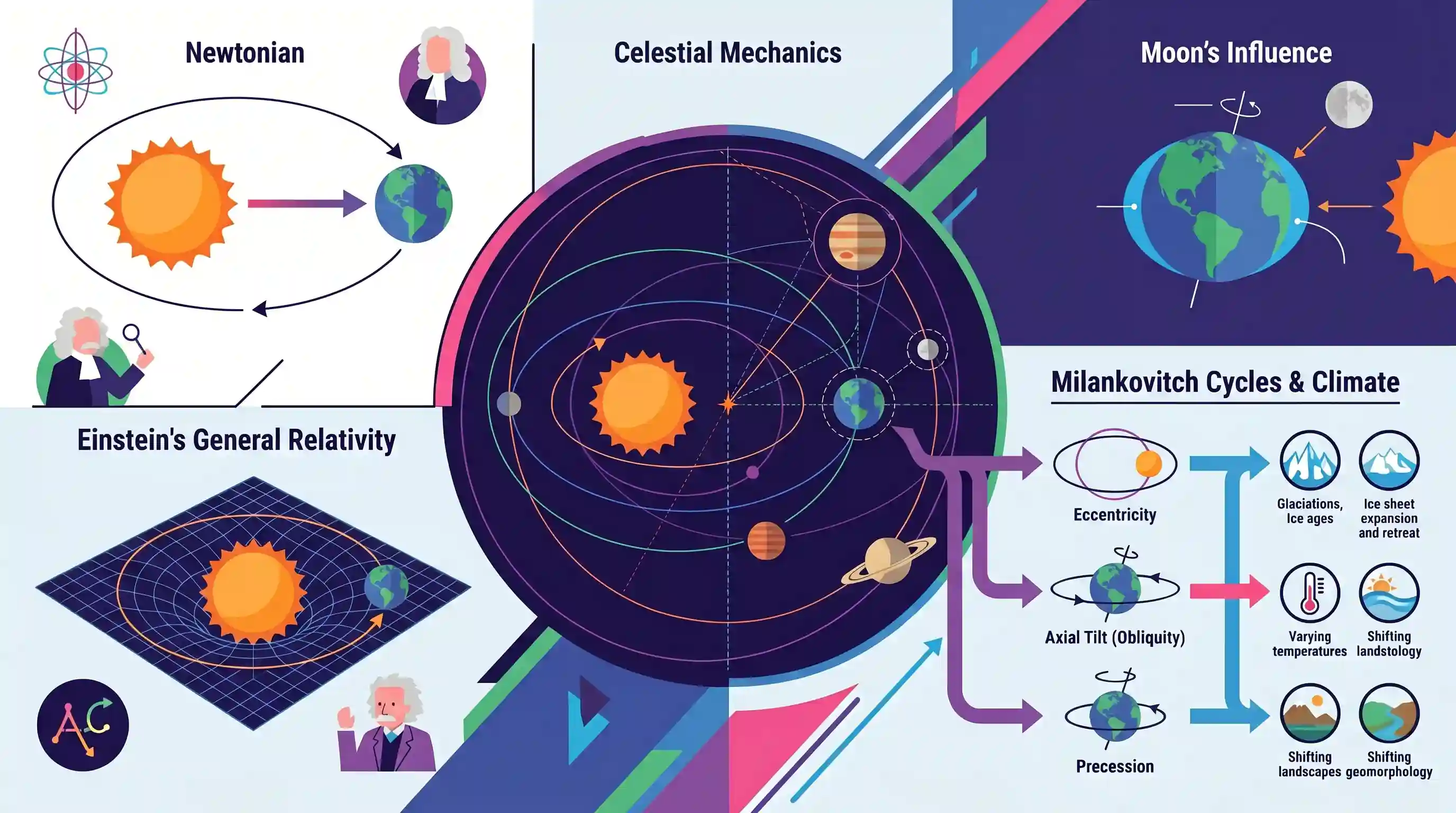
Why It Matters
Provides a foundational scientific understanding of gravity, orbital mechanics, and relativity—core concepts tested in UPSC Prelims Science & Tech and Geography. It also bridges space physics with physical geography by linking celestial gravity to Earth's climate cycles.
Summary
The article explores the mechanics of Earth's journey through space, focusing on the central role of gravity from both classical and modern physical perspectives. While Newtonian mechanics describes the Sun's gravity as a centripetal force tethering Earth in an elliptical orbit, Einstein's General Relativity reframes this motion as Earth traveling along the natural contours of a spacetime fabric warped by the Sun's immense mass. The dynamics of our orbit are further complicated by the barycenter—the actual center of mass of the solar system—and the gravitational influence of other bodies. The Moon's gravity stabilizes Earth's wobble, ensuring stable seasons and driving tides, while the pull of larger planets like Jupiter creates subtle orbital variations known as Milankovitch cycles, which profoundly influence Earth's long-term climate and ice age epochs.
Key Points
- Gravity is the fundamental interaction keeping Earth in its elliptical orbit around the Sun, functioning as a centripetal force in classical Newtonian mechanics.
- Under Albert Einstein's General Theory of Relativity, Earth's orbit is understood as the planet following a geodesic—the straightest possible path—through spacetime that has been curved by the Sun's massive mass.
- The Earth and Sun do not orbit the Sun's exact center; rather, they orbit a common center of mass known as the barycenter, which lies deep within the Sun.
- Gravitational perturbations from other celestial bodies, particularly the Moon and giant planets like Jupiter, influence Earth's orbital eccentricity and axial tilt, contributing to Milankovitch cycles that drive long-term climatic shifts.
- The Moon's gravitational pull is crucial for Earth's habitability, as it stabilizes the planet's axial tilt (ensuring predictable seasons) and drives the oceanic tides.
Prelims Trap
The Earth orbits the exact geometric center of the Sun.
Earth actually orbits the barycenter—the solar system's shared center of mass. Due to massive planets like Jupiter, this point constantly shifts and can lie outside the Sun.
Static Concepts Connected
What are the three components of Milankovitch cycles affecting Earth's climate?
- Eccentricity: The shape of Earth's orbit shifts from circular to elliptical over 100,000 years, driven by the gravitational pulls of giant planets like Jupiter.
- Obliquity: The angle of Earth's axial tilt varies between 22.1° and 24.5° over 41,000 years, dictating the severity and distribution of our seasons.
- Precession: Earth wobbles like a spinning top over a 26,000-year cycle, gradually altering which hemisphere faces the Sun when closest to it (perihelion).
How does General Relativity redefine planetary gravity compared to Newton?
- Newtonian View: Treats gravity as an invisible, attractive centripetal force acting across a distance to tether planets in their elliptical orbits.
- Einstein's View: Massive objects like the Sun warp spacetime. Planets are not 'pulled' but simply follow geodesics—the straightest possible paths in curved space.
Cross-Topic Patterns
Milankovitch cycles and historical Ice Ages
Astronomical orbital variations form the baseline for natural paleoclimatology, essential for contrasting historical glacial-interglacial periods with modern anthropogenic global warming.
Lunar gravity and Exoplanet habitability
The Moon's stabilization of Earth's axial wobble is now a critical parameter in astrophysics when evaluating the potential seasonal stability and habitability of newly discovered exoplanets.

A 2026 Prelims question will likely pair Milankovitch orbital cycles with historical glacial epochs and planetary gravitational forces.
Linked PYQs · 5
Linked PYQs · 5
- 2018PrelimsGS1
Consider the following phenomena : 1. Light is affected by gravity. 2. The Universe is constantly expanding. 3. Matter warps its surrounding space-time. Which of the above is/are the prediction/predictions of Albert Einstein's General Theory of Relativity, often discussed in media ?
- 2019PrelimsGS1
Recently, scientists observed the merger of giant 'blackholes' billions of light-years away from the Earth. What is the significance of this observation?
- 2025PrelimsGS1
Consider the following statements : Statement I: Scientific studies suggest that a shift is taking place in the Earth's rotation and axis. Statement II: Solar flares and associated coronal mass ejections bombarded the Earth's outermost atmosphere with tremendous amount of energy. Statement III : As the Earth's polar ice melts, the water tends to move towards the equator. Which one of the following is correct in respect of the above statements?
- 2017PrelimsGS1
The terms 'Event Horizon', 'Singularity', 'String Theory' and 'Standard Model' are sometimes seen in the news in the context of
- 2010PrelimsGS1
What causes wind to deflect toward left in the Southern hemisphere?
