Geopolitical Conflicts and India Macroeconomic Vulnerabilities
Source:The Hindu ↗
Why It Matters
This article serves as an excellent contemporary case study of how international conflicts translate into domestic economic stress, a recurring theme in both GS3 (Economy) and GS2 (International Relations). It provides concrete data points—such as the exchange rate drop and crude price spikes—that are highly useful for substantiating arguments on energy security, inflation, and forex management in Mains answers.
Summary
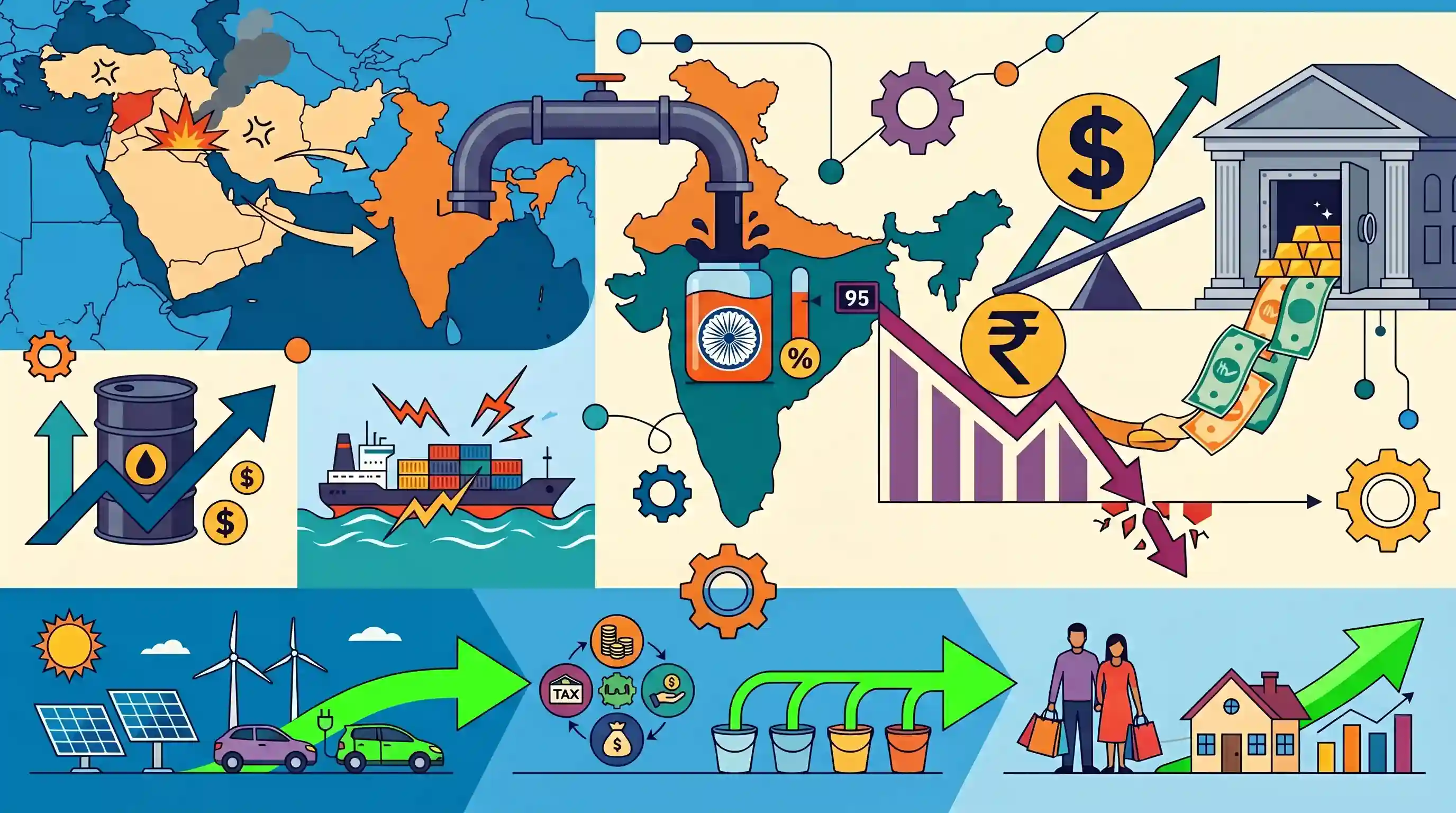
The article analyzes how escalating geopolitical tensions in West Asia are causing significant macroeconomic stress in India. Spikes in global crude oil prices and supply chain disruptions have pushed the rupee to a record low of ₹95 against the dollar, forcing the Reserve Bank of India to utilize its foreign exchange reserves to manage currency volatility. Given that India imports over 80% of its crude oil, the text advocates for urgent structural reforms to insulate the domestic economy from external shocks. These include diversifying energy sources, bolstering resilient revenue generation, and shifting towards income-led domestic demand to stabilize the nation's fiscal arithmetic.
Key Points
- Escalating geopolitical conflicts in West Asia are straining India's macroeconomic stability due to higher energy costs and shipping vulnerabilities.
- The Indian rupee depreciated to a historic low of ₹95 per US dollar, prompting the RBI to deploy significant foreign exchange reserves to mitigate currency volatility.
- India's heavy reliance on imported crude oil (over 80%) exposes its fiscal arithmetic to external price shocks, with the domestic crude basket reaching $156.29 per barrel.
- To insulate the economy from global shocks, India must structurally rebalance towards income-led demand, resilient revenue bases, and greater energy diversification.
Important Terms
Reserve Bank of India (RBI)

India’s central banking authority established under the RBI Act, 1934. It regulates monetary policy, supervises the financial system, manages foreign exchange, and acts as the banker to the government.
UPSC context
GS Paper 3: Indian Economy. Key for understanding monetary policy, inflation control, and financial stability.
Foreign Exchange (Forex) Reserves
Assets held by a central bank in foreign currencies (FCA), gold, Special Drawing Rights (SDRs), and IMF reserve positions to manage currency volatility and external debt obligations.
UPSC context
GS Paper 3: External Sector. Tests knowledge of balance of payments and currency stabilization mechanisms.
Exchange Rate Management
India's 'managed float' system where the exchange rate is primarily market-determined, but the RBI intervenes by buying or selling dollars to prevent excessive rupee volatility.
UPSC context
GS Paper 3: Economic Development. Crucial for topics like CAD, exports, and rupee-dollar dynamics.
Energy Security
Ensuring the uninterrupted availability of energy sources at an affordable price. For India, this involves reducing high import dependence (over 80%) on crude oil through diversification.
UPSC context
GS Paper 3: Infrastructure and Energy. Focuses on strategic autonomy and sustainable economic growth.
Macroeconomic Stability
A state where an economy has minimized vulnerability to external shocks, characterized by stable inflation, sustainable fiscal deficits, and a balanced current account.
UPSC context
GS Paper 3: Indian Economy. Essential for analyzing growth prospects and fiscal prudence.
Fiscal Arithmetic
The mathematical constraints of a budget, involving the relationship between government revenue, expenditure, debt sustainability, and the targeted fiscal deficit-to-GDP ratio.
UPSC context
GS Paper 3: Government Budgeting. Tests the ability to analyze fiscal consolidation glide paths.
Prelims Trap
"Under the managed float system, the RBI intervenes to fix or peg the Indian Rupee to a specific value against the US dollar."
India's exchange rate is market-determined. The RBI intervenes strictly to contain excessive volatility and smooth out sudden shocks, not to defend a pre-determined fixed exchange rate.
Static Concepts Connected
How does the RBI manage exchange rate volatility under the managed float system?
- Market-determined: The Rupee's base value is primarily decided by market forces of demand and supply for foreign exchange.
- Forex Intervention: To arrest sharp currency depreciation, the RBI sells US dollars from its forex reserves, increasing dollar supply in the domestic market to stabilize the Rupee.
- Sterilization: RBI uses Open Market Operations to absorb or inject domestic liquidity, offsetting the impact of its forex market interventions on the domestic money supply.
What is 'Imported Inflation' and how does it impact India's macroeconomic framework?
- Cost-Push Mechanism: It occurs when a weakening domestic currency or surging global commodity prices make imported raw materials (like crude oil and fertilizers) more expensive in Rupee terms.
- Widening CAD: Sustained imported inflation widens the Current Account Deficit (CAD), as the total outflow of foreign currency to pay for inelastic imports outpaces export earnings.
Cross-Topic Patterns
West Asia conflict & subsidy burden
Maritime chokepoint risks and oil spikes directly inflate India's Current Account Deficit and push up the government's fertilizer and fuel subsidy bills, stressing FRBM targets.
Energy security & Green Hydrogen
Import vulnerability from over 80% crude dependency necessitates short-term buffers like expanding Strategic Petroleum Reserves (SPRs) alongside long-term structural shifts via the National Green Hydrogen Mission.

Expect a multi-statement question in 2026 linking Rupee depreciation, Imported Inflation, and RBI's sterilization mechanisms.
Linked PYQs · 4
Linked PYQs · 4
- 2022PrelimsGS1
With reference to the Indian economy, consider the following statements: 1. If the inflation is too high, Reserve Bank of India (RBI) is likely to buy government securities. 2. If the rupee is rapidly depreciating, RBI is likely to sell dollars in the market. 3. If interest rates in the USA or European Union were to fall, that is likely to induce RBI to buy dollars. Which of the statements given above are correct?
- 2019PrelimsGS1
Which one of the following is not the most likely measure the Government/RBI takes to stop the slide of Indian rupee?
- 2017MainsGS2
The question of India's Energy Security constitutes the most important part of India's economic progress. Analyze India's energy policy cooperation with West Asian countries.
- 2025MainsGS2
"Energy security constitutes the dominant kingpin of India's foreign policy, and is linked with India's overarching influence in Middle Eastern countries.” How would you integrate energy security with India's foreign policy trajectories in the coming years?
