Macroeconomic Assessment Requires Deeper Analysis of GDP Data Gaps
Source:Indian Express ↗
ఇది ఎందుకు ముఖ్యం
Understanding GDP data nuances and limitations is essential for civil services aspirants to critically analyze fiscal and monetary policy decisions, economic growth trends, and macroeconomic stability in India.
సారాంశం
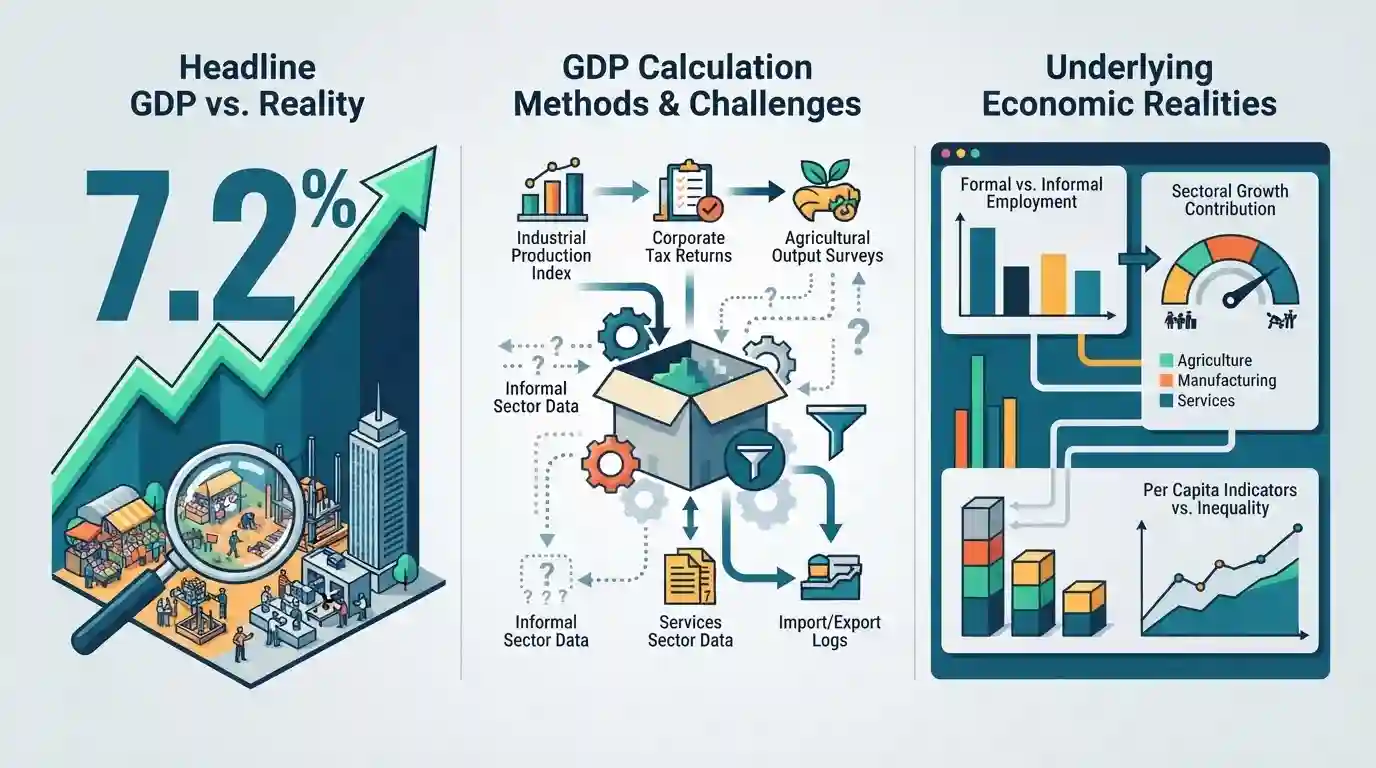
The article examines the complexities and challenges in interpreting India's GDP data, highlighting the need to look beyond headline figures and assess underlying economic realities, measurement issues, and structural data gaps.
ముఖ్య అంశాలు
- Discrepancies and gaps in GDP data reporting require a deeper analysis of underlying economic indicators beyond headline numbers.
- Issues with deflators, corporate performance tracking, and informal sector measurement affect accurate macroeconomic assessment.
- Reconciling Gross Value Added (GVA) and GDP growth numbers is vital for policymaking and assessing actual economic momentum.
ముఖ్యమైన పదాలు
Ministry of Statistics and Programme Implementation

The nodal central ministry responsible for the formulation and publication of national accounts, including Gross Domestic Product (GDP) and Gross Value Added (GVA) data in India.
UPSC context
UPSC Prelims/Mains (Economy) - Crucial for understanding official economic statistics, data methodologies, base years, and national income accounting.
RBI
India's central banking institution responsible for regulating the monetary policy, issuing currency, supervising the financial system, and providing economic growth forecasts.
UPSC context
UPSC Prelims/Mains (Economy) - Essential for questions on monetary policy, inflation targeting, economic growth projections, and macroeconomic stability.
ప్రిలిమ్స్ ఉచ్చు
GVA at basic prices and GVA at factor cost are identical measures used interchangeably in post-2015 macroeconomic reporting.
Aspirants often confuse GVA at basic prices with GVA at factor cost. GVA at basic prices includes production taxes less production subsidies, whereas factor cost excludes them entirely.
అనుసంధానమైన స్థిర భావనలు
What is the difference between GDP and GVA in India's national accounting framework?
- Output focus: Producer side: GVA measures economic activity from the producer side, calculated as total output minus intermediate consumption.
- Product taxes: Demand side: GDP is derived by adding net product taxes (taxes minus subsidies on products) to total GVA at basic prices.
- Policy utility: Policy utility: GVA reveals sector-wise supply-side momentum, while GDP highlights aggregate demand and expenditure patterns.
అంతర-అంశ నమూనాలు
GDP methodology vs. employment elasticity tracking
Discrepancies between GVA and expenditure GDP highlight structural data gaps in informal sector coverage, echoing long-standing challenges in measuring employment and output elasticity.
Corporate proxies and MSME monetary transmission
The reliance on corporate financial reporting proxies for informal sector performance mirrors monetary transmission puzzles where RBI policy rate changes bypass unorganised MSMEs.

Expect a statement-based prelims question on the structural distinction between GVA at basic prices and GDP, or deflator anomalies.
అనుసంధాన PYQలు · 2
అనుసంధాన PYQలు · 2
- 2021MainsGS3
Explain the difference between computing methodology of India's Gross Domestic Product (GDP) before the year 2015 and after the year 2015.
- 2020MainsGS3
Define potential GDP and explain its determinants. What are the factors that have been inhibiting India from realizing its potential GDP?
