Constituent Assembly Legacy and Presidential Address Insights
Source:Indian Express ↗
Why It Matters
The events surrounding the final session of the Constituent Assembly are fundamental to India's polity and modern history. UPSC frequently tests factual details regarding the Constituent Assembly (e.g., adoption dates of the Constitution and national symbols, election of the President) in Prelims, and the philosophical underpinnings of the Republic in Mains.
Summary
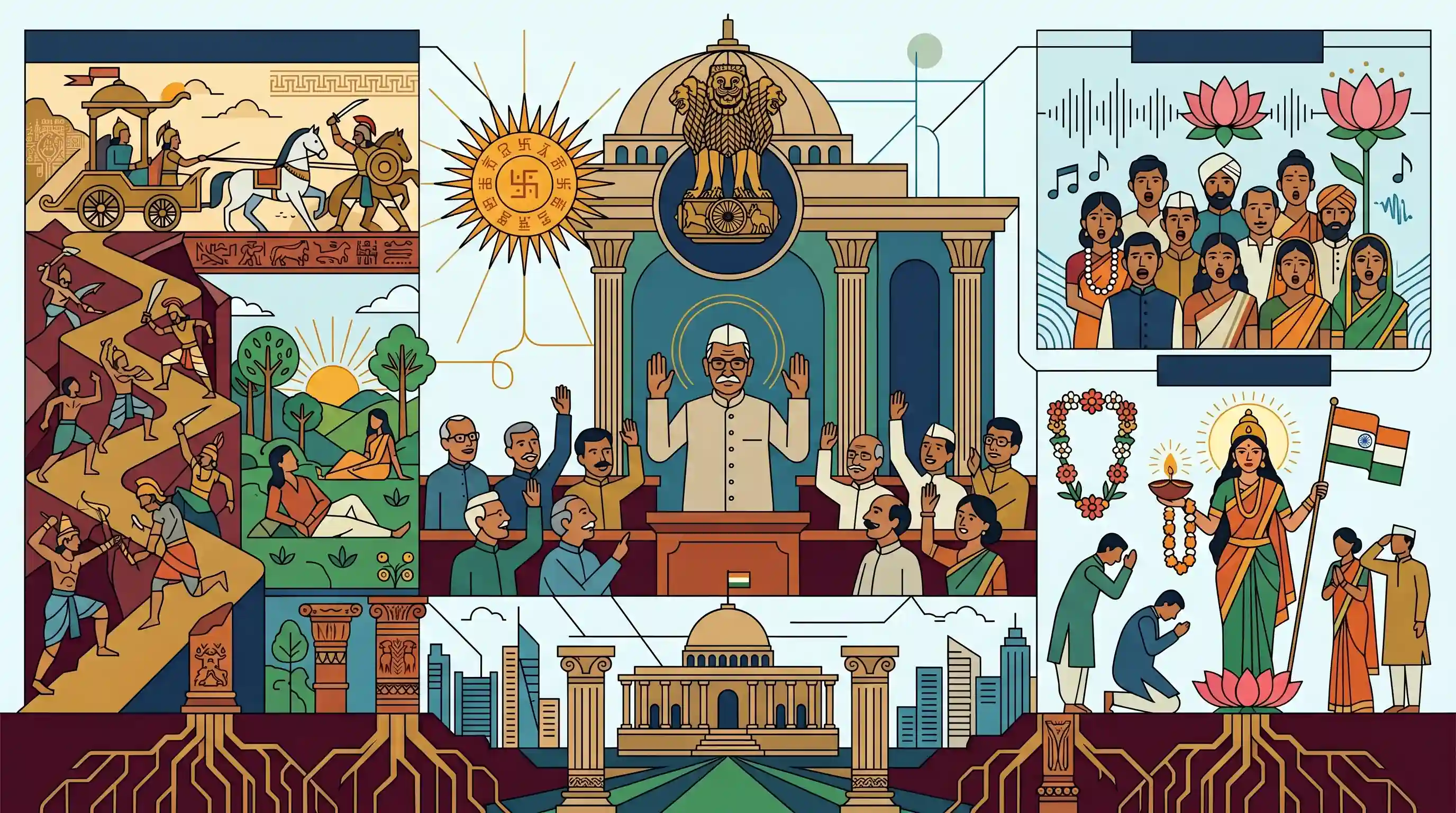
On the eve of India's first Republic Day, the Constituent Assembly met for the last time on January 24, 1950. In this historic session, key foundational decisions were made, including the unanimous election of Dr. Rajendra Prasad as the first President of India and the adoption of 'Jana Gana Mana' and 'Vande Mataram' as the National Anthem and National Song, respectively. Addressing the Assembly, Dr. Prasad invoked the epic Mahabharata, drawing parallels between the monumental effort of India's freedom struggle and the establishment of a just republic akin to the peace after the Kurukshetra war. The occasion underscored the grounding of the modern Indian constitutional republic in profound civilizational values.
Key Points
- January 24, 1950, marked the final session of the Constituent Assembly of India, two days before the Constitution formally came into effect on Republic Day.
- During this session, Dr. Rajendra Prasad was officially elected as the first President of the Republic of India.
- The Assembly officially adopted 'Jana Gana Mana' (composed by Rabindranath Tagore) as the National Anthem and 'Vande Mataram' (by Bankim Chandra Chatterjee) as the National Song.
- In his address, President Rajendra Prasad invoked the Mahabharata, likening the creation of the new republic following the freedom struggle to the establishment of a just order after the Kurukshetra war.
- The event highlights the blending of modern democratic institutional frameworks with ancient Indian civilizational ethos and values.
Important Terms
Constituent Assembly of India

A sovereign body elected in 1946 to draft India's Constitution. It also functioned as the country’s first legislature following independence until January 1950.
UPSC context
GS Paper II (Polity). Essential for understanding the democratic origins and the historical drafting process of the Indian state.
Constitution of India
The supreme law of India, adopted on Nov 26, 1949, and enforced on Jan 26, 1950. It establishes the nation as a sovereign, socialist, secular, and democratic republic.
UPSC context
GS Paper II (Polity). The core pillar of the syllabus; tests fundamental rights, structures, and constitutional morality.
Dr. Rajendra Prasad
India's first President and the President of the Constituent Assembly. He steered the assembly's deliberations and symbolised the transition from a dominion to a republic.
UPSC context
GS Paper I (History) & Paper II. Key figure in post-independence consolidation and the evolution of the Presidency.
Jana Gana Mana
India's National Anthem, composed by Rabindranath Tagore and adopted on Jan 24, 1950. It reflects the unity and pluralistic ethos of the nation.
UPSC context
GS Paper II (Polity) & Prelims. Important for understanding national symbols and their legal/constitutional adoption.
Vande Mataram
India's National Song, written by Bankim Chandra Chatterjee. It was accorded equal status to the anthem on Jan 24, 1950, honoring its role in the freedom movement.
UPSC context
GS Paper I (History) & Paper II. Tests knowledge of cultural symbols and historical inspirations of the independence struggle.
January 24, 1950
The date of the Constituent Assembly's final meeting where members signed the Constitution and elected Dr. Rajendra Prasad as India's first President.
UPSC context
GS Paper I & II. A specific historical milestone often tested in Prelims regarding the final acts of the Assembly.
Provisional Parliament
The status assumed by the Constituent Assembly from Jan 26, 1950, until the first general elections in 1952, serving as India's temporary unicameral legislature.
UPSC context
GS Paper II (Polity). Tests understanding of the transition of legislative authority during India's early post-independence governance.
Prelims Trap
The Constituent Assembly dissolved completely on January 26, 1950, ceasing all functions.
The Constituent Assembly did not dissolve entirely; it transformed into the Provisional Parliament of India, functioning as the legislature until the first elected Parliament convened in 1952.
Static Concepts Connected
When did the Constituent Assembly adopt India's primary national symbols?
- National Flag: Adopted on July 22, 1947, shortly before Independence.
- Anthem and Song: 'Jana Gana Mana' and 'Vande Mataram' were officially adopted during the Assembly's final session on January 24, 1950.
- State Emblem: Adopted on January 26, 1950, adapted from the Lion Capital of Ashoka at Sarnath.
What were the dual roles performed by the Constituent Assembly?
- Constitution Making: Tasked with drafting the Constitution, it met under the presidency of Dr. Rajendra Prasad.
- Legislative Body: Acted as India's first Parliament to enact ordinary laws, chaired by G.V. Mavalankar.
- Provisional Parliament: Following January 26, 1950, it shed its constitution-making role and acted exclusively as the Provisional Parliament.
Cross-Topic Patterns
Dharma and modern constitutional morality
Dr. Prasad's Mahabharata reference highlights the UPSC theme of linking modern democratic concepts (welfare, justice) to ancient Indian political texts like the Shanti Parva.
National Movement's cultural legacy
The adoption of 'Vande Mataram' reflects a cultural continuum—from its debut at the 1896 INC session and prominence in the 1905 Swadeshi movement to the foundational identity of the Republic.

Chronological ordering of Constituent Assembly milestones (Flag, Anthem, final session) combined with its dual-role function is highly probable.
Linked PYQs · 3
Linked PYQs · 3
- 2024PrelimsGS1
Who was the Provisional President of the Constituent Assembly before Dr. Rajendra Prasad took over?
- 2023PrelimsGS1
Consider the following statements in respect of the Constitution Day: Statement-I: The Constitution Day is celebrated on 26th November every year to promote constitutional values among citizens. Statement-II: On 26th November, 1949, the Constituent Assembly of India set up a Drafting Committee under the Chairmanship of Dr. B. R. Ambedkar to prepare a Draft Constitution of India. Which one of the following is correct in respect of the above statements?
- 2021PrelimsGS1
What was the exact constitutional status of India on 26th January, 1950?
