Delimitation freeze and parliamentary seats representation debate
Source:The Hindu ↗
Why It Matters
The intersection of delimitation, women's reservation, and federalism is a critical issue. It highlights the tension between demographic shifts and equitable political representation. Questions can arise on the implications of Article 81, the rationale behind the freeze on delimitation, the provisions of the Nari Shakti Vandan Adhiniyam, and the ongoing debate regarding the political weight of Southern versus Northern states in the Lok Sabha.
Summary
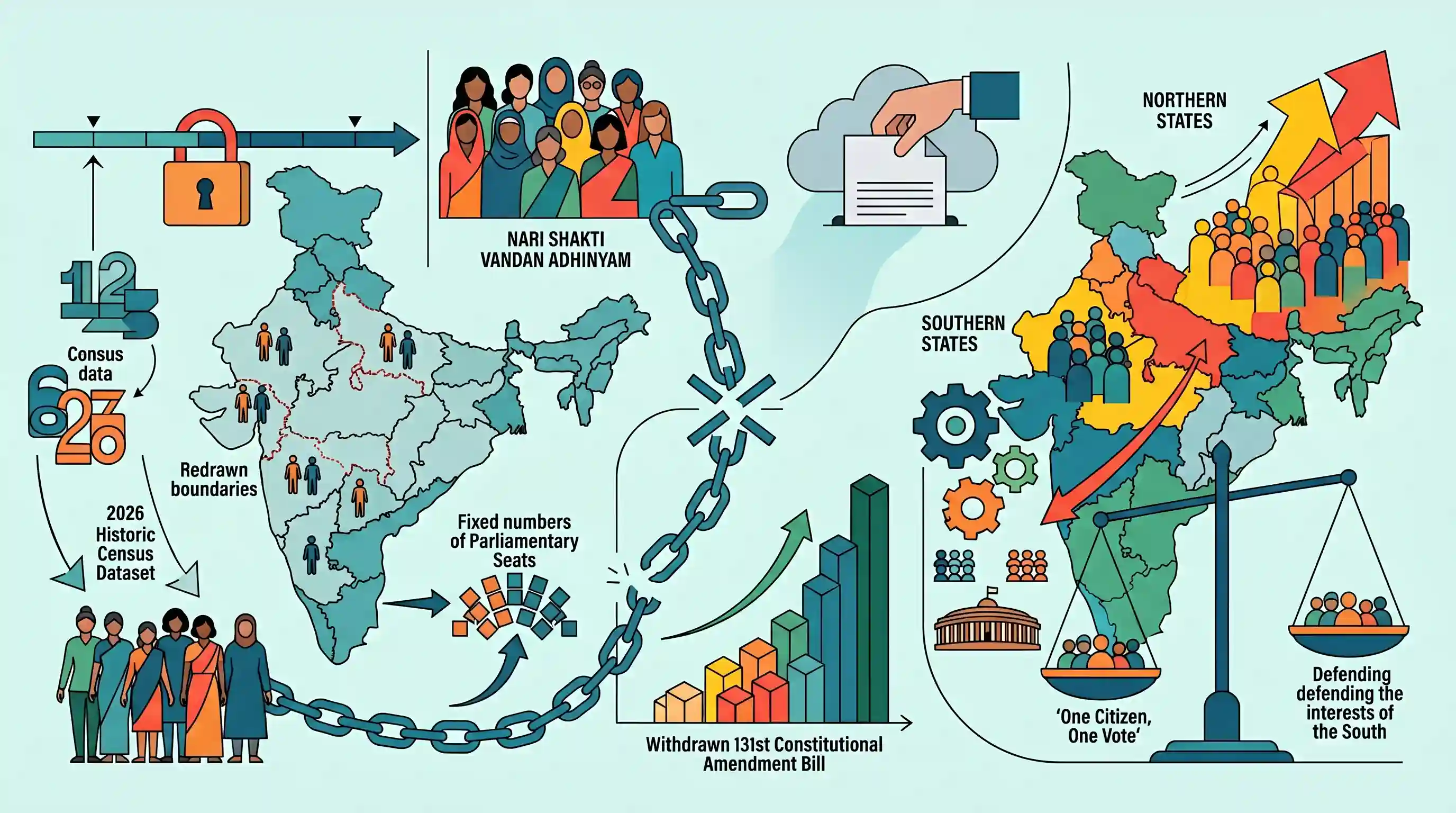
The article examines the complexities surrounding the delimitation of parliamentary constituencies in India, specifically analyzing the withdrawal of the 131st Constitutional Amendment Bill. Delimitation—the process of redrawing boundaries and adjusting seat counts—remains frozen at 1971 census levels until after 2026 to avoid penalizing states that have successfully controlled their population. However, the implementation of the 106th Amendment (Nari Shakti Vandan Adhiniyam) for women's reservation is currently contingent upon this upcoming delimitation. The proposed bill attempted to delink these processes to expedite women's reservation using 2011 census data while expanding total Lok Sabha seats. This has ignited a broader debate on federalism, as Southern states express apprehension over diminished political representation relative to Northern states, highlighting the tension between the principle of 'one citizen, one vote' and the need to protect state interests in a federal structure.
Key Points
- The 131st Constitutional Amendment Bill, which proposed increasing Lok Sabha seats and setting up a Delimitation Commission, was recently withdrawn.
- Delimitation determines constituency boundaries and seat counts, currently frozen at 1971 census levels until after 2026 to avoid penalizing states with effective population control.
- The 106th Amendment (Nari Shakti Vandan Adhiniyam) mandates 33% reservation for women, but its implementation is currently contingent on the first delimitation post-2026.
- The withdrawn 131st Amendment sought to delink women's reservation from the 2027 census, applying it instead via 2011 census data to ensure earlier implementation.
- A significant federalism debate has emerged, as Southern states fear diminished parliamentary representation compared to Northern states if seats are reallocated strictly on updated population figures.
Important Terms
Article 81(2)

Constitutional provision governing Lok Sabha's composition. Clause 2 requires that seat allocation among states and the division of states into constituencies maintain a uniform seat-to-population ratio across India.
UPSC context
GS Paper II: Parliament structure. Essential for understanding the 'one person, one vote, one value' principle and its challenges in a federal setup.
106th Constitutional Amendment Act
The 2023 law (Nari Shakti Vandan Adhiniyam) mandating 1/3 reservation for women in Lok Sabha and State Assemblies, initially contingent upon the first census and delimitation after 2026.
UPSC context
GS Paper II: Women's representation and electoral reforms. A landmark act testing the intersection of social justice and administrative processes.
131st Constitutional Amendment Bill
A failed 2026 legislative attempt to increase Lok Sabha seats to 850 and delink women's reservation from the post-2026 census by allowing delimitation based on 2011 data.
UPSC context
GS Paper II: Constitutional amendments. Illustrates political tensions over federal representation and the procedural hurdles of constitutional changes.
Delimitation Commission
An independent statutory body appointed by the President to redraw electoral boundaries and reallocate seats based on census data to ensure equitable representation.
UPSC context
GS Paper II: Statutory bodies and Elections. Critical for understanding the technical and legal process of maintaining democratic parity.
One Citizen, One Vote, One Value
The democratic ideal where every individual's vote carries equal weight. In India, delimitation aims to achieve this by equalizing the population size of different constituencies.
UPSC context
GS Paper II: Principles of Democracy. The core philosophical debate pitting individual representation against federal state interests.
Delimitation Freeze
A provision in Article 82 of the Constitution that pauses the readjustment of Lok Sabha seats until the first census after 2026 to protect states with successful population control.
UPSC context
GS Paper II: Federalism and Centre-State relations. Central to the North-South political divide and the debate on 'penalizing' demographic performance.
Prelims Trap
The 106th Amendment Act immediately implements 33% reservation for women in the Lok Sabha.
Under Article 334A, the quota only becomes operational after a fresh delimitation exercise based on the first census published post-2026. It is not currently active.
Static Concepts Connected
What are the unique powers of the Delimitation Commission?
- Statutory basis: Established by Parliament under Article 82. Appointed by the President, it works in collaboration with the Election Commission of India.
- Finality of Orders: Its orders have the absolute force of law and cannot be challenged in any court, preventing election delays.
- Legislative restriction: When its orders are laid before the Lok Sabha or State Assembly, the legislatures cannot effect any modifications to them.
When does a Constitutional Amendment require ratification by half the States?
- Federal Structure: Triggered under Article 368(2) if the bill alters core federal provisions, such as the election of the President, the Supreme Court, or legislative power distribution.
- State Representation: Crucially for delimitation, any change to the 'representation of States in Parliament' (Schedule IV and Article 82) strictly requires this 50% state ratification.
Cross-Topic Patterns
Finance Commission vs Delimitation
Southern states faced a similar 'demographic penalty' debate when the 15th Finance Commission mandated the shift from 1971 to 2011 census data for determining tax devolution criteria.
Demographic Transition Theory in Federalism
Connects to Geography/Society syllabus: Southern states are in the advanced stages of demographic transition (low fertility/mortality), while Northern states lag, driving the asymmetric population growth that creates this federal friction.

Delimitation + 106th CAA + Article 368(2) state ratification will likely merge into a high-difficulty Polity question for 2026 Prelims.
Linked PYQs · 2
Linked PYQs · 2
- 2024PrelimsGS1
How many Delimitation Commissions have been constituted by the Government of India till December 2023?
- 2023MainsGS2
Discuss the contribution of civil society groups for women's effective and meaningful participation and representation in state legislatures in India.
