US policy shifts and global climate negotiations challenges
Source:Indian Express ↗
Why It Matters
Understanding the dynamics of global climate negotiations, the role of major polluters, and key UN reports (like the GEO) is essential for both Prelims (Environment) and Mains (GS2 International Relations, GS3 Environment and Ecology).
Summary
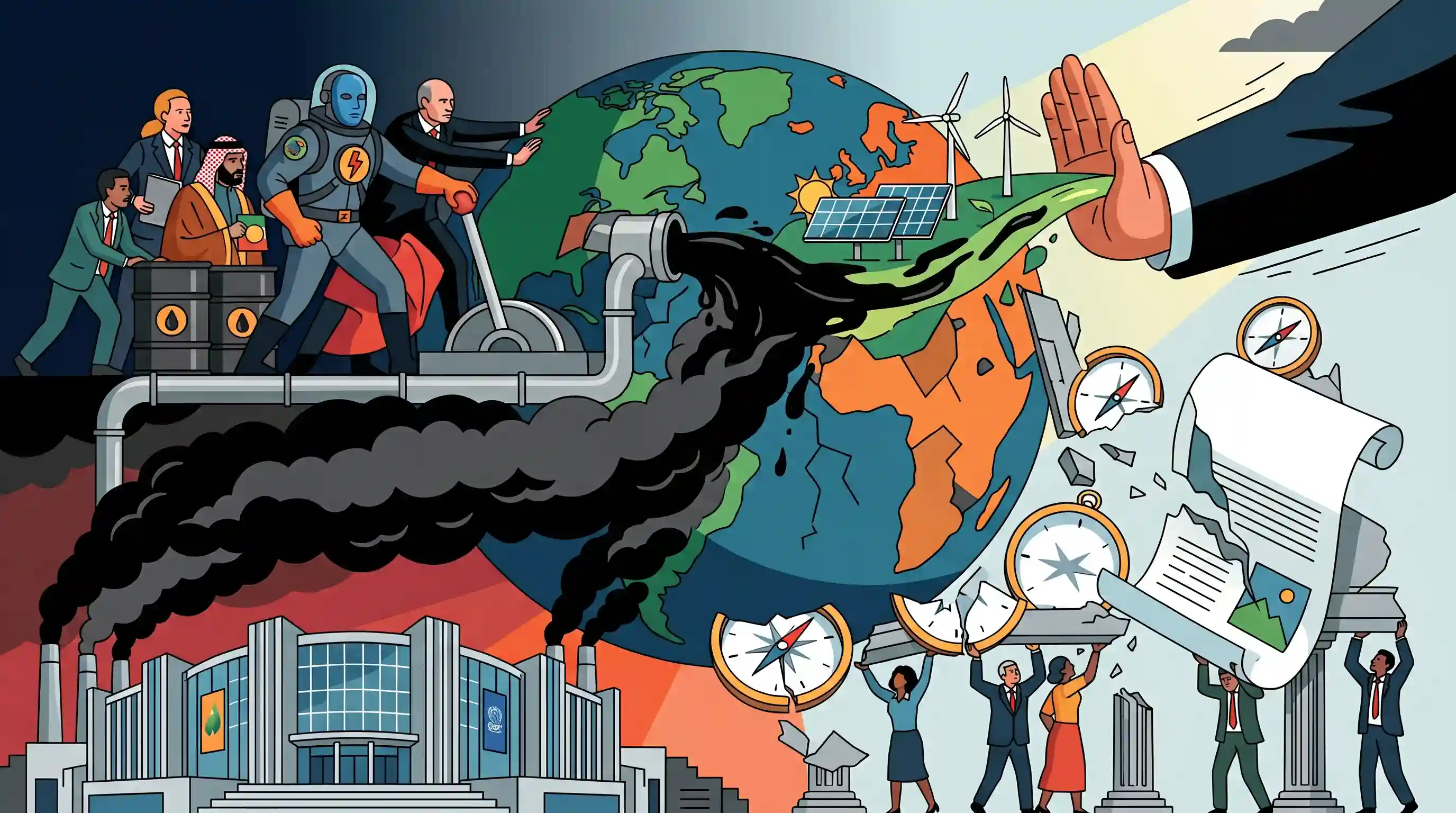
The editorial discusses the challenges in global climate governance highlighted by the recent UN Global Environment Outlook (GEO-7) report. Due to pushback from the US Trump administration—supported by Russia, Saudi Arabia, and Iran—the report failed to reach a consensus on phasing out fossil fuels and lacked a policymaker summary for the first time. The US\'s rollback of clean energy commitments is projected to dramatically increase global carbon emissions, casting a shadow over international efforts and multilateral agreements like the Paris Pact and recent COP 30 initiatives.
Key Points
- The UN\'s seventh Global Environment Outlook (GEO-7) report connects the climate crisis to broader political economy issues, highlighting its threat to human health, food/water security, and global stability.
- For the first time, a GEO report was published without a plain-language summary for policymakers due to international dissension.
- The US Trump administration, backed by Russia, Saudi Arabia, and Iran, obstructed consensus on phasing out fossil fuels and transitioning to clean energy.
- US rollbacks on clean energy policies are projected to increase the country\'s carbon emissions by 7 billion tonnes over the next five years.
- The US withdrawal from the Paris Pact and its obstructionist role at multilateral forums highlights the fragility of global climate governance architecture post-COP 30.
Important Terms
Global Environment Outlook (GEO)

The flagship scientific assessment report by UNEP that reviews the state of the global environment, tracks policy effectiveness, and provides future projections for sustainable development pathways.
UPSC context
GS Paper 3 (Environment); tests understanding of global assessment reports and the science-policy interface in environmental governance.
COP 30
The 30th UN Climate Change Conference, held in Belém, Brazil (2025), focused on the 10-year review of the Paris Agreement and transitioning from pledges to concrete implementation.
UPSC context
GS Paper 3; critical for analyzing outcomes of global climate summits, fossil fuel phase-out debates, and India’s interests.
Paris Agreement
A legally binding international treaty adopted in 2015 (COP21) aiming to limit global warming to well below 2°C, preferably 1.5°C, through Nationally Determined Contributions (NDCs).
UPSC context
GS Paper 3; the foundational framework for international climate cooperation, testing knowledge of NDCs and global temperature goals.
Intergovernmental Panel on Climate Change (IPCC)
The United Nations body responsible for assessing the science related to climate change. It synthesizes existing research into comprehensive reports to inform global climate negotiations.
UPSC context
GS Paper 3; tests understanding of the scientific basis for climate policy and the role of intergovernmental scientific organizations.
United Nations Environment Programme (UNEP)
The leading global environmental authority established in 1972 that sets the global environmental agenda, promotes implementation of sustainable development, and publishes the GEO reports.
UPSC context
GS Paper 2/3; fundamental for international institutional frameworks and global environmental management.
Summary for Policymakers (SPM)
A concise, government-vetted distillation of a scientific report's key findings. Its endorsement by member states is required to provide the report political legitimacy and consensus.
UPSC context
GS Paper 3; relevant for questions on the challenges of multilateral consensus and the political adoption of scientific evidence.
Prelims Trap
"The entire UNEP Global Environment Outlook report requires line-by-line approval from UN member states."
Only the "Summary for Policymakers" (SPM) requires line-by-line political consensus. The underlying scientific chapters are drafted independently by experts without needing direct state approval.
Static Concepts Connected
What are the primary flagship reports published by UNEP?
- GEO Report: The Global Environment Outlook (GEO), a comprehensive assessment of the state of the global environment.
- Emissions Gap Report: Tracks the difference between current global greenhouse gas emissions and the levels needed to limit warming.
- Adaptation Gap Report: Assesses global progress in planning, financing, and implementing climate adaptation measures.
What are the legal mechanics of withdrawing from the Paris Agreement?
- Article 28: Under Article 28, a party can notify its withdrawal any time after three years from the date the Agreement entered into force for that party.
- Notice Period: The withdrawal legally takes effect exactly one year after the UN Depositary receives the notification.
Cross-Topic Patterns
Petrostate blocs & Climate Diplomacy
The rare alignment of the US, Russia, and Iran highlights how major oil-producing economies bypass traditional geopolitical rivalries to collectively protect domestic fossil-fuel interests.
Climate Finance & Multilateral Shortfalls
A US pullback from global climate agreements directly threatens capitalization of the Green Climate Fund and Loss & Damage Fund, forcing developing nations to pivot toward domestic green financing.

Expect a 2026 Prelims multi-statement question distinguishing UNEP’s GEO report from IPCC assessments, specifically testing the SPM approval process.
Linked PYQs · 4
Linked PYQs · 4
- 2022MainsGS2
‘Clean energy is the order of the day.’ Describe briefly India's changing policy towards climate change in various international fora in the context of geopolitics.
- 2022MainsGS3
Discuss global warming and mention its effects on the global climate. Explain the control measures to bring down the level of greenhouse gases which cause global warming, in the light of the Kyoto Protocol, 1997.
- 2022PrelimsGS1
"Climate Action Tracker" which monitors the emission reduction pledges of different countries is a :
- 2021PrelimsGS1
The 'Common Carbon Metric', supported by UNEP, has been developed for
