India and China Leadership in Global Renewable Energy Expansion
Source:Indian Express ↗
Why It Matters
It counters the narrative that developing nations are primarily responsible for rising emissions, offering crucial context for GS3 answers on climate equity, carbon budgets, and the practical challenges of transitioning to renewable energy (like grid stability).
Summary
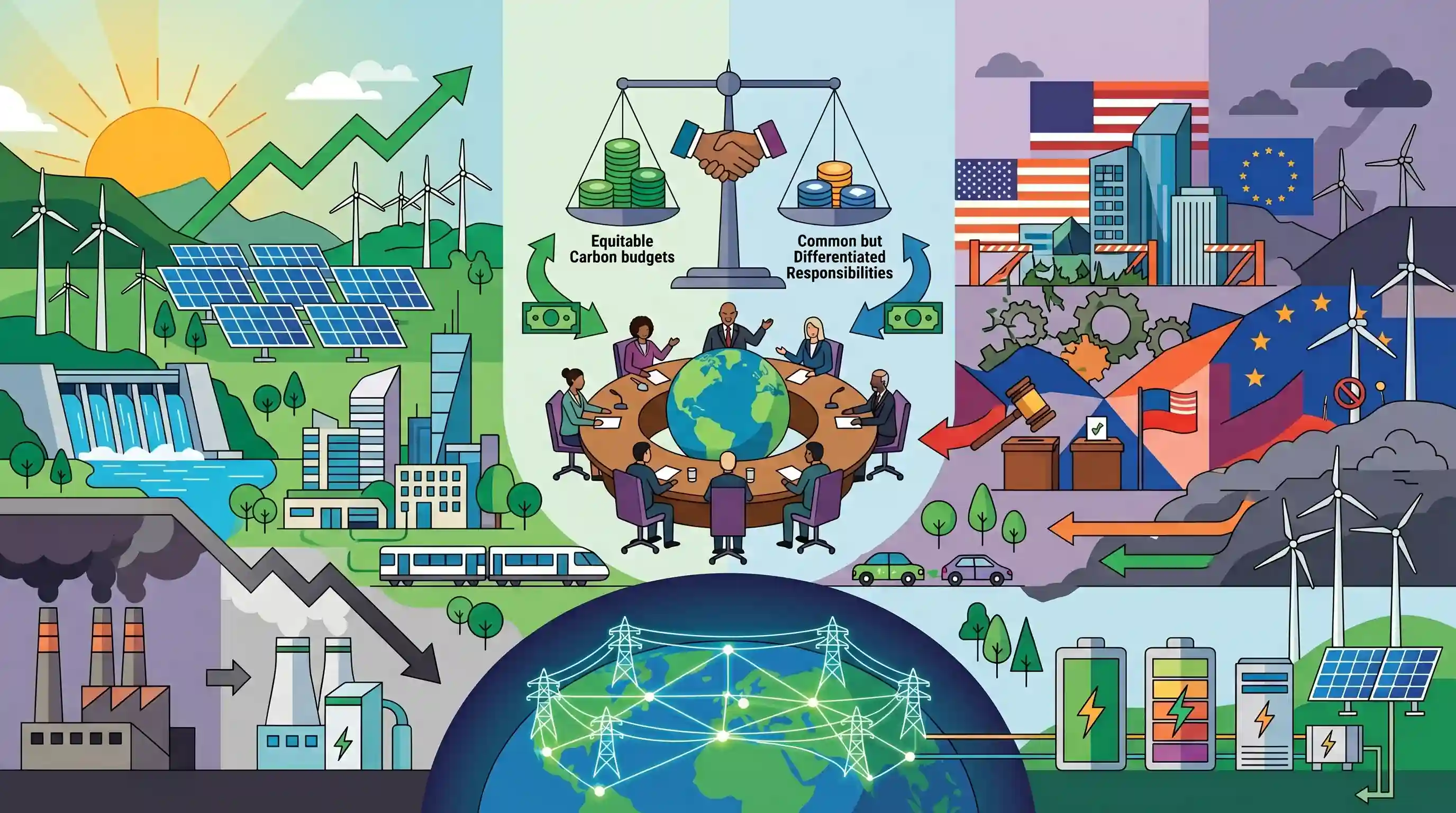
This editorial underscores the leading role of India and China in the global expansion of renewable energy, noting a historic decline in their coal power generation. It contrasts their progress with setbacks in developed regions like the US and the EU, where political shifts and infrastructure limitations have hindered decarbonization. The piece advocates for equitable carbon budgets for developing nations and emphasizes the need to modernize grids and enhance energy storage to manage the intermittency of renewable sources.
Key Points
- Data from Carbon Brief shows India and China led global renewable energy expansion in 2025, resulting in their first drop in coal power generation in 50 years.
- The EU saw an increase in fossil fuel-generated electricity due to unstable wind conditions and an aging grid, while the US reversed its decarbonization trend with rising emissions.
- Developing nations like India and China continue to advocate for a larger carbon budget, aligning with the principle of Common but Differentiated Responsibilities.
- Sustaining the decline in fossil fuel usage in emerging economies requires significant investments in grid modernization and energy storage to counter renewable energy intermittency.
Important Terms
International Energy Agency (IEA)

An autonomous intergovernmental organization established in 1974 to ensure energy security and promote clean energy. India is currently an Associate Member seeking full membership.
UPSC context
GS Paper II & III; tests knowledge of international energy governance and India’s strategic energy diplomacy.
Common but Differentiated Responsibilities (CBDR)
A principle under the 1992 UNFCCC acknowledging that all states share responsibility for environmental protection, but developed nations bear a greater burden due to historical emissions.
UPSC context
GS Paper III; core concept for climate justice, equity, and India's negotiating position in COP summits.
Carbon Budget
The total cumulative amount of CO2 emissions allowed globally to limit global warming to a specific temperature threshold, such as 1.5°C or 2°C.
UPSC context
GS Paper III; relevant for understanding climate science, net-zero targets, and the fair distribution of atmospheric space.
European Union (EU)
A 27-member political and economic union that leads global climate policy through the "European Green Deal," though it currently faces energy security and infrastructure setbacks.
UPSC context
GS Paper II; tests knowledge of regional blocs and their impact on global environmental and trade standards.
Carbon Brief
A specialist UK-based organization providing data-driven analysis and reporting on climate science and energy policy, often cited in global climate progress debates.
UPSC context
Current Affairs; useful for evidence-based analysis of global emission trends and national decarbonization efforts.
Prelims Trap
India has pledged to completely halt new coal capacity additions, leading to the decline in coal generation.
India continues to build new coal plants for energy security. The drop is in electricity actually generated (due to renewables taking the load), not a halt in installed coal capacity.
Static Concepts Connected
What is the global Carbon Budget and how does CBDR-RC relate to it?
- Carbon Budget: The maximum cumulative amount of global greenhouse gas emissions permitted over time to limit global temperature rise to thresholds like 1.5°C.
- Historical Emissions: Developed countries have already consumed the vast majority of the historical budget since the Industrial Revolution, leaving a rapidly shrinking margin.
- CBDR-RC Equity: Developing nations invoke Common But Differentiated Responsibilities to demand a larger, equitable share of the remaining budget to support their economic growth.
What are the structural grid challenges of Renewable Energy intermittency?
- Duck Curve: The distinct mismatch between peak solar generation (midday) and peak electricity demand (evening), which causes severe supply-demand imbalances and grid instability.
- Baseload Deficit: Unlike coal or nuclear, solar and wind cannot provide a constant, dependable power supply, requiring a rapid ramp-up of alternative power when weather changes.
- Storage Imperative: Overcoming intermittency requires massive capital investments in Battery Energy Storage Systems (BESS) or Pumped Hydro Storage to bank excess daytime energy.
Cross-Topic Patterns
Grid stability & Critical Mineral diplomacy
Shifting from coal baseloads to renewables requires massive Battery Energy Storage Systems (BESS), pivoting national import dependencies from Middle Eastern fossil fuels to China-dominated critical mineral supply chains (Lithium, Cobalt).
Climate Equity vs. WTO Trade Barriers
While developing nations demand a larger carbon budget under UNFCCC, developed entities like the EU are erecting Carbon Border Adjustment Mechanisms (CBAM), creating friction between climate equity and WTO trade rules.

Expect a 2026 Prelims question testing the subtle difference between 'installed coal capacity' and 'coal generation' alongside CBDR.
Linked PYQs · 4
Linked PYQs · 4
- 2025MainsGS3
Write a review on India's climate commitments under the Paris Agreement (2015) and mention how these have been further strengthened in COP26 (2021). In this direction, how has the first Nationally Determined Contribution intended by India been updated in 2022?
- 2021MainsGS3
Explain the purpose of the Green Grid Initiative launched at World Leaders Summit of the COP26 UN Climate Change Conference in Glasgow in November, 2021. When was this idea first floated in the International Solar Alliance (ISA)?
- 2012MainsGS2
Explain briefly the "Clean Development Mechanism" as provided under the United Nations Framework Convention on Climate Change (UNFCCC).
- 2020MainsGS3
Explain intra-generational and inter-generational issues of equity from the perspective of inclusive growth and sustainable development.
