Bilateral Agricultural Trade Negotiations and Domestic Protectionism
Source:Indian Express ↗
Why It Matters
It highlights the complex trade-offs in bilateral trade negotiations involving the agriculture sector, which supports millions of livelihoods in India. Aspirants must understand the nuances of tariff policies, yield disparities, and the economic rationale for selective liberalization to answer questions on international trade, farm incomes, and biofuel policies.
Summary
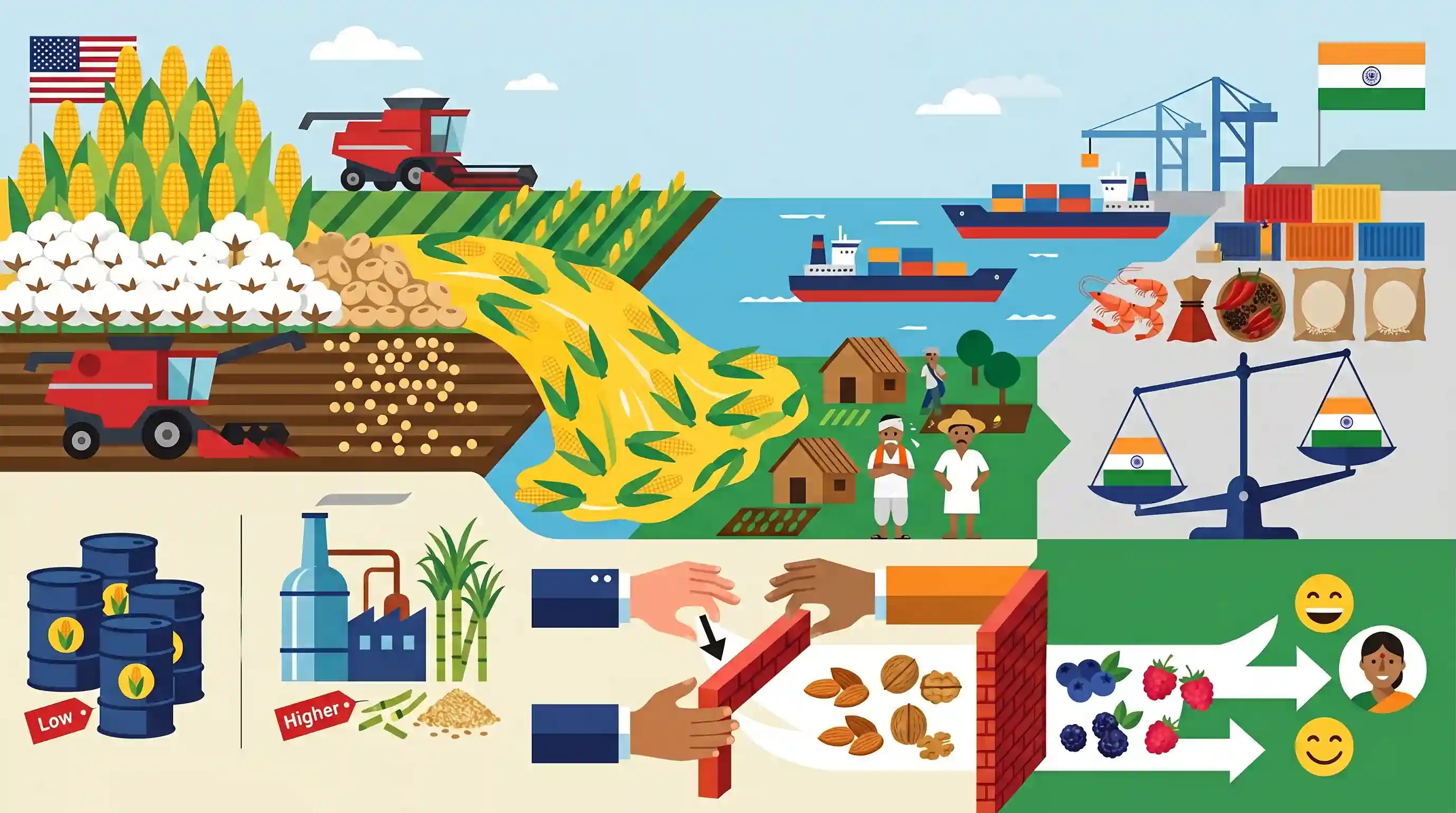
The editorial analyzes the agricultural dimensions of a potential India-US trade agreement, warning against sweeping market openness while advocating for strategic liberalization. Because US yields for crops like corn, cotton, and soyabean far exceed India's, unrestricted imports could devastate domestic farmers. Similarly, opening India to cheap US corn-based ethanol would threaten local distilleries reliant on sugarcane and broken grains. However, the author cautions against a maximalist defensive posture. Since India enjoys an agricultural trade surplus with the US—exporting items like shrimp, spices, and basmati rice—it must protect its export interests through a give-and-take approach. The government is advised to lower high import tariffs on "low-hanging fruits" like almonds, walnuts, and berries, which have minimal domestic cultivation, thereby satisfying US demands without jeopardizing Indian agriculture.
Key Points
- Indian agriculture faces significant yield disadvantages compared to large-acreage US farms for crops like soyabean, corn, and cotton, necessitating import safeguards.
- Allowing cheap imports of US corn-based ethanol could severely disrupt domestic biofuel supply chains built around sugarcane and cereal grains.
- India can employ a strategic 'give-and-take' approach by lowering high tariffs on 'low-hanging fruit'—such as tree nuts, blueberries, and cranberries—which are not widely grown domestically.
- Because India currently enjoys a net agricultural trade surplus with the US, rigid protectionism could invite retaliatory measures against Indian exports like shrimp, spices, and basmati rice.
Important Terms
India-US Interim Trade Agreement

A 2026 bilateral framework reducing tariffs to a reciprocal 18%. It aims to stabilize trade relations while protecting India's sensitive agricultural sectors through a strict "negative list" of excluded products.
UPSC context
GS Paper II (International Relations) and GS Paper III (Economy). Tests bilateral diplomacy and strategic trade-offs in global markets.
Ethanol Blended Petrol (EBP) Programme
A national initiative to blend ethanol with petrol, with a 20% blending target (E20) advanced to 2025. It targets energy security, emission reduction, and enhanced farmer income via crop diversification.
UPSC context
GS Paper III (Economy/Infrastructure/Environment). Tests energy security, bio-fuel policy, and agro-industrial linkages.
Reciprocal Tariff
A trade policy where a country matches the import duty rates imposed by its trading partner. India and the US aligned rates at 18% in 2026 to resolve previous tariff disputes.
UPSC context
GS Paper III (Economy/International Trade). Tests concepts of trade equity, protectionism, and bilateral negotiation dynamics.
Negative List (Trade)
A specific list of sensitive products excluded from tariff concessions in a trade agreement. India uses this to protect millions of small-scale farmers in dairy and staple grain sectors.
UPSC context
GS Paper III (Economy/Agriculture). Tests understanding of protectionist mechanisms used during trade liberalization.
Tariff-Rate Quotas (TRQs)
A trade mechanism allowing a set quantity of imports at a lower duty, while higher tariffs apply to volumes exceeding the quota. Used to manage imports of commodities like soy oil.
UPSC context
GS Paper III (Economy). Tests technical knowledge of trade barriers and market access regulations.
Prelims Trap
India maintains an agricultural trade deficit with the US due to large-scale imports of GM corn and soybean.
India actually enjoys an agricultural trade surplus with the US, led by marine products and basmati. It also strictly bans US GM corn and soybean.
Static Concepts Connected
What are the permitted domestic feedstocks for India's Ethanol Blended Petrol (EBP) Programme?
- Sugarcane derivatives: Sugarcane juice, syrup, B-heavy molasses, and C-heavy molasses are the primary feedstocks utilized by domestic distilleries.
- Cereal grains: Damaged food grains unfit for human consumption, broken rice, surplus FCI rice stocks, and domestic maize are explicitly permitted.
How does the WTO treat agricultural import restrictions like India's ban on GM crops?
- SPS Agreement: Sanitary and Phytosanitary (SPS) measures allow members to restrict imports to protect human, animal, or plant health, provided there is scientific justification.
- Tariffification: The Agreement on Agriculture generally requires replacing non-tariff barriers with equivalent tariffs, making health and safety exceptions (like GM bans) highly scrutinized.
Cross-Topic Patterns
Biofuels & Sugarcane FRP linkages
Restricting US ethanol imports directly protects domestic sugarcane farmers, intimately tying India's international trade posture to the political economy of the Fair and Remunerative Price (FRP) mechanism.
GEAC regulations as trade barriers
India's domestic environmental regulation requiring Genetic Engineering Appraisal Committee (GEAC) approval acts as a crucial Sanitary and Phytosanitary (SPS) barrier against cheap US GM commodities.
Shrimp exports & US anti-dumping duties
While India has an agri-surplus via marine exports, these frequently face US anti-dumping duties and traceability regulations, highlighting the fragility of this bilateral surplus.

Expect a 2026 multi-statement Prelims question testing the intersection of India's Ethanol Blending feedstocks and WTO SPS trade measures.
Linked PYQs · 3
Linked PYQs · 3
- 2023MainsGS3
What are the direct and indirect subsidies provided to farm sector in India? Discuss the issues raised by the World Trade Organization (WTO) in relation to agricultural subsidies.
- 2018MainsGS3
How would the recent phenomena of protectionism and currency manipulations in world trade affect macroeconomic stability of India?
- 2017MainsGS3
How do subsidies affect the cropping pattern, crop diversity and economy of farmers? What is the significance of crop insurance, minimum support price and food processing for small and marginal farmers?
