Omkareshwar and Ujjain development as global spiritual centres
Source:freepressjournal ↗
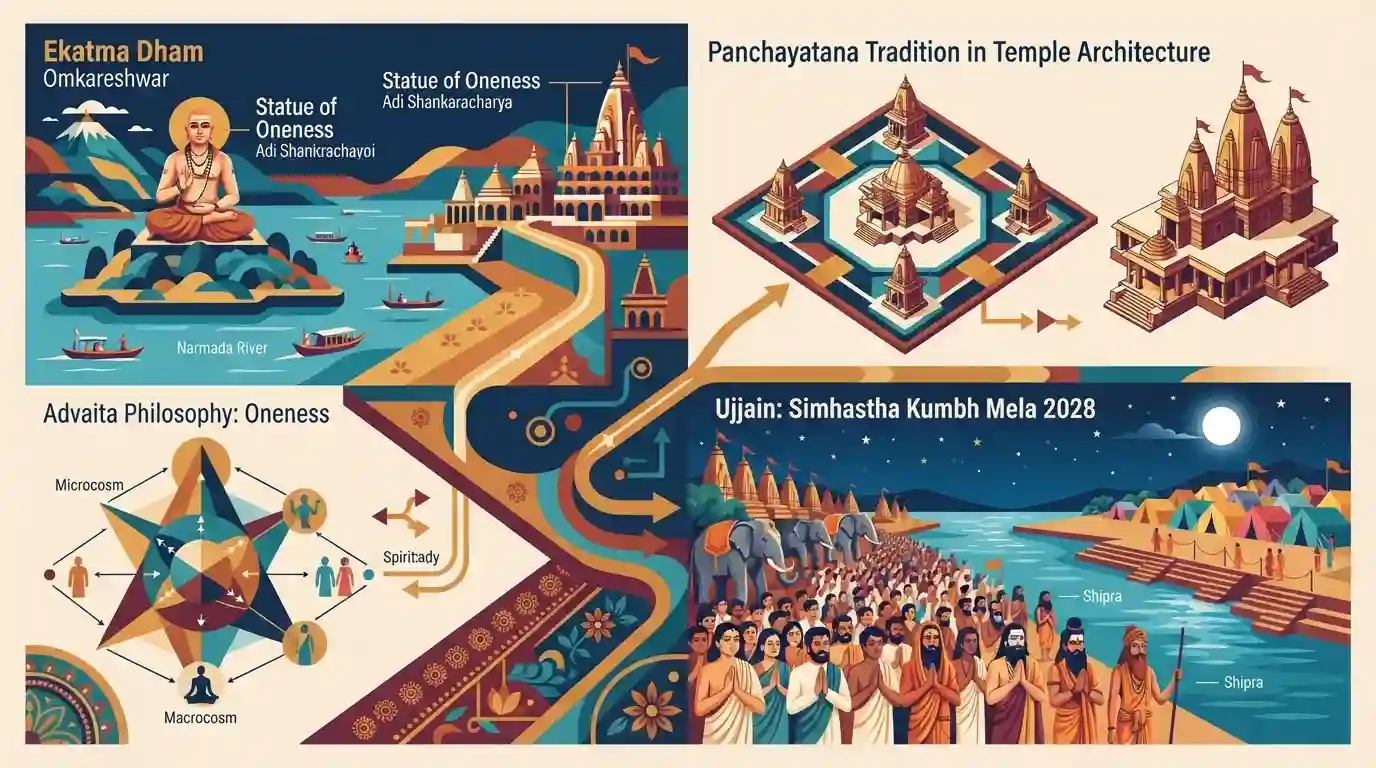
Why It Matters
Knowledge of major cultural and spiritual centers, philosophical traditions (Advaita Vedanta), and architectural styles (Panchayatana) is essential for State Service Prelims under Art & Culture and MP-specific GK.
Summary
Chief Minister Mohan Yadav announced that Omkareshwar and Ujjain are set to become prominent global spiritual centers, bolstered by recent developments such as the inauguration of the first phase of Ekatma Dham in Omkareshwar. The project, located on Mandhata Mountain, is dedicated to Adi Shankaracharya's Advaita (Oneness) philosophy and features the 'Statue of Oneness'. He also highlighted the Panchayatana tradition in temple architecture as a symbol of unity in diversity, which aligns with Advaita teachings. Ujjain is also gearing up for the monumental Simhastha Kumbh Mela in 2028.
Key Points
- Madhya Pradesh Chief Minister Mohan Yadav envisions Omkareshwar and Ujjain emerging as major global spiritual centers.
- The first phase of the Ekatma Dham on Mandhata Mountain in Omkareshwar was inaugurated by RSS chief Mohan Bhagwat.
- Omkareshwar is being developed as a hub of the Advaita (Oneness) philosophy, linked to the legacy of Adi Shankaracharya, marked by the 'Statue of Oneness'.
- The CM highlighted the traditional Panchayatana temple structure (a main shrine of Shiva surrounded by shrines of Surya, Ganesha, Shakti, and Vishnu), drawing parallels to the inclusiveness of Advaita philosophy.
- Preparations are underway for the upcoming Simhastha Kumbh Mela in Ujjain, scheduled for 2028.
Important Terms
Ekatma Dham

A spiritual complex on Mandhata Mountain, Omkareshwar, dedicated to Adi Shankaracharya’s Advaita philosophy. It features the Advaita Lok museum, a research institute, and the Statue of Oneness, celebrating non-dualism and universal unity.
UPSC context
GS-1 MP Art & Culture. Crucial for questions on major religious tourism initiatives and historical figures associated with Madhya Pradesh.
Statue of Oneness
A 108-foot-tall, multi-metal statue of philosopher Adi Shankaracharya as a 12-year-old boy. Located on Mandhata Hill in Omkareshwar, Madhya Pradesh, it overlooks the Narmada River and serves as a major cultural landmark.
UPSC context
GS-1 MP Tourism & Culture. High-probability factual topic regarding state-sponsored heritage monuments, their location, height, and philosophical dedication.
Simhastha 2028
A massive Hindu spiritual gathering (Kumbh Mela) held every 12 years along the sacred Shipra River in Ujjain. The 2028 mega-event will run from March to May, driving significant state infrastructure upgrades.
UPSC context
GS-1 Culture & MP Current Affairs. Core topic for MP administrative preparedness, cultural heritage, and regional religious geography.
Panchayatana Tradition
A Hindu temple architecture style where a central shrine housing the main deity is surrounded by four subsidiary shrines at the corners of its platform. This inclusive layout symbolizes unity in diversity.
UPSC context
GS-1 Indian Art & Culture. Vital for architectural history questions, especially regarding structural layouts of prominent temples like Khajuraho.
Prelims Trap
Assuming the 'Statue of Oneness' is located in Ujjain or dedicated to Ramanujacharya.
Aspirants often confuse the 'Statue of Oneness' (Adi Shankaracharya, Omkareshwar) with the 'Statue of Equality' (Ramanujacharya, Hyderabad) or wrongly attribute it to Ujjain due to recent Mahakal Lok developments.
Static Concepts Connected
What are the key features of the Panchayatana style of temple architecture?
- Layout: Consists of a main central shrine surrounded by four smaller subsidiary shrines located at the corners of the temple platform.
- Deities: Typically involves a principal deity (like Shiva or Vishnu) accompanied by Surya, Ganesha, Shakti, and another primary god.
- Famous Examples: Prominently seen in Madhya Pradesh at the Lakshmana and Kandariya Mahadeva temples of Khajuraho, and the Dashavatara temple in Deogarh.
What are the core tenets of Advaita Vedanta philosophy?
- Non-Dualism: Asserts the absolute non-duality and fundamental oneness of the individual soul (Atman) and the ultimate reality (Brahman).
- Concept of Maya: Teaches that the empirical, material world is merely an illusion (Maya) that obscures the ultimate, singular truth.
- Key Proponent: Propounded by the 8th-century philosopher Adi Shankaracharya, who established four principal Mathas across India to institutionalize this teaching.
Cross-Topic Patterns
Panchayatana style & MP Tourism
Linking the architectural legacy of Khajuraho (Panchayatana) to modern spiritual circuits like Ekatma Dham highlights MP's strategy of merging ancient heritage with major religious tourism development.
Philosophers & Statues circuit
Recent mega-statue projects map deeply to Indian philosophical schools. 'Statue of Oneness' links to Advaita in MP, whereas the 'Statue of Equality' links to Vishishtadvaita in Telangana.

Expect a match-the-following question linking recent mega-statues (Oneness, Equality, Knowledge) to their philosophers and locations.
Linked PYQs · 4
Linked PYQs · 4
- 2023MPPSC_PRELIMSGS1
Where is the historical Matangeshwar temple situated?
- 2025MPPSC_PRELIMSGS1
In which style is the Kailasanathar temple of Kanchi built?
- 2025MPPSC_PRELIMSGS1
While living in which Ashram did a person have to perform the rituals of Panch Mahayagya ?
- 2016MPPSC_PRELIMSGS1
Which tourist place is known as ‘pilgrimage of sculpture?
