Omicron RF Variant Detected in Covid Samples in Andhra Pradesh
Source:business-today ↗
Why It Matters
Continuous genomic sequencing and tracking of emerging viral variants are critical components of public health administration for early detection and mitigation of potential outbreaks.
Summary
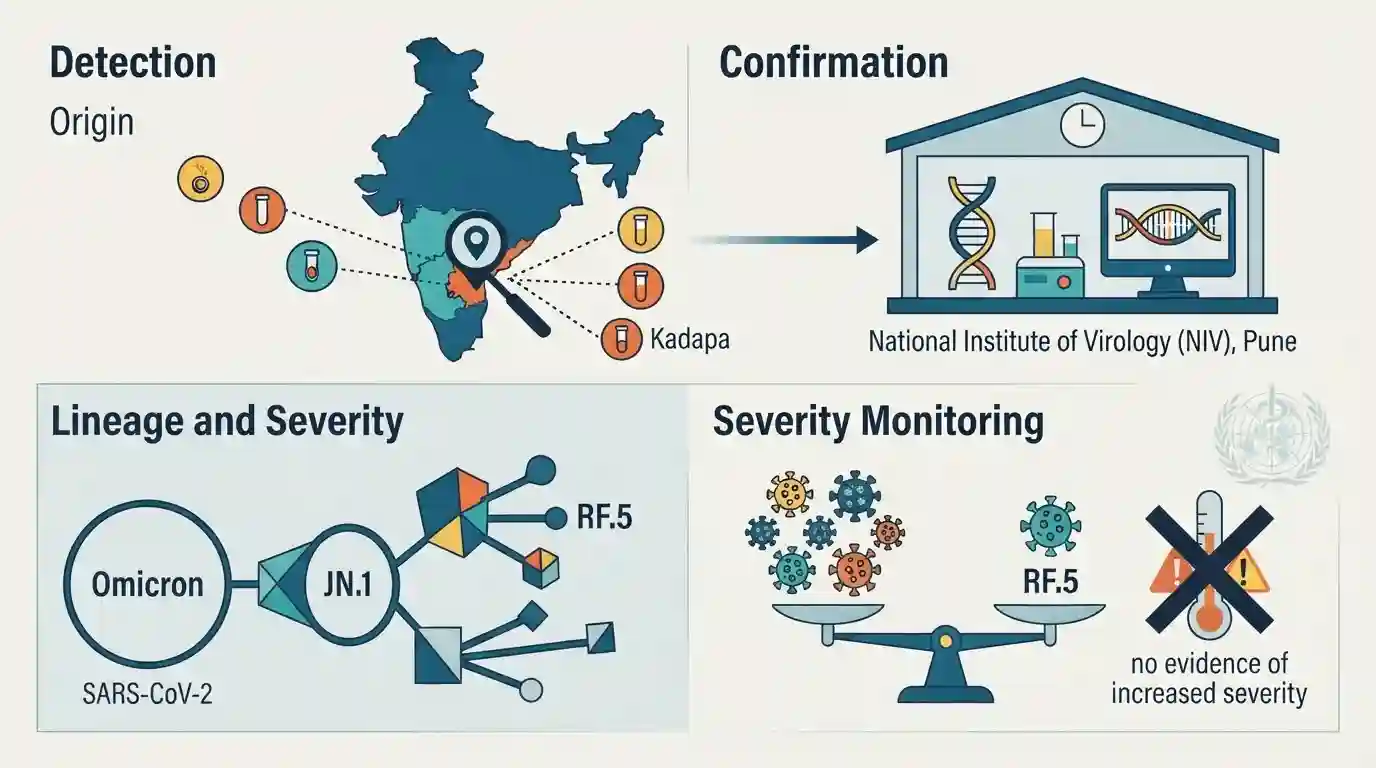
The Omicron RF.5 variant of the SARS-CoV-2 virus has been detected in four samples originating from Kadapa district in Andhra Pradesh. Genome sequencing to confirm the strain was conducted at the National Institute of Virology (NIV) in Pune. RF.5 is a natural evolutionary branch stemming from the JN.1 lineage. Health officials maintain that there is currently no evidence to suggest that the RF.5 variant causes more severe illness than other circulating Omicron strains, though the World Health Organisation (WHO) continues to monitor its global spread.
Key Points
- Four Covid-19 samples from Kadapa district in Andhra Pradesh tested positive for the Omicron RF.5 variant.
- The variant was confirmed through genome sequencing at the National Institute of Virology in Pune.
- RF.5 is a naturally evolved sub-lineage originating from the JN.1 variant of SARS-CoV-2.
- While the World Health Organisation (WHO) is tracking the variant globally, experts state there is no evidence suggesting it is more lethal than other Omicron strains.
Important Terms
National Institute of Virology

India's apex virology research laboratory under the Indian Council of Medical Research (ICMR), established in 1952 in Pune. It is critical for viral diagnostic research, outbreak investigation, and vaccine development.
UPSC context
Relevant for GS-3 (Science and Technology) and GS-2 (Health). Tests knowledge of India's premier public health and research institutions.
World Health Organisation
A specialized agency of the United Nations established in 1948, headquartered in Geneva, Switzerland. It acts as the directing and coordinating authority on international public health and global health emergencies.
UPSC context
Crucial for GS-2 (International Relations and Health). Tests understanding of global governance bodies and international health frameworks.
Genome Sequencing
A laboratory method used to determine the complete DNA or RNA sequence of an organism's genome. It helps researchers identify genetic variations, track pathogen mutations, and develop targeted therapies.
UPSC context
Vital for GS-3 (Biotechnology). Tests comprehension of genetic engineering, indigenous initiatives like Genome India, and pathogen tracking.
Genomic Surveillance
The continuous monitoring of pathogens using genomic sequencing to track their evolution, transmission patterns, and genetic mutations. It is crucial for detecting new infectious disease variants and guiding public health responses.
UPSC context
Relevant for GS-3 (S&T, Biotechnology) and GS-2 (Public Health). Tests understanding of epidemiological tracking systems like INSACOG.
JN.1 lineage
A sub-lineage of the SARS-CoV-2 Omicron BA.2.86 variant. Known for having a high number of spike mutations, JN.1 represents a significant evolutionary step characterized by increased transmissibility and immune evasion properties.
UPSC context
GS-3 (Science and Technology). Tests knowledge of virus evolution, mutation nomenclature, and pathogen public health threats.
Omicron RF.5 variant
A naturally evolved sub-lineage of the SARS-CoV-2 Omicron variant descending from the JN.1 lineage. It is tracked globally through genomic surveillance and was detected in Andhra Pradesh in 2026.
UPSC context
Relevant for GS-3 (Science & Technology - Biotechnology) and GS-2 (Public Health). Tests awareness of contemporary viral mutations and disease tracking.
Prelims Trap
The Genome India Project, which sequenced 10,000 genomes, was conceptualized and completed by the Council of Scientific & Industrial Research (CSIR).
The Genome India Project (10,000 genomes) is led by the Department of Biotechnology (DBT). CSIR led the earlier, smaller 'IndiGen' pilot project (1,008 genomes).
Static Concepts Connected
How do DNA and RNA viruses differ in mutation rates and classification?
- Mutation Rates: RNA viruses mutate faster than DNA viruses because RNA polymerases generally lack proofreading mechanisms, leading to rapid variant emergence.
- Replication Site: DNA viruses usually replicate inside the host cell nucleus, while most RNA viruses replicate in the cytoplasm.
- Pathogen Examples: Smallpox and Chickenpox are caused by DNA viruses; COVID-19, Influenza, Dengue, and HIV are caused by RNA viruses.
What are the key differences between the IndiGen and Genome India Projects?
- Nodal Agency: CSIR led the IndiGen project, while the Department of Biotechnology (DBT) is the nodal agency for the Genome India Project.
- Sample Size: IndiGen completed whole-genome sequencing for 1,008 Indians; the Genome India Project sequenced 10,000 individuals across 99 ethnic groups.
- Primary Objective: IndiGen focused on clinical applications and pilot pharmacogenomics; Genome India builds a vast grid to map Indian genetic diversity.
Cross-Topic Patterns
Genomics in Climate-Resilient Agriculture
Whole-genome sequencing bridges medical pathogen surveillance with farm security by identifying genes for drought tolerance and Marker-Assisted Selection in major crops.
Federal Health Infrastructure and INSACOG
Collaborative genomic surveillance highlights how cooperative federalism operates during health crises, involving central laboratories like Pune's NIV and state health departments.

Expect a 2026 question mapping RNA/DNA viral diseases paired with the applications of whole-genome sequencing in agriculture.
Linked PYQs · 1
Linked PYQs · 1
- 2012APPSC_PRELIMSGS1
Virus diseases include
