PDP Response to Proposals on Indus Waters Treaty Abrogation
Source:The Hindu ↗
Why It Matters
The Indus Water Treaty is a foundational agreement governing transboundary water sharing between India and Pakistan. Any political call to abrogate the treaty or revive stalled infrastructure projects (like Tulbul) carries immense diplomatic, geopolitical, and security implications, directly affecting bilateral relations and regional stability.
Summary
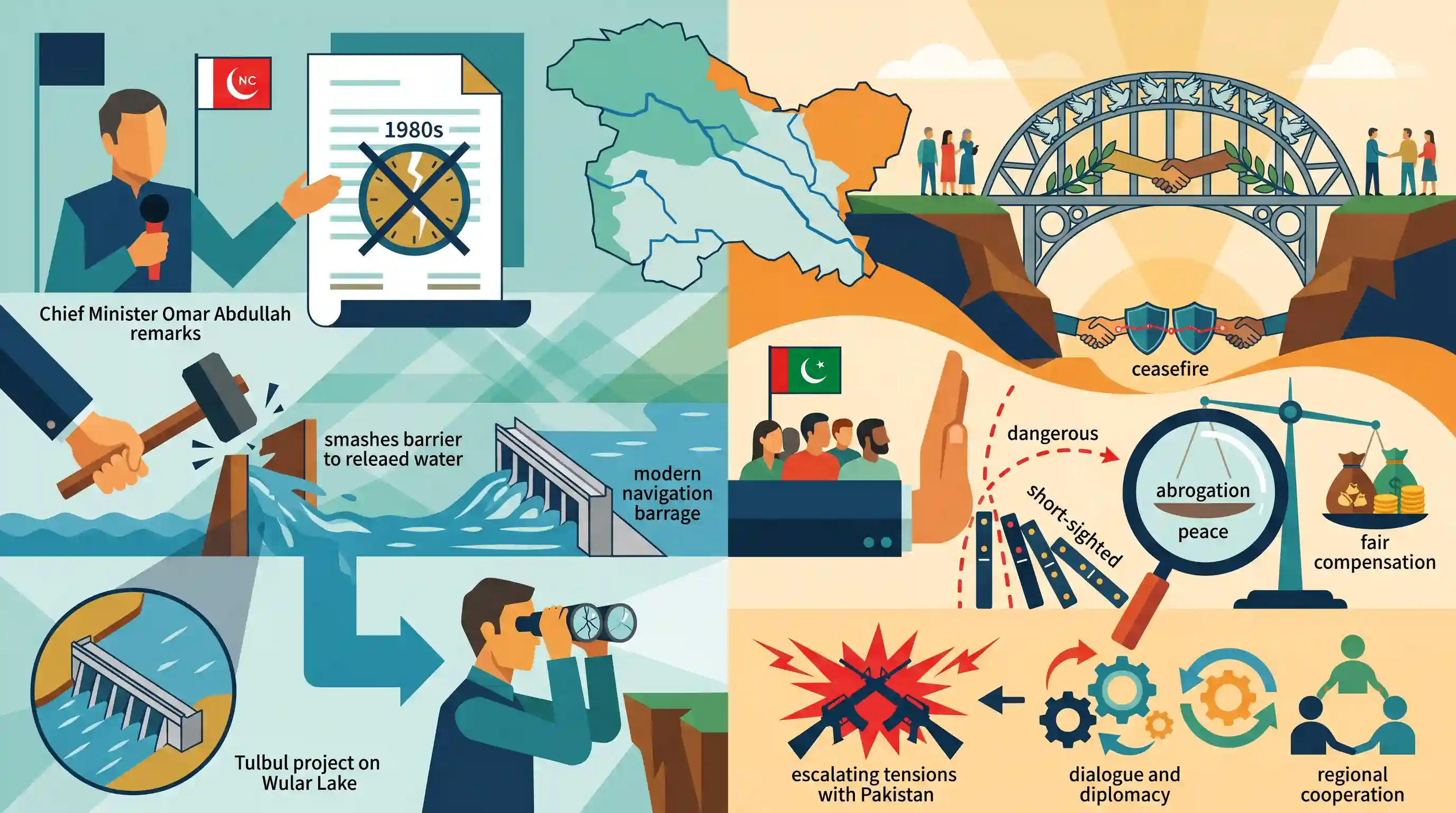
The Peoples Democratic Party (PDP) has strongly criticised Jammu and Kashmir Chief Minister Omar Abdullah's remarks suggesting the scrapping of the Indus Water Treaty (IWT) and the revival of the Tulbul navigation project. The PDP labelled the call as dangerous, short-sighted, and irresponsible, warning that such provocations risk escalating tensions with Pakistan during a fragile ceasefire. Emphasising dialogue and diplomacy, the PDP argued that J&K should act as a bridge of peace rather than a battleground, and advocated for seeking fair compensation under the treaty instead of outright abrogation. The Tulbul project near Wular Lake was previously halted in 1987 following objections from Pakistan.
Key Points
- The Peoples Democratic Party (PDP) criticised J&K Chief Minister Omar Abdullah for proposing the abrogation of the Indus Water Treaty (IWT) and the revival of the Tulbul navigation project.
- The PDP described the remarks as dangerous and irresponsible, warning that such rhetoric could jeopardise regional stability and a fragile ceasefire with Pakistan.
- Instead of scrapping the treaty, the PDP advocates demanding fair compensation for J&K under the existing IWT framework.
- The Tulbul navigation project near Wular Lake was halted in 1987 after Pakistan objected to it, alleging it violated the IWT.
- The PDP stressed that Jammu & Kashmir should act as a bridge for peace and diplomacy between India and Pakistan rather than a battleground.
Important Terms
Indus Water Treaty (IWT)

A 1960 World Bank-brokered water-sharing agreement dividing the Indus system; India controls eastern rivers (Ravi, Beas, Sutlej), while Pakistan controls western rivers (Indus, Jhelum, Chenab) with limited Indian usage.
UPSC context
GS Paper II: Bilateral relations; tests understanding of transboundary water diplomacy and dispute resolution mechanisms like the Permanent Indus Commission.
Tulbul Navigation Project
A proposed lock-and-control structure on the Jhelum River at Wular Lake designed to ensure year-round navigation; stalled since 1987 due to Pakistani objections regarding treaty violations.
UPSC context
GS Paper II: India-Pakistan relations; specifically technical disputes over 'non-consumptive use' versus 'storage' under the IWT framework.
Peoples Democratic Party (PDP)
A major regional political party in Jammu and Kashmir, currently in opposition, which advocates for "soft borders," dialogue with Pakistan, and maintaining the IWT as a bridge of peace.
UPSC context
GS Paper II: Regional political dynamics; tests knowledge of internal stakeholders’ impact on India’s foreign policy and federal water rights.
National Conference (NC)
The current ruling party in Jammu and Kashmir, led by Omar Abdullah, which has historically criticized the IWT as "unjust" for restricting the region's vast hydroelectric potential.
UPSC context
GS Paper II: Indian Constitution and Federalism; highlights the tension between state economic interests and national international obligations.
Run-of-the-river projects
Hydroelectric plants that generate electricity by using the natural flow of the river without significant water storage, permitted for India on western rivers under the IWT.
UPSC context
GS Paper III: Energy and Infrastructure; crucial for understanding technical constraints on J&K’s power generation under international law.
Prelims Trap
"Under the Indus Water Treaty, India is strictly prohibited from building any hydroelectric projects on the Western rivers (Indus, Jhelum, Chenab)."
India is permitted to build "run-of-the-river" hydroelectric projects on the Western rivers. The treaty restricts large water storage and consumptive use, not all hydropower.
Static Concepts Connected
What is the 3-tier dispute resolution mechanism of the Indus Water Treaty?
- Permanent Indus Commission: Initial questions or bilateral disputes are addressed here by the respective commissioners of India and Pakistan.
- Neutral Expert: Appointed by the World Bank to resolve unresolved technical differences regarding water sharing or project designs.
- Court of Arbitration: The highest level of adjudication for complex legal interpretations and unresolved treaty disputes.
What is the geographical significance of Wular Lake and the Tulbul Project?
- Wular Lake: Located in J&K, it is one of South Asia's largest tectonic freshwater lakes. The Jhelum river flows directly through it.
- Tulbul Project: A proposed navigation lock-cum-control structure on the Jhelum to maintain water levels for year-round navigation, opposed by Pakistan.
Cross-Topic Patterns
Federal friction over International Treaties
Article 253 grants Parliament exclusive power to implement international treaties, but border states like J&K (hydro potential) and West Bengal (Teesta waters) often bear the economic costs, triggering internal friction over foreign policy.
Hydro-diplomacy as a strategic border tool
India's rhetoric on the IWT and the revival of stalled projects like Tulbul aligns with a broader post-Uri strategy of leveraging upper-riparian geographical advantages against cross-border terrorism.

Expect a composite Prelims question testing the geographical pairing of Jhelum/Wular alongside the World Bank's arbitration role in the IWT.
Linked PYQs · 3
Linked PYQs · 3
- 2012MainsGS2
The situation today is far different to that prevalent fifty years back when the Indus Water Treaty was signed." Highlight the complexity of the current challenges on both sides of the border in this regard. Do you think that a review of the Treaty is in India's best interests?
- 2023PrelimsGS1
Consider the following statements: 1. Jhelum River passes through Wular Lake. 2. Krishna River directly feeds Kolleru Lake. 3. Meandering of Gandak River formed Kanwar Lake. How many of the statements given above are correct?
- 2021PrelimsGS1
With reference to the Indus river system, of the following four rivers, three of them pour into one of them which joins the Indus direct. Among the following, which one is such river that joins the Indus direct?
