Lok Sabha Speaker to attend Bangladesh leadership swearing in
Source:Indian Express ↗
Why It Matters
Understanding how India navigates political transitions in neighboring countries is critical for GS-2. It exemplifies practical foreign policy execution, demonstrating how constitutional offices (like the Lok Sabha Speaker) are utilized in diplomatic outreach and reinforcing the 'Neighbourhood First' doctrine.
Summary
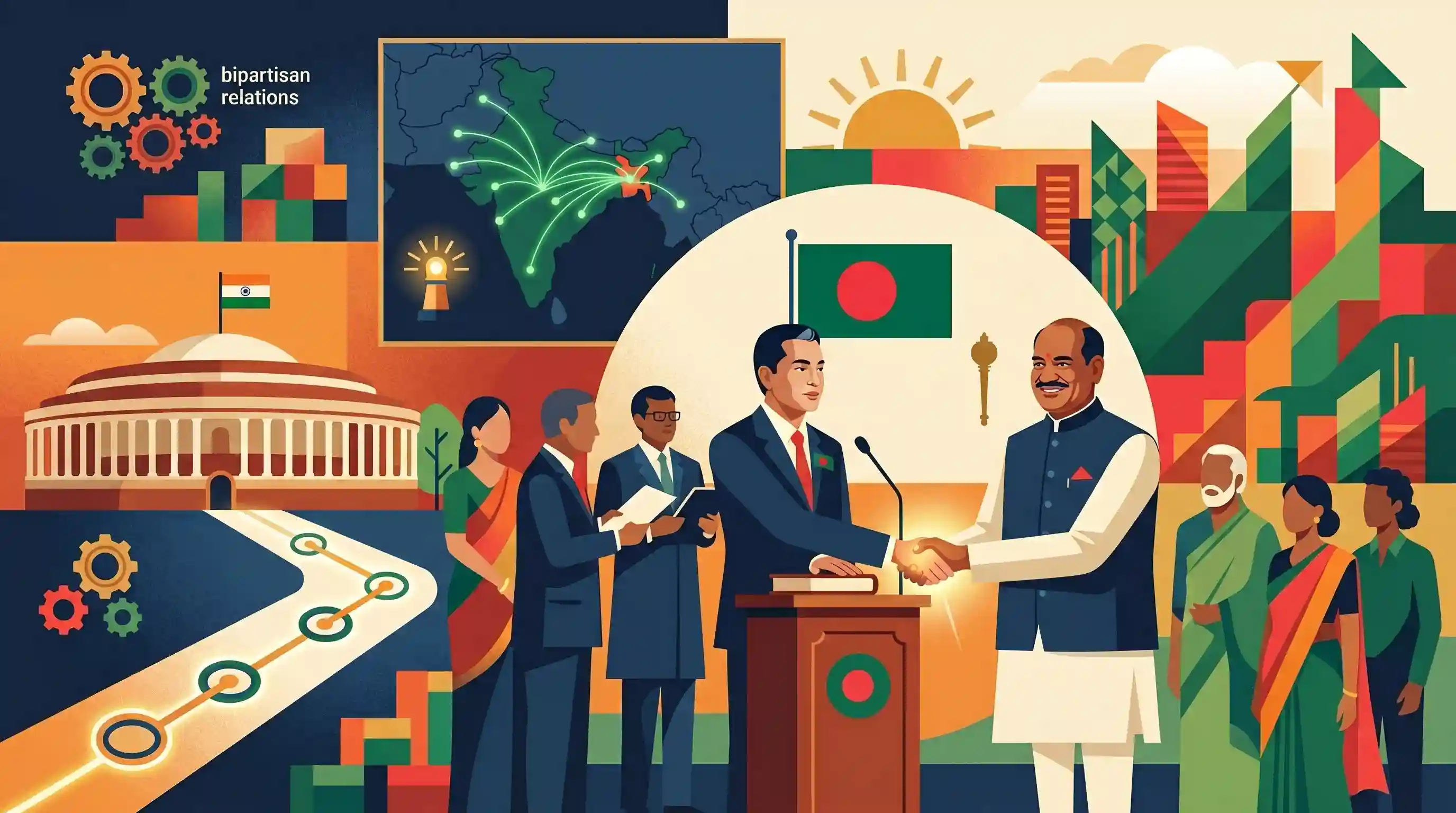
Lok Sabha Speaker Om Birla will represent India at the swearing-in ceremony of Bangladesh Nationalist Party (BNP) leader Tarique Rahman in Bangladesh. This significant diplomatic move indicates New Delhi's pragmatic adjustment to the changing political landscape in Dhaka. By deploying a high-ranking constitutional authority like the Lok Sabha Speaker, India reinforces its 'Neighbourhood First' policy and emphasizes its commitment to maintaining stable, bipartisan bilateral relations with Bangladesh, despite the shift in political power.
Key Points
- Lok Sabha Speaker Om Birla will represent the Indian government at the swearing-in ceremony of BNP leader Tarique Rahman in Bangladesh.
- The decision highlights India's pragmatic diplomatic shift to engage with the Bangladesh Nationalist Party (BNP) amidst political transitions in Dhaka.
- Sending the Lok Sabha Speaker underscores the importance of parliamentary diplomacy and the high priority accorded to Bangladesh under India's 'Neighbourhood First' policy.
- It reflects New Delhi's strategy of maintaining robust bilateral relations regardless of the ruling political party in the neighbourhood.
Important Terms
Neighbourhood First Policy

India’s foreign policy priority to build strong, mutually beneficial ties with immediate neighbors through improved connectivity, trade, and people-to-people contact.
UPSC context
GS-II (IR); critical for regional stability, border security, and countering external influences like China's BRI.
Parliamentary Diplomacy
The use of inter-parliamentary dialogue and visits by legislators or presiding officers to supplement executive diplomacy and foster mutual trust between nations.
UPSC context
GS-II (Polity/IR); tests the role of the Legislature in foreign affairs and "second-track" diplomatic channels.
Bangladesh Nationalist Party (BNP)
A major center-right political party in Bangladesh, currently led by Tarique Rahman, emphasizing "Bangladesh-first" nationalism and sovereign equality in international partnerships.
UPSC context
GS-II (Bilateral Relations); important for analyzing how regime shifts in Dhaka affect India’s security and connectivity projects.
Lok Sabha Speaker
The constitutional head and presiding officer of India's lower house of Parliament, who represents the nation in international inter-parliamentary forums.
UPSC context
GS-II (Polity); tests knowledge of constitutional authorities and their representational roles beyond domestic law-making.
India-Bangladesh Relations
Comprehensive bilateral ties rooted in the 1971 Liberation War, covering trade, trans-boundary water sharing, counter-terrorism, and Northeast Indian connectivity.
UPSC context
GS-II (IR); a pillar of India's neighborhood strategy and vital for internal security in the Northeast.
Prelims Trap
"The Lok Sabha Speaker operates under the mandate of the Ministry of External Affairs during foreign diplomatic visits."
The Speaker heads the independent Lok Sabha Secretariat. While the MEA facilitates logistics, the Speaker is a sovereign constitutional authority, not an executive subordinate.
Static Concepts Connected
What is the Speaker's role in India's Parliamentary Diplomacy?
- Global Forums: The Speaker acts as the ex-officio President of the Indian Parliamentary Group, representing India at the Inter-Parliamentary Union (IPU) and Commonwealth Parliamentary Association.
- Delegation Leadership: Heads all Indian parliamentary delegations sent abroad and officially receives visiting foreign parliamentary delegations.
- Constitutional Autonomy: Operates autonomously from the Executive (MEA) while conducting international parliamentary relations, upholding the separation of powers.
Why is bipartisan stability in Bangladesh critical for India?
- Transit & Connectivity: Provides vital transit routes and port access (Chattogram, Mongla), bypassing the vulnerable Siliguri Corridor to supply India's landlocked Northeastern states.
- Internal Security: Consistent cooperation is essential for preventing cross-border terrorism and dismantling insurgent safe havens in the Chittagong Hill Tracts.
- Economic Integration: Bangladesh remains India's largest trade partner in South Asia, acting as the vital geopolitical anchor for India's 'Act East' policy.
Cross-Topic Patterns
Constitutional posts as diplomatic tools
Deploying the Speaker (Polity) serves as Track 1.5 diplomacy (IR), allowing high-level engagement with new regimes while bypassing the immediate friction of formal executive-level (PM/MEA) visits.
Regime shifts & internal security management
Political transitions in Dhaka (IR) directly impact India's internal security, requiring proactive bipartisan engagement to secure the 4,096-km porous eastern border and maintain counter-insurgency cooperation.

Expect a multi-statement Prelims question in 2026 contrasting the Speaker's diplomatic powers with the MEA's executive authority.
Linked PYQs · 3
Linked PYQs · 3
- 2015MainsGS2
Project 'Mausam' is considered a unique foreign policy initiative of the Indian Government to improve relationship with its neighbours. Does the project have a strategic dimension? Discuss.
- 2024PrelimsGS1
With reference to the Speaker of the Lok Sabha, consider the following statements : While any resolution for the removal of the Speaker of the Lok Sabha is under consideration 1. He/She shall not preside. 2. He/She shall not have the right to speak. 3. He/She shall not be entitled to vote on the resolution in the first instance. Which of the statements given above is/are correct?
- 2022PrelimsGS1
With reference to Deputy Speaker of Lok Sabha, consider the following statements: 1. As per the Rules of Procedure and Conduct of Business in Lok Sabha, the election of Deputy Speaker shall be held on such date as the Speaker may fix. 2. There is a mandatory provision that the election of a candidate as Deputy Speaker of Lok Sabha shall be from either the principal opposition party or the ruling party. 3. The Deputy Speaker has the same power as of the Speaker when presiding over the sitting of the House and no appeal lies against his rulings. 4. The well established parliamentary practice regarding the appointment of Deputy Speaker is that the motion is moved by the Speaker and duly seconded by the Prime Minister. Which of the statements given above are correct?
