Om Birla to Represent India at Bangladesh Oath Ceremony
Source:Indian Express ↗
Why It Matters
Regime changes in neighboring countries heavily impact India's regional security and foreign policy. Engaging with the new BNP government in Bangladesh is crucial for UPSC aspirants studying the nuances of the 'Neighbourhood First' policy, border management (GS3), and the strategic use of parliamentary diplomacy.
Summary
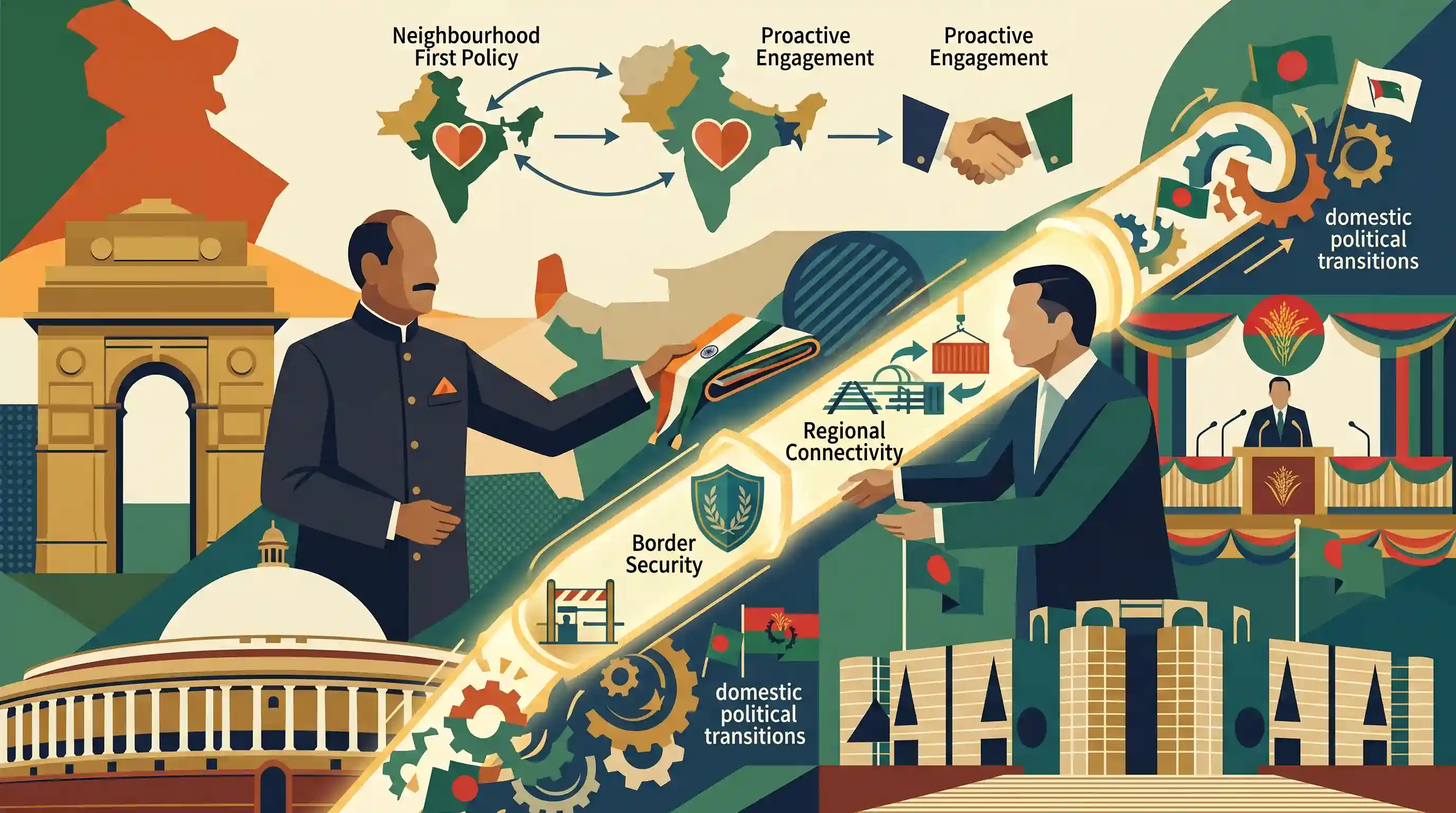
Lok Sabha Speaker Om Birla was designated to represent India at the swearing-in ceremony of Tarique Rahman, the new Prime Minister of Bangladesh from the Bangladesh Nationalist Party (BNP). This diplomatic gesture signifies New Delhi's proactive engagement with the newly formed government in Dhaka, moving past its historical closeness with the Awami League. The move underscores India's commitment to its 'Neighbourhood First' policy, utilizing parliamentary diplomacy to ensure that critical bilateral interests—ranging from border security to regional connectivity—remain insulated from domestic political transitions in neighboring countries.
Key Points
- Lok Sabha Speaker Om Birla represented India at the swearing-in ceremony of Tarique Rahman as the new Prime Minister of Bangladesh.
- The visit underscores India's pragmatic diplomatic approach to engage with the new Bangladesh Nationalist Party (BNP) leadership following regime change in Dhaka.
- Sending the Lok Sabha Speaker highlights the use of parliamentary diplomacy to signal goodwill and democratic solidarity.
- Maintaining stable ties with the new administration in Bangladesh remains critical for India's border security, connectivity projects in the North-East, and overall regional stability under the 'Neighbourhood First' policy.
Important Terms
Neighbourhood First Policy

India's foreign policy approach prioritizing immediate neighbors to ensure regional stability, economic connectivity, and cooperative security through a consultative and often non-reciprocal framework.
UPSC context
GS Paper II: International Relations. Tests understanding of regional leadership, 'Gujral Doctrine' evolution, and countering external influences like China.
Bangladesh Nationalist Party (BNP)
A major center-right political party in Bangladesh founded by Ziaur Rahman. It champions 'Bangladeshi nationalism' and has historically had more strained, security-focused relations with India compared to its rivals.
UPSC context
GS Paper II: India and its neighborhood. Relevant for analyzing political shifts in Dhaka and their impact on India’s security and Northeast stability.
Awami League
The secular, historically pro-India party that led the 1971 Liberation War. Under Sheikh Hasina, it maintained a 'Golden Chapter' of ties with India focused on security and connectivity until its 2024 ouster.
UPSC context
GS Paper II: Bilateral relations. Crucial for understanding the historical foundation of Indo-Bangla ties and the strategic challenges of regime transitions.
Lok Sabha Speaker
The constitutional head and presiding officer of India’s Lower House. The Speaker represents the House at international events and facilitates inter-parliamentary relations as ex-officio President of the Indian Parliamentary Group.
UPSC context
GS Paper II: Indian Polity. Tests knowledge of constitutional offices and the use of legislative figures to promote India's interests abroad.
Parliamentary Diplomacy
The use of inter-parliamentary exchanges and legislative representatives to conduct international relations, foster mutual understanding, and maintain bilateral ties, especially during sensitive executive-level political transitions.
UPSC context
GS Paper II: International Relations. Relevant for discussing non-traditional diplomatic channels and India’s soft power engagement strategies in the neighborhood.
Prelims Trap
"The Lok Sabha Speaker constitutionally acts as the ex-officio diplomatic envoy for foreign state ceremonies."
Sending the Speaker to a foreign PM's swearing-in is an executive diplomatic gesture ('parliamentary diplomacy'), not a constitutional or statutory mandate.
Static Concepts Connected
What are the key connectivity links between India and Bangladesh?
- Rail Links: Agartala-Akhaura (Tripura to Bangladesh) and Haldibari-Chilahati (West Bengal to Bangladesh) connect the Northeast to broader commercial networks.
- Maitri Setu: A strategic bridge built over the Feni River, connecting Sabroom in Tripura to Ramgarh in Bangladesh.
- Port Transit: Bilateral agreements currently allow India to use Chattogram and Mongla ports for the transshipment of goods to the Northeast.
What is the Speaker's role in inter-parliamentary relations?
- IPG President: The Speaker is the ex-officio President of the Indian Parliamentary Group (IPG), which links India's Parliament to foreign parliaments.
- Delegation Head: The Speaker leads Indian parliamentary delegations to the Inter-Parliamentary Union (IPU) and the Commonwealth Parliamentary Association (CPA).
Cross-Topic Patterns
Parliamentary Diplomacy + Soft Power
Deploying legislative heads for executive ceremonies acts as a 'soft power' tool, building institutional, non-partisan trust in transitional democracies independent of executive-to-executive baggage.
Internal Security + Regime Change
India's swift outreach to the BNP underscores that border management (4,096-km) and preventing North-East insurgent spillover demand regime-agnostic pragmatism, decoupling security from political ideologies.

Expect a GS2 Mains question in 2026 on the shift toward 'regime-agnostic' diplomacy to protect Act East and Neighbourhood First interests.
Linked PYQs · 3
Linked PYQs · 3
- 2020MainsGS3
Analyze internal security threats and transborder crimes along Myanmar, Bangladesh and Pakistan borders including Line of Control (LoC). Also discuss the role played by various security forces in this regard.
- 2022MainsGS2
India is an age-old friend of Sri Lanka.’ Discuss India's role in the recent crisis in Sri Lanka in the light of the preceding statement.
- 2015MainsGS2
Project 'Mausam' is considered a unique foreign policy initiative of the Indian Government to improve relationship with its neighbours. Does the project have a strategic dimension? Discuss.
