Strait of Hormuz Tanker Blast and Maritime Security Risks
Source:Indian Express ↗
ఇది ఎందుకు ముఖ్యం
The escalation of maritime hostilities in the Strait of Hormuz directly threatens global energy corridors. For India, which relies heavily on crude imports passing through the Persian Gulf, such disruptions jeopardize energy security, spike oil import bills, threaten Indian expatriates, and necessitate protective naval operations like Operation Sankalp.
సారాంశం
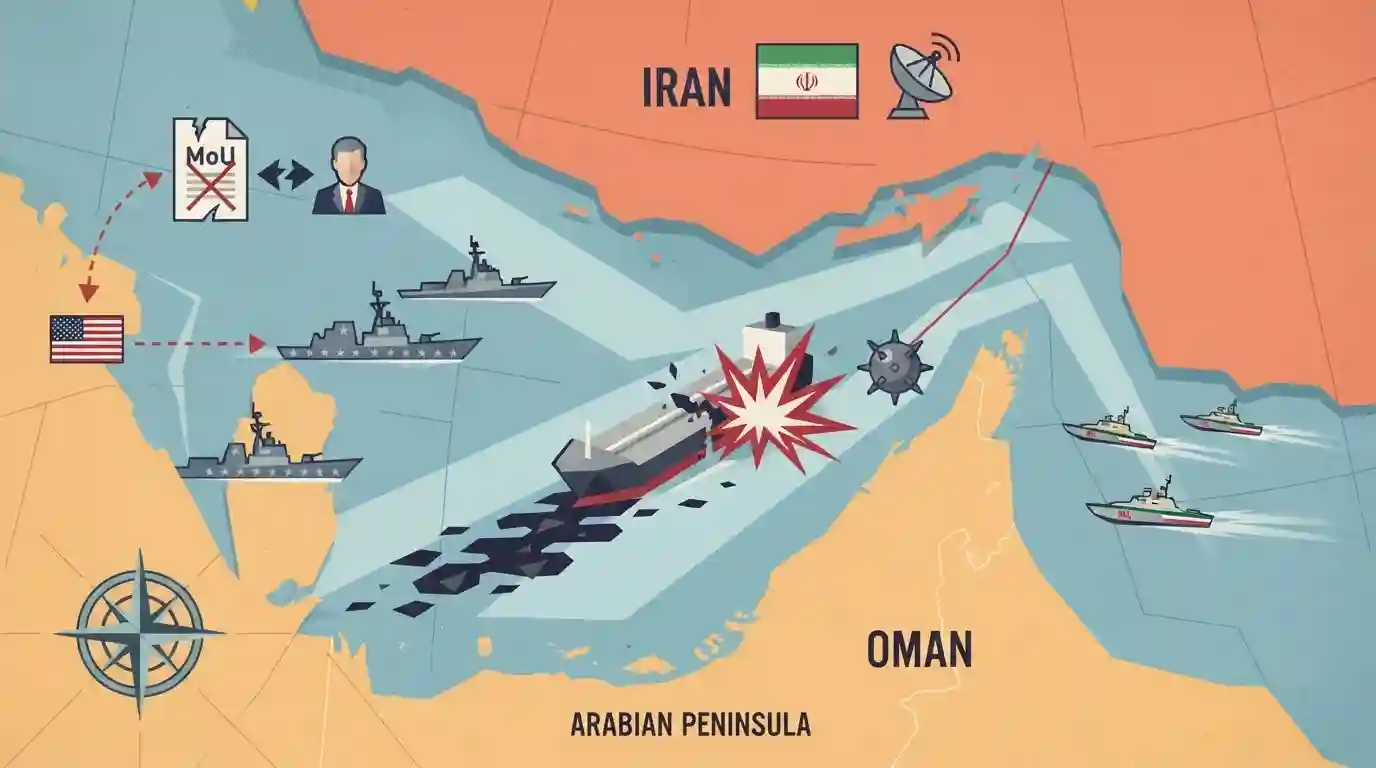
On July 26, 2026, an oil tanker exploded in the strategic Strait of Hormuz after hitting an Iranian naval mine. The vessel had drifted outside the navigation routes unilaterally designated by Iran's military. This incident follows a series of maritime disruptions by the Islamic Revolutionary Guard Corps (IRGC) in July 2026 and comes amid heightened US-Iran tensions after US President Donald Trump terminated a month-old bilateral Memorandum of Understanding (MoU) on July 8, 2026.
ముఖ్య అంశాలు
- An unidentified oil tanker exploded in the Strait of Hormuz after colliding with an Iranian naval mine outside Tehran's designated navigation routes.
- Iran's military (IRGC) had unilaterally restricted passage through the strait starting June 26, 2026, warning that vessels deviating from authorized lanes would face military action or mine hazards.
- Tensions between the US and Iran escalated significantly after US President Donald Trump canceled a bilateral Memorandum of Understanding (MoU) on July 8, 2026, citing violations by Iran.
- This incident is part of a series of maritime confrontations in July 2026, including the IRGC disabling two tankers on July 14 and another tanker catching fire on July 23 after hitting an explosive device.
- The Strait of Hormuz is the world's most vital energy chokepoint; unilateral restrictions and mining directly threaten global oil supply chains, maritime trade, and India's energy security.
ముఖ్యమైన పదాలు
Strait of Hormuz

A strategically vital narrow waterway between the Persian Gulf and the Gulf of Oman, handling approximately 20% of global oil consumption and serving as a critical global energy chokepoint.
UPSC context
GS Paper I (World Geography) & GS II (International Relations). Tests knowledge of critical maritime chokepoints affecting India's energy security.
Sea Lines of Communication (SLOCs)
Principal maritime routes between ports used for trade, military, and commercial shipping, vital for global commerce and a country's economic and energy security.
UPSC context
GS Paper III (Security) & GS II (International Relations). Tests understanding of maritime security and India's net security provider role.
Islamic Revolutionary Guard Corps (IRGC)
An elite, multi-service branch of the Iranian Armed Forces established after the 1979 Revolution, tasked with protecting the country's Islamic system, internal security, and projecting regional influence.
UPSC context
GS Paper II (International Relations) & GS III (Security). Tests understanding of Middle East geopolitics, proxy warfare, and regional stability.
Tasnim News Agency
A major semi-official Iranian news agency founded in 2012, closely aligned with and controlled by the Islamic Revolutionary Guard Corps (IRGC) to promote state narratives.
UPSC context
GS Paper II (International Relations). Relates to information warfare, state media's geopolitical influence, and international sanctions.
Mehr News Agency
A semi-official Iranian news agency based in Tehran, established in 2003 and owned by the Islamic Development Organization to disseminate state-approved news and cultural content.
UPSC context
GS Paper II (International Relations). Tests awareness of state-controlled media apparatuses in the Middle East and international propaganda networks.
ప్రిలిమ్స్ ఉచ్చు
The Strait of Hormuz is governed strictly by UNCLOS 'Transit Passage' rules ratified by all bordering nations.
Iran signed but did not ratify UNCLOS. It applies 'Innocent Passage' under domestic law, allowing it to suspend transit, unlike 'Transit Passage' which cannot be suspended.
అనుసంధానమైన స్థిర భావనలు
What is the legal distinction between 'Transit Passage' and 'Innocent Passage' under UNCLOS?
- Transit Passage rules: Applies to straits used for international navigation. It permits continuous, expeditious transit—including submerged submarines and overflight—which coastal states cannot suspend.
- Innocent Passage limitations: Applies to territorial waters. Coastal states can temporarily suspend transit for security. Submarines must navigate on the surface, and overflight is not permitted.
- Iran's legal stance: Because Iran signed but did not ratify UNCLOS, it recognizes only 'Innocent Passage' in its territorial portion of the strait, asserting unilateral monitoring rights.
What are the key maritime chokepoints of the Indian Ocean Region (IOR)?
- Strait of Hormuz: Connects the Persian Gulf to the Gulf of Oman; handles ~25% of global seaborne oil trade, making it the world's most critical energy transit corridor.
- Bab-el-Mandeb: Connects the Red Sea to the Gulf of Aden; acts as the gateway to the Suez Canal, highly vulnerable to geopolitical instability and regional conflict.
- Strait of Malacca: Connects the Indian Ocean to the South China Sea; the primary conduit for East Asian trade, central to the geopolitical concept of the 'Malacca Dilemma'.
అంతర-అంశ నమూనాలు
Energy security & Strategic Petroleum Reserves (SPR)
Hormuz disruptions directly threaten India's oil supply, highlighting the policy urgency to expand India's Phase II Strategic Petroleum Reserves (SPR) to counter sudden maritime supply shocks.
UNCLOS disputes & Indo-Pacific rule of law
Iran's unilateral maritime restrictions parallel China's domestic maritime laws, showing how selective interpretation of UNCLOS by regional powers threatens global Sea Lines of Communication (SLOCs).

UNCLOS legal regimes (Transit vs Innocent passage) combined with West Asian chokepoint geography will likely feature in 2026 Prelims.
అనుసంధాన PYQలు · 4
అనుసంధాన PYQలు · 4
- 2026PrelimsGS1
Ships from which of the following countries have to cross the Strait of Hormuz to reach out to the Indian Ocean ? 1. Bahrain 2. Syria 3. Qatar 4. Egypt Select the answer using the code given below :
- 2025MainsGS3
Why is maritime security vital to protect India's sea trade? Discuss maritime and coastal security challenges and the way forward.
- 2025MainsGS2
"Energy security constitutes the dominant kingpin of India's foreign policy, and is linked with India's overarching influence in Middle Eastern countries.” How would you integrate energy security with India's foreign policy trajectories in the coming years?
- 2018MainsGS2
In what ways would the ongoing US-Iran Nuclear Pact Controversy affect the national interest of India? How should India respond to this situation?
