Crude Oil Prices Rise Following US Maritime Advisory Near Iran
Source:Indian Express ↗
Why It Matters
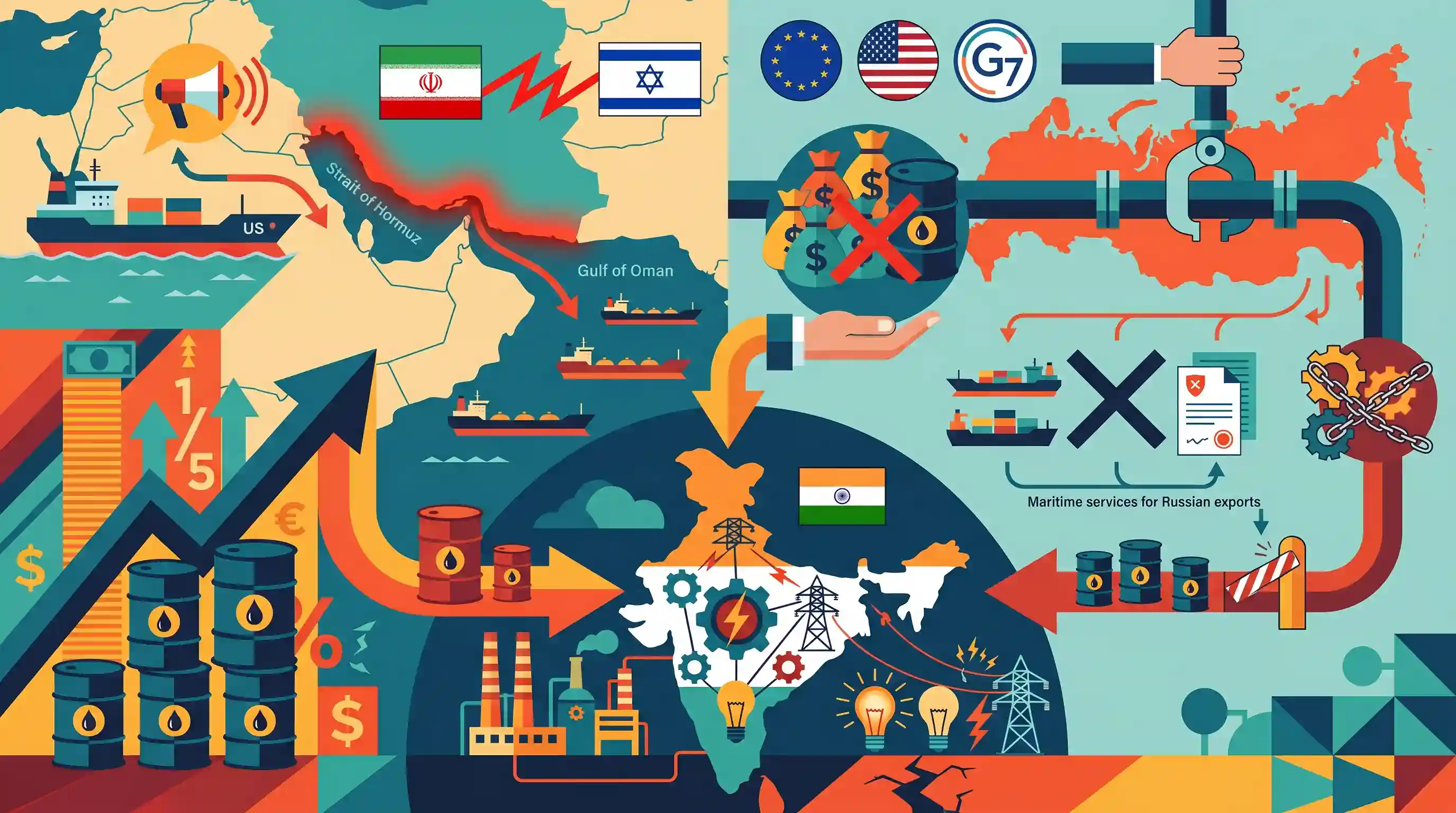
The developments highlight the fragility of global energy supply chains dependent on maritime chokepoints like the Strait of Hormuz, and demonstrate how Western sanctions on Russia directly shape India's energy import strategies and broader economic interests.
Summary
The United States issued a maritime advisory urging its vessels to avoid Iranian territory while navigating the Strait of Hormuz and the Gulf of Oman, reflecting heightened geopolitical tensions involving Iran and Israel. This development triggered an immediate rise in global crude oil prices, underscoring the strategic vulnerability of the Strait, which facilitates roughly one-fifth of global oil consumption. Parallelly, Western nations are intensifying efforts to restrict Russia's oil revenues, with the European Commission proposing bans on maritime services supporting Russian seaborne crude exports. Consequently, Indian refiners have reportedly curtailed purchases of Russian crude to comply with international sanctions, further compounding global energy security dynamics.
Key Points
- The US Department of Transportation issued an advisory urging US-flagged vessels to maintain maximum distance from Iranian waters while navigating the Strait of Hormuz and the Gulf of Oman.
- The maritime warning, stemming from escalating Iran-Israel tensions, sparked an immediate surge in global crude oil prices due to supply disruption fears.
- The Strait of Hormuz is a vital global energy chokepoint, facilitating the transit of approximately one-fifth of total global oil consumption.
- The European Commission proposed sweeping bans on European shipping and insurance services supporting Russia's seaborne crude exports to restrict its war-funding capabilities.
- In response to tightening Western sanctions and price caps, Indian refiners have reportedly halted or reduced purchases of Russian seaborne crude.
Important Terms
Strait of Hormuz

A strategic waterway between the Persian Gulf and Gulf of Oman, facilitating roughly 20% of global oil consumption. It is the world's most critical oil chokepoint.
UPSC context
GS Paper 1/2: World Geography/International Relations. Tests knowledge of maritime chokepoints and India’s energy vulnerability in West Asia.
Russian Oil Price Cap
A sanction mechanism by the G7, EU, and Australia capping Russian seaborne crude at $60/barrel to restrict its war-financing revenue while preventing global supply shocks.
UPSC context
GS Paper 2/3: International Relations/Economy. Tests understanding of geo-economic sanctions and their impact on India’s crude procurement.
G7 (Group of Seven)
An informal intergovernmental forum of seven advanced economies (USA, UK, France, Germany, Italy, Japan, Canada) coordinating on global economic governance and security.
UPSC context
GS Paper 2: Important International Institutions. Tests the role of developed-nation blocs in shaping global policies affecting India.
European Commission
The executive branch of the European Union responsible for proposing legislation, enforcing EU laws, and managing the implementation of international sanctions.
UPSC context
GS Paper 2: International Relations. Relevant for understanding the institutional mechanics of EU-led global economic policies.
Maritime Advisory
Security guidance issued by the U.S. Maritime Administration (MARAD) to commercial vessels regarding regional threats, such as potential Iranian interference in the Persian Gulf.
UPSC context
GS Paper 2: International Relations/Security. Tests awareness of maritime safety protocols and geopolitical signaling in conflict-prone regions.
Energy Security
The uninterrupted availability of energy sources at an affordable price, crucial for a nation's economic stability and industrial growth.
UPSC context
GS Paper 3: Economic Development/Environment. A core theme regarding India's dependence on imports and strategic reserves.
Prelims Trap
"The G7 price cap strictly prohibits non-G7 nations like India from purchasing Russian crude oil."
The mechanism does not ban purchases by third countries; it merely restricts access to Western shipping and insurance services if the oil is bought above the agreed cap.
Static Concepts Connected
What are the geographical boundaries of key Middle Eastern maritime chokepoints?
- Strait of Hormuz: Connects the Persian Gulf to the Gulf of Oman and the Arabian Sea. It is bordered by Iran to the north and Oman (Musandam Peninsula) to the south.
- Bab el-Mandeb: Connects the Red Sea to the Gulf of Aden and the Indian Ocean. It is bordered by Yemen on the Arabian Peninsula, and Djibouti and Eritrea in Africa.
How does the G7 'Price Cap Coalition' restrict Russian oil revenues?
- Price Ceiling: Permits third countries to continue buying Russian seaborne oil, avoiding a global supply shock, provided the oil is purchased at or below a set maximum price.
- Service Ban: Prohibits Western-dominated firms from providing crucial maritime insurance, trade finance, or shipping services for Russian oil cargoes sold above the established cap.
- Shadow Fleet: Russia's primary counter-response involves using aging, under-insured tankers to bypass Western maritime services, significantly raising the risk of maritime oil spills.
Cross-Topic Patterns
Chokepoint risks and India's SPR limits
Disruptions in Hormuz directly threaten India's macroeconomy (current account deficit, inflation). This frequently links to the necessity of expanding India's Strategic Petroleum Reserves (SPR) beyond its current ~9.5 days capacity.
Sanctions, Vostro Accounts, and Deficits
Tightening Western secondary sanctions on Russian oil payments forced a shift to Rupee-Rouble trade via Special Rupee Vostro Accounts (SRVAs), which has stalled due to massive bilateral trade imbalances.

A 2026 Prelims question will likely fuse Middle East map locations (Hormuz, Gulf of Oman) with the mechanics of the G7 oil price cap.
Linked PYQs · 2
Linked PYQs · 2
- 2025MainsGS2
"Energy security constitutes the dominant kingpin of India's foreign policy, and is linked with India's overarching influence in Middle Eastern countries.” How would you integrate energy security with India's foreign policy trajectories in the coming years?
- 2024PrelimsGS1
Consider the following statements : Statement-I : Sumed pipeline is a strategic route for Persian Gulf oil and natural gas shipments to Europe. Statement-II : Sumed pipeline connects the Red Sea with the Mediterranean Sea. Which one of the following is correct in respect of the above statements?
