Geopolitical Supply Shocks Keep Global Crude Oil Markets Volatile
Source:The Hindu ↗
Why It Matters
The Strait of Hormuz is a critical chokepoint for India's energy imports. Geopolitical instability involving the US, Iran, and OPEC directly impacts global crude oil prices, which in turn affects India's macroeconomic stability, inflation, and foreign policy calculus in the Middle East.
Summary
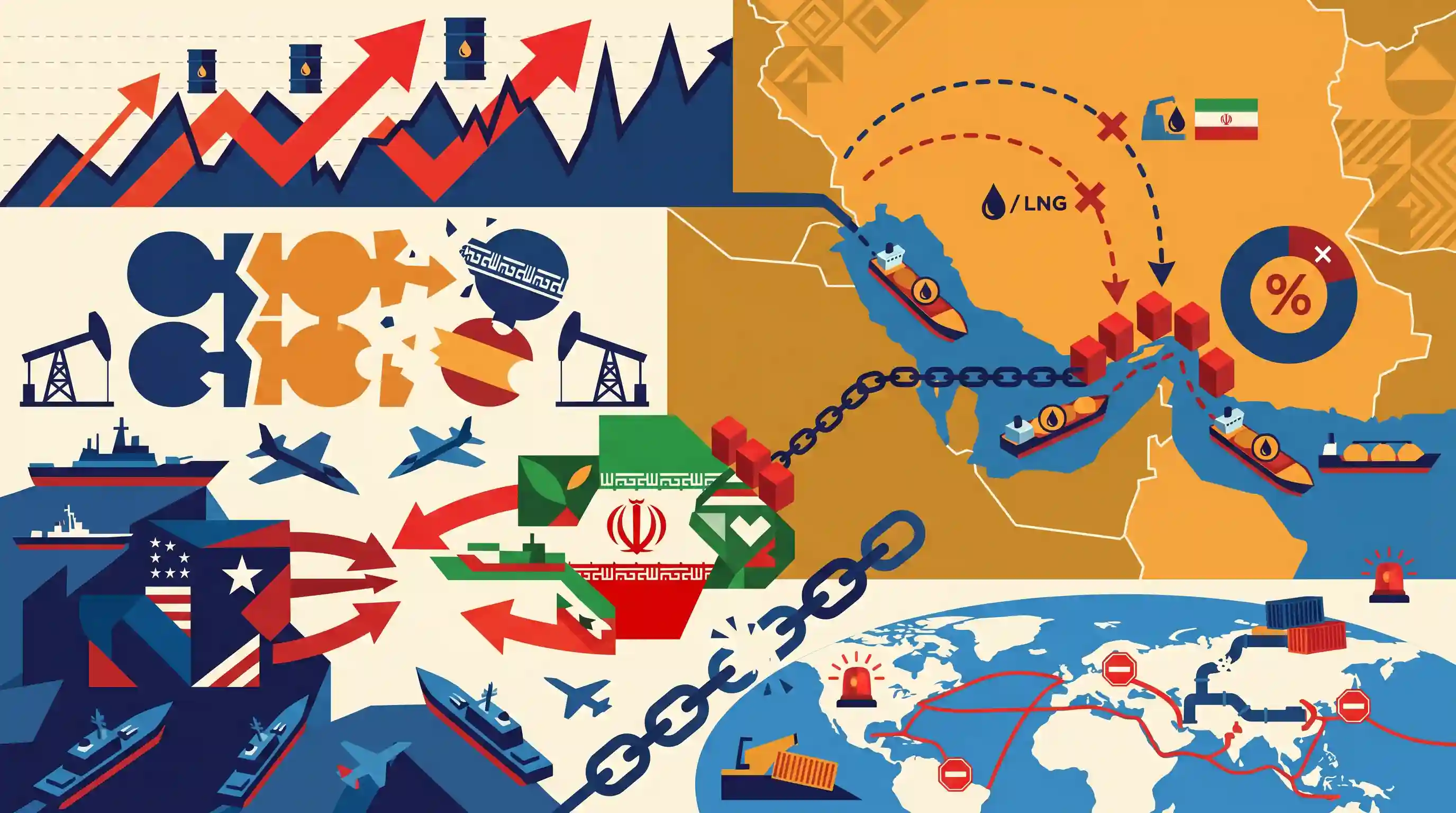
Global oil prices remain highly volatile and elevated amid dual geopolitical supply shocks in the Middle East. The United Arab Emirates (UAE) made a surprise exit from OPEC, disrupting established oil production consensus. Simultaneously, the US-Iran conflict has escalated, with Iran blockading the Strait of Hormuz—a vital transit route for 20% of global oil and LNG—while the US prepares a counter-blockade on Iranian shipping. These compounding crises highlight extreme risks to global energy security and crude oil supply chains.
Key Points
- The UAE unexpectedly exited the OPEC oil cartel, introducing major uncertainty into global oil production quotas and market stability.
- Iran has blockaded the Strait of Hormuz—a maritime chokepoint handling roughly 20% of global oil and LNG supplies—over a nuclear dispute and demands for reparations.
- The US government is preparing to enforce a shipping blockade to further squeeze Iran's economy and crude exports.
- Despite a slight easing from recent peaks, Brent crude prices remain highly elevated (above $111 a barrel) due to these compounded geopolitical supply shocks.
Important Terms
OPEC

A permanent intergovernmental organization founded in 1960 to coordinate petroleum policies among member nations and ensure stable oil prices. Its headquarters are in Vienna, Austria.
UPSC context
GS Paper 2 (International Relations) and GS Paper 3 (Energy/Economy); tests understanding of global groupings and India's energy diplomacy.
OPEC+
An expanded alliance formed in 2016 between OPEC and 10 non-OPEC oil-producing countries (notably Russia) to exercise greater control over global oil supply and market stability.
UPSC context
GS Paper 2 (IR) and GS Paper 3; critical for understanding production quotas and their impact on global inflation and India's trade deficit.
Strait of Hormuz
A narrow, strategically vital waterway between Iran and Oman connecting the Persian Gulf to the Gulf of Oman; it handles approximately 20% of global oil and LNG flows.
UPSC context
GS Paper 1 (World Geography) and GS Paper 2 (West Asia Relations); tests knowledge of critical maritime chokepoints and geopolitical flashpoints.
Energy Security
The uninterrupted availability of energy sources at an affordable price, vital for a nation's economic growth and stability.
UPSC context
GS Paper 3 (Energy sector and Internal Security); essential for discussing India's 85% dependence on crude oil imports and strategic petroleum reserves.
Maritime Chokepoint
A narrow maritime passage with high traffic volume where a blockage can significantly disrupt global shipping and trade routes.
UPSC context
GS Paper 1 (Geography) and GS Paper 3 (Economic Development); tests the ability to map global trade vulnerabilities and strategic naval priorities.
UNCLOS
A 1982 international treaty establishing the legal framework for all marine and maritime activities, including rights of transit through strategic straits.
UPSC context
GS Paper 2 (International Law and Institutions); crucial for legal discussions on maritime blockades, navigation freedom, and territorial waters.
Prelims Trap
"Chabahar Port is located within the Strait of Hormuz."
Chabahar is actually in the Gulf of Oman, completely outside the Strait of Hormuz. This geographic bypass is precisely what makes it a strategic asset during Persian Gulf blockades.
Static Concepts Connected
What are the key maritime chokepoints in the Middle East?
- Strait of Hormuz: Connects the Persian Gulf to the Gulf of Oman. Geographically bounded by Iran and Oman; a critical global oil transit route.
- Bab el-Mandeb: Connects the Red Sea to the Gulf of Aden and Arabian Sea. Bounded by Yemen on the Arabian Peninsula, and Djibouti/Eritrea in Africa.
- Suez Canal: An artificial waterway connecting the Red Sea to the Mediterranean Sea, controlled by Egypt.
How do OPEC and OPEC+ differ in their mandate and membership?
- OPEC: Established in 1960, it is a permanent intergovernmental cartel of major oil-exporting nations designed to coordinate petroleum policies and stabilize oil markets.
- OPEC+: An extended alliance created in 2016 between OPEC members and 10 major non-OPEC oil producers, predominantly led by Russia, to better control global supply.
Cross-Topic Patterns
Energy Security + Rupee Depreciation
High crude prices directly widen India's Current Account Deficit (CAD), causing imported inflation and putting downward pressure on the Indian Rupee, limiting RBI's policy maneuvers.
Hormuz Blockade + INSTC Validation
The chokepoint vulnerability justifies India's strategic push for Chabahar Port and the International North-South Transport Corridor (INSTC) to secure resilient trade routes outside the Persian Gulf.

Expect a multi-statement Prelims question mapping Middle East chokepoints against India's strategic assets like Chabahar in 2026.
Linked PYQs · 4
Linked PYQs · 4
- 2025MainsGS2
"Energy security constitutes the dominant kingpin of India's foreign policy, and is linked with India's overarching influence in Middle Eastern countries.” How would you integrate energy security with India's foreign policy trajectories in the coming years?
- 2018MainsGS2
In what ways would the ongoing US-Iran Nuclear Pact Controversy affect the national interest of India? How should India respond to this situation?
- 2024PrelimsGS1
Consider the following statements : Statement-I : Sumed pipeline is a strategic route for Persian Gulf oil and natural gas shipments to Europe. Statement-II : Sumed pipeline connects the Red Sea with the Mediterranean Sea. Which one of the following is correct in respect of the above statements?
- 2025PrelimsGS1
India is one of the founding members of the International North-South Transport Corridor (INSTC), a multimodal transportation corridor, which will connect
