Brent Crude Crosses 100 Dollars Following Hormuz Blockade
Source:The Hindu ↗
Why It Matters
The blockade of the Strait of Hormuz is a prime example of how geopolitical conflicts in the Middle East can trigger global macroeconomic shocks. For UPSC aspirants, this illustrates the critical importance of maritime chokepoints in international trade (Prelims Geography), the dynamics of global crude oil benchmarks like Brent and WTI (Prelims Economy), and the strategic imperative of energy security in India's foreign policy (Mains GS2 & GS3).
Summary
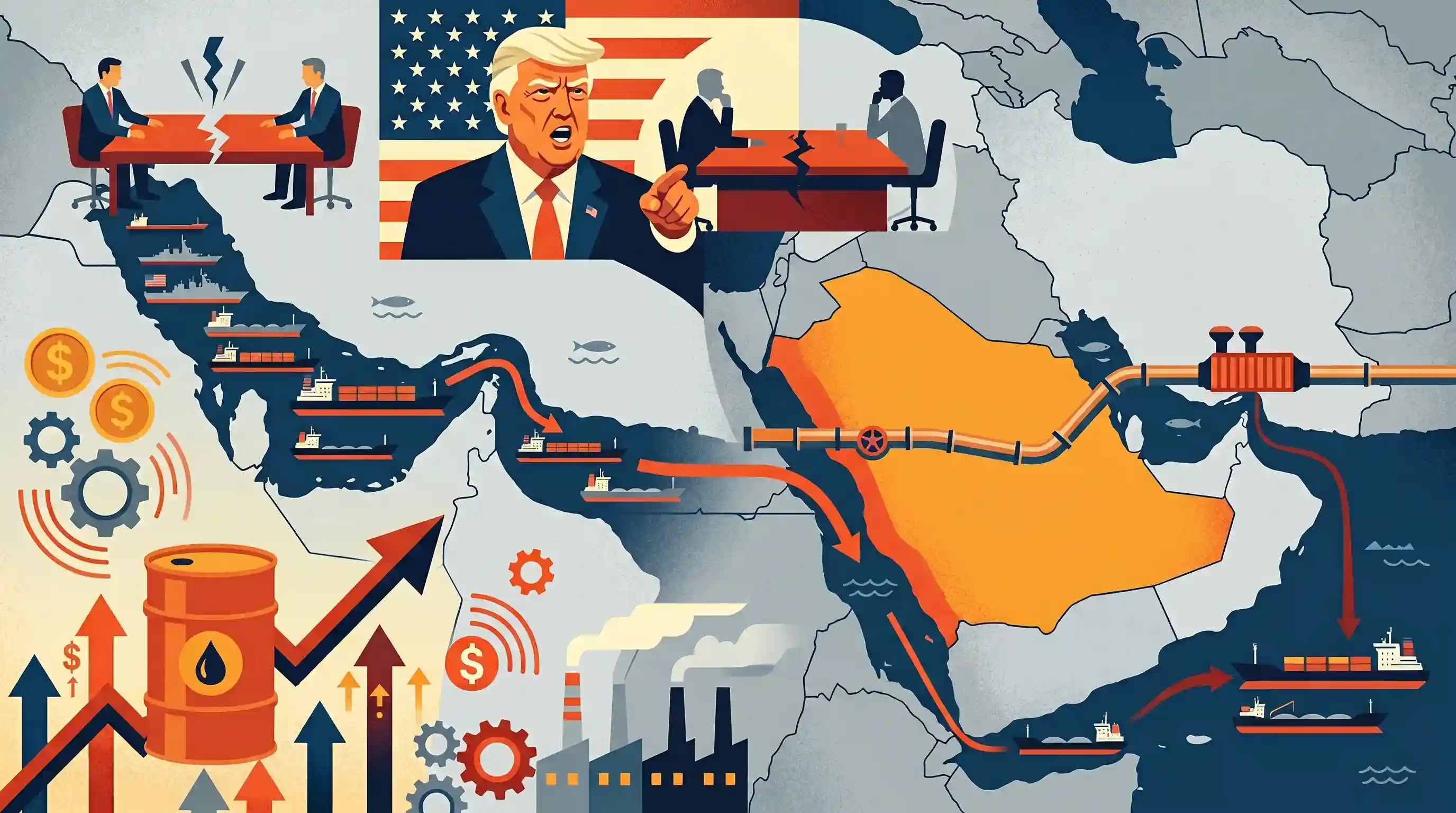
In April 2026, Brent crude oil prices breached the $100 per barrel mark following the U.S. Navy's commencement of a blockade in the Strait of Hormuz. Ordered by U.S. President Donald Trump after failed peace negotiations with Iran, the blockade aims to halt Iranian oil exports. This geopolitical escalation raises severe concerns over global energy security, as the Strait is a vital maritime chokepoint for international oil trade. To mitigate the disruption, Saudi Arabia has maximized its pumping capacity via the East-West pipeline to bypass the strait, highlighting the critical interplay between Middle Eastern geopolitics and global macroeconomic stability.
Key Points
- The U.S. Navy initiated a blockade of the Strait of Hormuz to restrict Iranian oil shipments after negotiations to end the U.S.-Iran conflict failed under President Donald Trump.
- Brent crude prices surged past $100 a barrel as a direct consequence of the supply chain disruption in the critical maritime chokepoint.
- Saudi Arabia responded by fully restoring its oil pumping capacity through the East-West pipeline to bypass the blockaded strait.
- The escalation highlights the vulnerability of global energy security and oil markets to geopolitical tensions in the Middle East.
Important Terms
Strait of Hormuz

The world's most critical maritime chokepoint, situated between Iran and Oman, connecting the Persian Gulf to the Arabian Sea. It handles approximately 20% of global oil and LNG trade.
UPSC context
GS Paper 1 (Geography) and Paper 2 (International Relations); essential for mapping and understanding West Asian geopolitics and energy security.
Brent crude
A major global price benchmark for light, sweet crude oil sourced from the North Sea. It is used to price over 75% of internationally traded oil.
UPSC context
GS Paper 3 (Economy); critical for analyzing India's energy import costs, inflation, and fiscal deficit.
East-West pipeline
A 1,200 km Saudi Arabian pipeline (Petroline) connecting eastern oil fields to the Red Sea port of Yanbu, designed to bypass the Strait of Hormuz during regional conflicts.
UPSC context
GS Paper 2 (International Relations) and GS Paper 3 (Energy Security); illustrates strategic infrastructure used to mitigate maritime chokepoint risks.
Maritime chokepoints
Narrow, strategic maritime passages (e.g., straits, canals) where high volumes of trade pass, making them vulnerable to geopolitical disruptions and security threats.
UPSC context
GS Paper 1 (Geography) and Paper 3 (Economy); tests awareness of global trade vulnerabilities and their macroeconomic impacts.
U.S. Navy
The naval warfare branch of the U.S. military. Its Fifth Fleet, based in Bahrain, ensures maritime security and freedom of navigation in the Persian Gulf and Arabian Sea.
UPSC context
GS Paper 2 (International Relations); concerns the role of global powers in maintaining maritime order and the UNCLOS framework.
Prelims Trap
"The Strait of Hormuz connects the Persian Gulf directly to the Red Sea."
Aspirants often confuse Middle Eastern chokepoints. Hormuz connects the Persian Gulf to the Gulf of Oman, whereas Bab-el-Mandeb connects the Red Sea to the Gulf of Aden.
Static Concepts Connected
What are the key geographical features of the Strait of Hormuz?
- Bordering Nations: It lies between Iran to the north and the UAE and Oman (specifically the Musandam Peninsula) to the south.
- Connecting Waters: It forms a crucial maritime chokepoint connecting the Persian Gulf to the Gulf of Oman and subsequently the Arabian Sea.
- Strategic Value: Facilitates transit for nearly 20% of global oil consumption and substantial LNG trade, making it highly vulnerable to geopolitical blockades.
How do Brent Crude and WTI differ as global oil benchmarks?
- Geographical Origin: Brent is extracted from the North Sea (Europe), while West Texas Intermediate (WTI) is sourced entirely from US oil fields.
- Indian Context: India’s crude basket is predominantly benchmarked against Brent and Dubai/Oman, making India more sensitive to Brent price fluctuations than WTI.
- Market Influence: Brent serves as the broader global price reference for waterborne crude, whereas WTI reflects the US domestic landlocked market.
Cross-Topic Patterns
Oil shocks & India's Macroeconomics
A surge in Brent crude directly widens India's Current Account Deficit (CAD), drives imported inflation, and depreciates the Rupee, squeezing the RBI's monetary policy space.
Strategic Petroleum Reserves (SPR) relevance
Supply disruptions in Hormuz underscore the critical importance of India's Strategic Petroleum Reserves (SPR) at locations like Padur and Visakhapatnam to cushion against short-term global shocks.

Expect a 2026 Prelims map question pairing West Asian chokepoints (Hormuz, Bab-el-Mandeb) with bordering nations and bypass pipelines.
Linked PYQs · 3
Linked PYQs · 3
- 2020PrelimsGS1
The term 'West Texas Intermediate', sometimes found in news, refers to a grade of
- 2024PrelimsGS1
Consider the following statements : Statement-I : Sumed pipeline is a strategic route for Persian Gulf oil and natural gas shipments to Europe. Statement-II : Sumed pipeline connects the Red Sea with the Mediterranean Sea. Which one of the following is correct in respect of the above statements?
- 2025MainsGS2
"Energy security constitutes the dominant kingpin of India's foreign policy, and is linked with India's overarching influence in Middle Eastern countries.” How would you integrate energy security with India's foreign policy trajectories in the coming years?
