Assessing India Energy Dependence and Strategic Imports from Russia
Source:The Hindu ↗
Why It Matters
This article provides a critical, multi-dimensional analysis of India's current energy diplomacy. It connects trade data (Ministry of Commerce and Industry) with high-stakes geopolitical questions of strategic autonomy, secondary sanctions, West Asian choke points, and the macroeconomic impact of settling oil trade in Chinese Yuan.
Summary
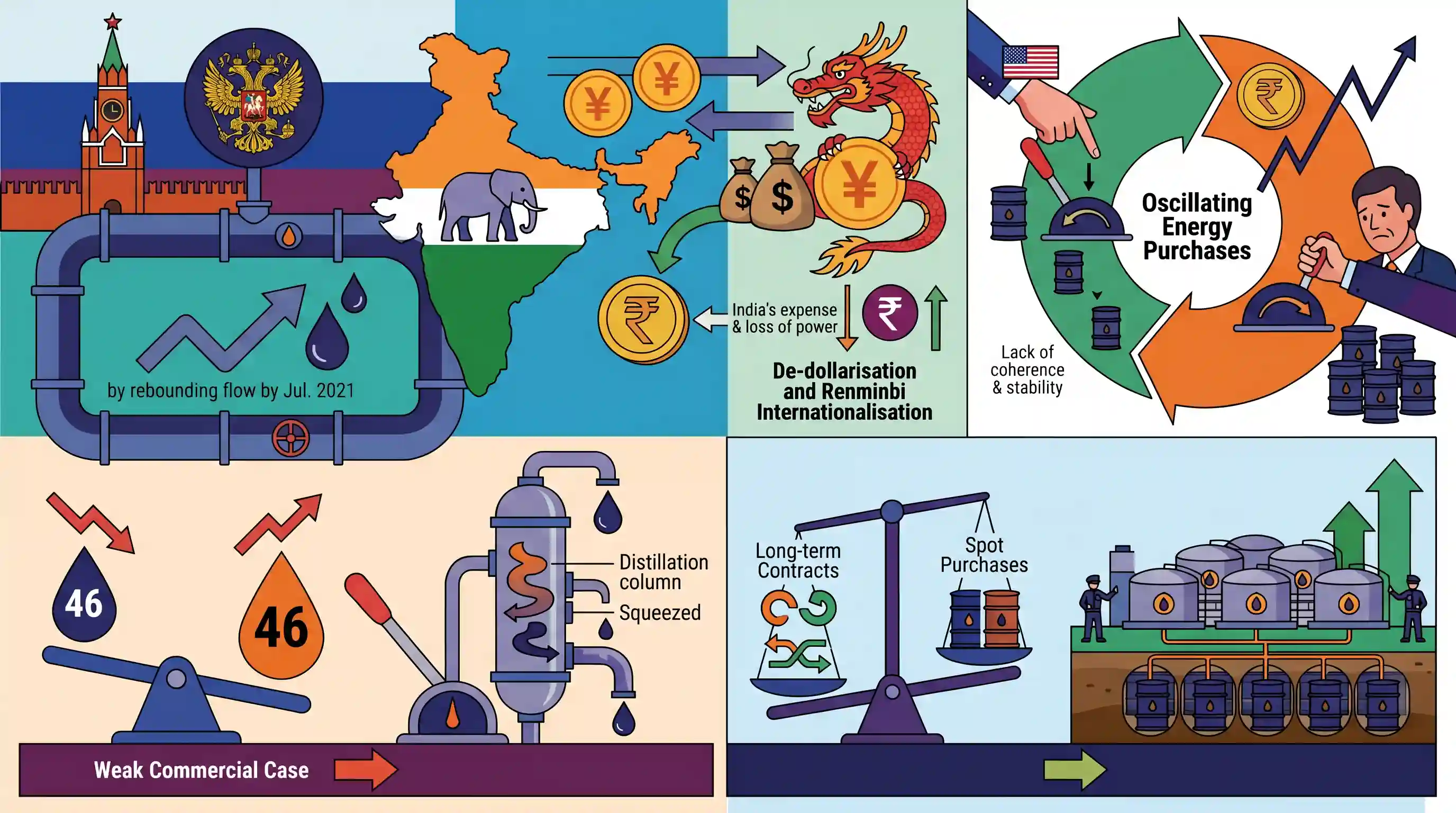
India's crude imports from Russia have rebounded to over 40% of its total imports as of May 2026. However, the commercial justification is weakening as narrowing discounts have turned into a premium of $46 per ton, compressing refining margins. Geopolitically, settling trades in Yuan aids China's currency internationalisation at India's expense. The article argues that India's oscillating energy purchases—bowing to US pressure to cut cheap imports but surging back during high-premium periods—expose a lack of strategic coherence. To secure its energy future, India must balance spot purchases with stable long-term contracts and urgently expand its Strategic Petroleum Reserves (SPR).
Key Points
- India's oil imports from Russia rebounded to pre-sanction levels (over 40% of its import basket) in May 2026, despite growing geopolitical pressure.
- The discount on Russian crude (Urals vs Brent) has significantly narrowed, with May imports carrying a premium of $46 per ton, which has reduced gross refining margins for Indian refiners.
- Paying for Russian crude in Chinese Yuan aids the internationalisation of Beijing's currency at India's geopolitical expense, despite domestic capital controls shielding the Rupee.
- Over-reliance on a single oil source undermines India's long-standing energy diversification strategy, erodes its bargaining leverage, and exposes it to secondary sanctions.
- India's shifting import patterns—cutting Russian imports under US pressure when they were cheap, but increasing them at a premium due to West Asian tensions—reveal inconsistencies in strategic autonomy.
- To mitigate vulnerabilities, India needs to balance spot-market buying with long-term contracts (historically accounting for 70% of imports) and prioritize the expansion of Strategic Petroleum Reserves (SPR).
Important Terms
Strategic Petroleum Reserves (SPR)

Emergency stockpiles of crude oil maintained by governments to safeguard national energy security against supply disruptions, geopolitical crises, and extreme global price volatility.
UPSC context
GS Paper III (Energy Security); tests India's import vulnerability, strategic storage capacity, and infrastructure requirements.
Strategic Autonomy
A foreign policy doctrine enabling a nation to make sovereign decisions and pursue independent policies without being constrained by formal military alliances or external pressures.
UPSC context
GS Paper II (International Relations); tests India's multi-alignment strategy, bilateral relationships, and diplomatic balancing.
De-dollarisation
The process of reducing a country's reliance on the U.S. dollar as the dominant reserve currency and medium for international trade settlement.
UPSC context
GS Paper III (Indian Economy); tests international trade dynamics, foreign exchange management, and rupee internationalisation.
Renminbi Internationalisation
China's policy to promote the global use of its currency (Yuan/Renminbi) in cross-border trade, settlement, financial transactions, and reserve holdings.
UPSC context
GS Paper II (Geopolitics); tests China’s economic influence, trade-settlement shifts, and implications for India’s regional trade.
Union Ministry of Commerce and Industry (MCI)
The cabinet-level ministry in India responsible for formulating and implementing national industrial policy, promoting foreign direct investment, and regulating international trade.
UPSC context
GS Paper III (Economic Development); tests institutional roles in trade facilitation, export promotion, and foreign trade policy.
Prelims Trap
All Indian crude oil imports from Russia are settled in Rupees under a risk-free bilateral mechanism.
Due to severe trade imbalances, Russia limits Rupee accumulation, forcing Indian refiners to settle trade in Chinese Renminbi (Yuan) and UAE Dirhams.
Static Concepts Connected
What is India's Strategic Petroleum Reserve (SPR) framework?
- Phase I Capacity: Holds 5.33 MMT across three coastal rock caverns: Visakhapatnam (Andhra Pradesh), Mangaluru (Karnataka), and Padur (Karnataka).
- Phase II Expansion: Approved to add 6.5 MMT at Chandikhol (Odisha) and Padur (Karnataka) using a Public-Private Partnership (PPP) commercial model.
- Nodal Agency: Managed by Indian Strategic Petroleum Reserves Limited (ISPRL), a special purpose vehicle under the Ministry of Petroleum.
Why is bilateral trade settlement in Rupees challenging?
- Trade Asymmetries: Large trade deficits leave partner nations with massive, unusable rupee surpluses they cannot easily spend on Indian exports.
- Capital Account Limits: India’s partial capital account convertibility limits offshore liquidity and free international trading of the currency.
Cross-Topic Patterns
Energy security vs Currency geopolitics
Settling energy trades in Yuan inadvertently strengthens Beijing's financial clearing systems, directly running counter to India's strategic goals of countering Chinese economic hegemony.
Choke points and Strategic Reserves
Extreme import dependency ties Indian Ocean sea-lane security directly to SPR capacity, merging maritime naval doctrine with energy procurement policies.

Mains 2026: Evaluate how high energy import dependence compromises monetary sovereignty and tests India's strategic autonomy.
Linked PYQs · 3
Linked PYQs · 3
- 2025MainsGS2
"Energy security constitutes the dominant kingpin of India's foreign policy, and is linked with India's overarching influence in Middle Eastern countries.” How would you integrate energy security with India's foreign policy trajectories in the coming years?
- 2017MainsGS2
The question of India's Energy Security constitutes the most important part of India's economic progress. Analyze India's energy policy cooperation with West Asian countries.
- 2025MainsGS3
What are the challenges before the Indian economy when the world is moving away from free trade and multilateralism to protectionism and bilateralism? How can these challenges be met?
