UAE Exit From OPEC Strains Regional Ties and Energy Security
Source:Indian Express ↗
Why It Matters
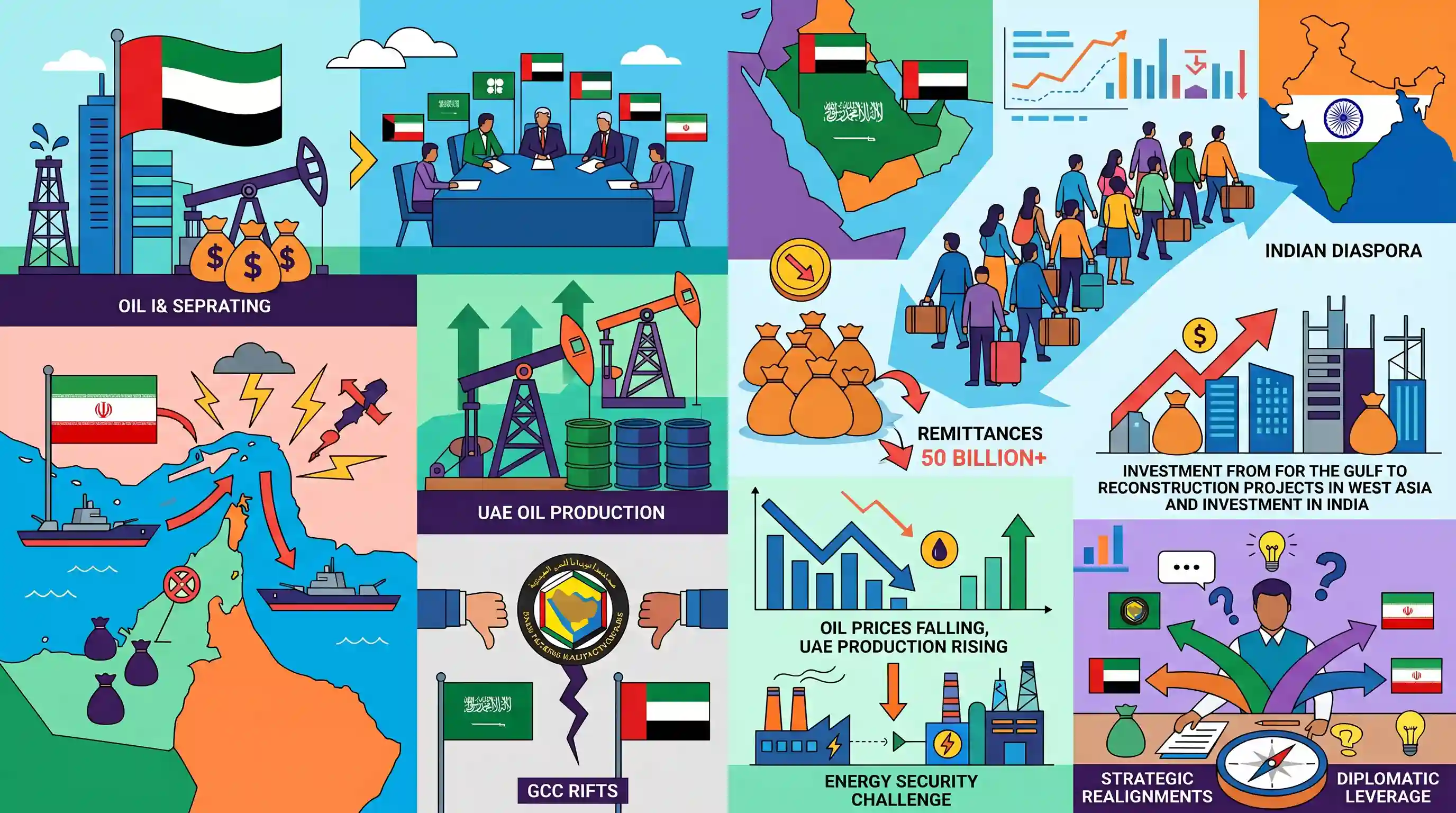
The UAE's potential realignment away from OPEC and the GCC amidst regional conflict has major implications for India's energy security, the safety of its 9-million-strong Gulf diaspora, and significant remittance and investment inflows.
Summary
The article analyzes the geopolitical and economic fallout of the UAE's exit from OPEC amidst an ongoing regional conflict involving Iran and the blockage of the Strait of Hormuz. Driven by a desire to independently maximize its low-cost oil production capacity, the UAE's departure highlights growing rifts with Saudi Arabia over regional policies and threatens the broader cohesion of the Gulf Cooperation Council (GCC). For India, this development presents a highly complex scenario. Immediate concerns center on the safety of approximately 9 million Indian migrants in the Gulf and the potential disruption of over $50 billion in annual remittances. Additionally, vital investments from Gulf sovereign wealth funds may decline as capital is diverted to domestic reconstruction. Conversely, the UAE's push to increase production could eventually lower global oil prices, potentially alleviating India's severe energy security challenges. The crisis underscores the urgent need for India to reassess its strategic alignments and diplomatic leverage in the Middle East.
Key Points
- The UAE has announced its exit from OPEC after nearly 60 years, driven by a desire to maximize its low-cost oil production outside of cartel quotas.
- The move reflects deepening rifts with Saudi Arabia over regional conflicts (e.g., Sudan, Yemen) and differing economic philosophies, potentially threatening the cohesion of the GCC.
- In the short term, the UAE's exit will have a muted impact on oil markets due to the ongoing blockage of the Strait of Hormuz caused by the Iran conflict.
- The conflict and regional realignment pose severe risks to India, including the safety of 9 million Indian migrants in the Gulf and the stability of over $50 billion in annual remittances.
- Investments from Gulf sovereign wealth funds into India may decrease as these nations redirect capital toward post-conflict domestic redevelopment.
- A potential silver lining for India is that the UAE's increased oil output could eventually lower global prices, easing India's energy import burden and mitigating domestic shortages.
- While India benefits from Strategic Petroleum Reserve releases via its associate membership in the IEA, it lacks a formal seat at the organization's decision-making table.
Important Terms
Organization of the Petroleum Exporting Countries (OPEC)

Intergovernmental organization of 12 oil-exporting nations (pre-UAE exit) that coordinates petroleum policies to stabilize global markets and ensure steady income for producers.
UPSC context
GS Paper 2 (International Institutions) and Paper 3 (Energy Security); tests impact of cartels on India's import bill.
Gulf Cooperation Council (GCC)
A political and economic alliance of six Middle Eastern nations (Saudi Arabia, UAE, Qatar, Kuwait, Oman, Bahrain) critical for India's energy, trade, and diaspora interests.
UPSC context
GS Paper 2 (Bilateral/Regional groupings); crucial for topics on Indian Diaspora, Remittances, and West Asia policy.
Strategic Petroleum Reserves (SPR)
Emergency crude oil stockpiles maintained by the government (managed by ISPRL) in underground caverns to safeguard against global supply disruptions or geopolitical shocks.
UPSC context
GS Paper 3 (Energy Security/Infrastructure); focuses on India's energy sovereignty and 90-day import cover target.
Strait of Hormuz
A vital maritime chokepoint between the Persian Gulf and Gulf of Oman through which approximately 20% of global crude oil and LNG supplies pass.
UPSC context
GS Paper 1 (World Geography) and Paper 2 (International Relations); key for maritime security and energy supply chains.
OPEC+
An expanded alliance formed in 2016 between OPEC members and 10 non-OPEC producers, notably Russia, to gain greater control over global oil prices.
UPSC context
GS Paper 3 (Economic Development/Energy); tests understanding of global price-setting mechanisms and Indo-Russian energy ties.
International Energy Agency (IEA)
A Paris-based autonomous intergovernmental agency established in 1974 to ensure energy security; India is currently an Associate Member seeking full membership.
UPSC context
GS Paper 3 (Energy/Environment); relevant for India's integration into global energy governance and clean energy transitions.
Prelims Trap
India is a full member of the International Energy Agency (IEA).
Aspirants confuse associate with full membership. India is an Associate Member; full membership mandates OECD status and maintaining 90 days of net oil imports in Strategic Petroleum Reserves.
Static Concepts Connected
What is the geographical location of the Strait of Hormuz?
- Bordering Nations: Located strategically between Iran to the north and Oman (the Musandam Peninsula) to the south.
- Connecting Waters: It connects the Persian Gulf to the Gulf of Oman and the broader Arabian Sea.
- Trade Chokepoint: Acts as a vital maritime chokepoint through which roughly 20% of global oil trade transits.
What are the primary criteria for full IEA membership?
- OECD Prerequisite: A candidate country must be a member of the Organization for Economic Co-operation and Development (OECD).
- Strategic Reserves: Must maintain crude oil and/or product reserves equivalent to 90 days of the previous year's net imports.
- Demand Restraint: The government must have the authority to control oil consumption and release SPR during severe supply disruptions.
Cross-Topic Patterns
Remittances and Current Account Deficit
Gulf remittances fundamentally offset India's massive oil import bill. Disruption to the 9-million diaspora directly threatens India's Balance of Payments and Current Account Deficit stability.
Minilaterals over GCC consensus
As Saudi-UAE rifts weaken the GCC framework, India's 'Think West' policy will pivot harder toward strategic bilateral trade deals (like the UAE CEPA) and minilaterals (I2U2).

Expect a 2026 Prelims multi-statement question mapping Middle East chokepoints alongside IEA/OPEC membership criteria and SPR capacities.
Linked PYQs · 4
Linked PYQs · 4
- 2025MainsGS2
"Energy security constitutes the dominant kingpin of India's foreign policy, and is linked with India's overarching influence in Middle Eastern countries.” How would you integrate energy security with India's foreign policy trajectories in the coming years?
- 2017MainsGS2
The question of India's Energy Security constitutes the most important part of India's economic progress. Analyze India's energy policy cooperation with West Asian countries.
- 2017MainsGS2
Indian diaspora has an important role to play in South-East Asian countries' economy and society. Appraise the role of Indian diaspora in South-East Asia in this context.
- 2020MainsGS2
Indian diaspora has a decisive role to play in the politics and economy of America and European Countries'. Comment with examples.
