Census data accuracy and administrative planning in India
Source:The Hindu ↗
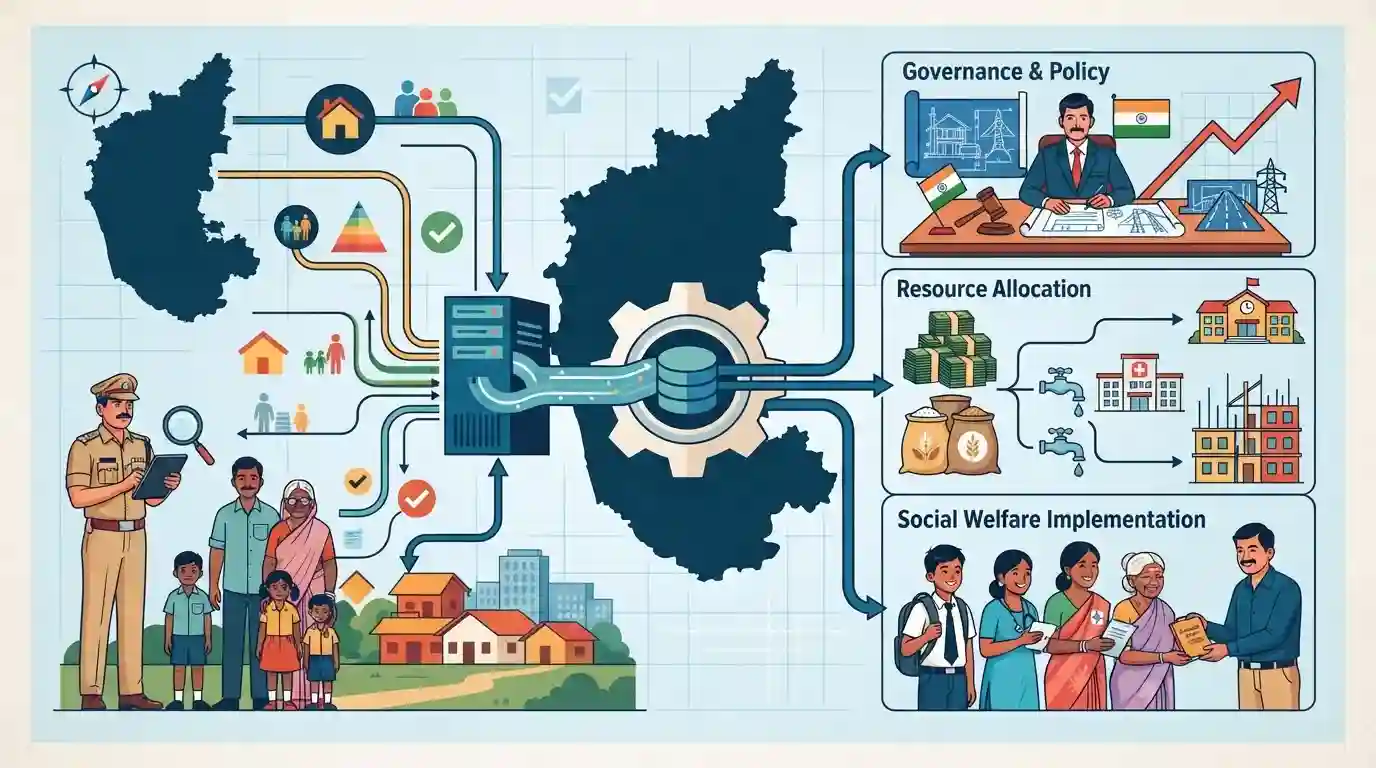
Why It Matters
The Census is the foundational demographic exercise in India, directly influencing parliamentary delimitation, resource allocation, welfare delivery, and administrative planning. Aspirants must understand the administrative framework, data collection challenges, and the developmental significance of population censuses.
Summary
Officials in Karnataka have been instructed to ensure utmost accuracy during the upcoming Census preparation. Emphasizing grassroots precision, the directive highlights the vital role accurate demographic data plays in resource allocation, governance, policy formulation, and the effective implementation of social welfare programs across India.
Key Points
- Officials in Karnataka have been directed to ensure accurate preparation and data collection for the upcoming Census.
- The Census is a crucial statistical exercise used for evidence-based policymaking, resource allocation, and administrative demarcation.
- Accuracy at the grassroots and enumeration unit level determines the effectiveness of targeted welfare schemes and social development programs.
Important Terms
Census of India

The largest decennial demographic, economic, and social data collection exercise in India, conducted under the Census Act, 1948 to guide policy formulation and resource allocation.
UPSC context
GS Paper I (Population and Associated Issues) and GS Paper II (Governance) — tests understanding of demographic dividends and socio-economic planning.
Office of the Registrar General and Census Commissioner
The statutory authority under the Ministry of Home Affairs responsible for conducting the decennial Census of India and overseeing vital statistics collection.
UPSC context
GS Paper II (Statutory bodies, governance, and administrative machinery) — tests knowledge of institutional frameworks for demographic data collection.
Static Concepts Connected
What are the key statutory and administrative features of the Census of India?
- Statutory Basis: Statutory basis: Conducted under the statutory provisions of the Census Act, 1948, making participation and accurate disclosure legally mandatory.
- Central Authority: Central authority: Administered centrally by the Office of Registrar General and Census Commissioner under the Ministry of Home Affairs.
- First Census: Historical milestone: The first fully synchronous census across India was conducted in 1881 under Census Commissioner W.C. Plowden.
Cross-Topic Patterns
Census data and parliamentary constituency delimitation
Accurate census enumeration blocks form the base for delimitation exercises and Panchayati Raj constituency demarcation under the 73rd and 74th Amendments.
Demographic mapping and welfare scheme targeting
Micro-level demographic data directly powers poverty estimation, PDS targeting, and multi-dimensional poverty index mapping by NITI Aayog.

Census Act provisions + Registrar General's dual role under MHA frequently tested in match-the-column or multi-statement prelims Qs.
Linked PYQs · 3
Linked PYQs · 3
- 2009PrelimsGS1
Consider the following statements: 1. Between Census 1951 and Census 2001, the density of the population of India has increased more than three times. 2. Between Census 1951 and Census 2001, the annual growth rate (exponential) of the population of India has doubled. Which of the statements given above is/are correct?
- 2016MainsGS2
Effectiveness of the government system at various levels and people's participation in the governance system are inter-dependent." Discuss their relationship in the context of India.
