Institutional apathy in academic grievance redressal mechanisms
Source:The Hindu ↗
Why It Matters
This tragic case serves as a critical case study for GS4 and GS2, illustrating the catastrophic consequences of institutional apathy, a lack of empathy, and the failure of statutory grievance redressal mechanisms (like Internal Complaints Committees) to protect vulnerable individuals.
Summary
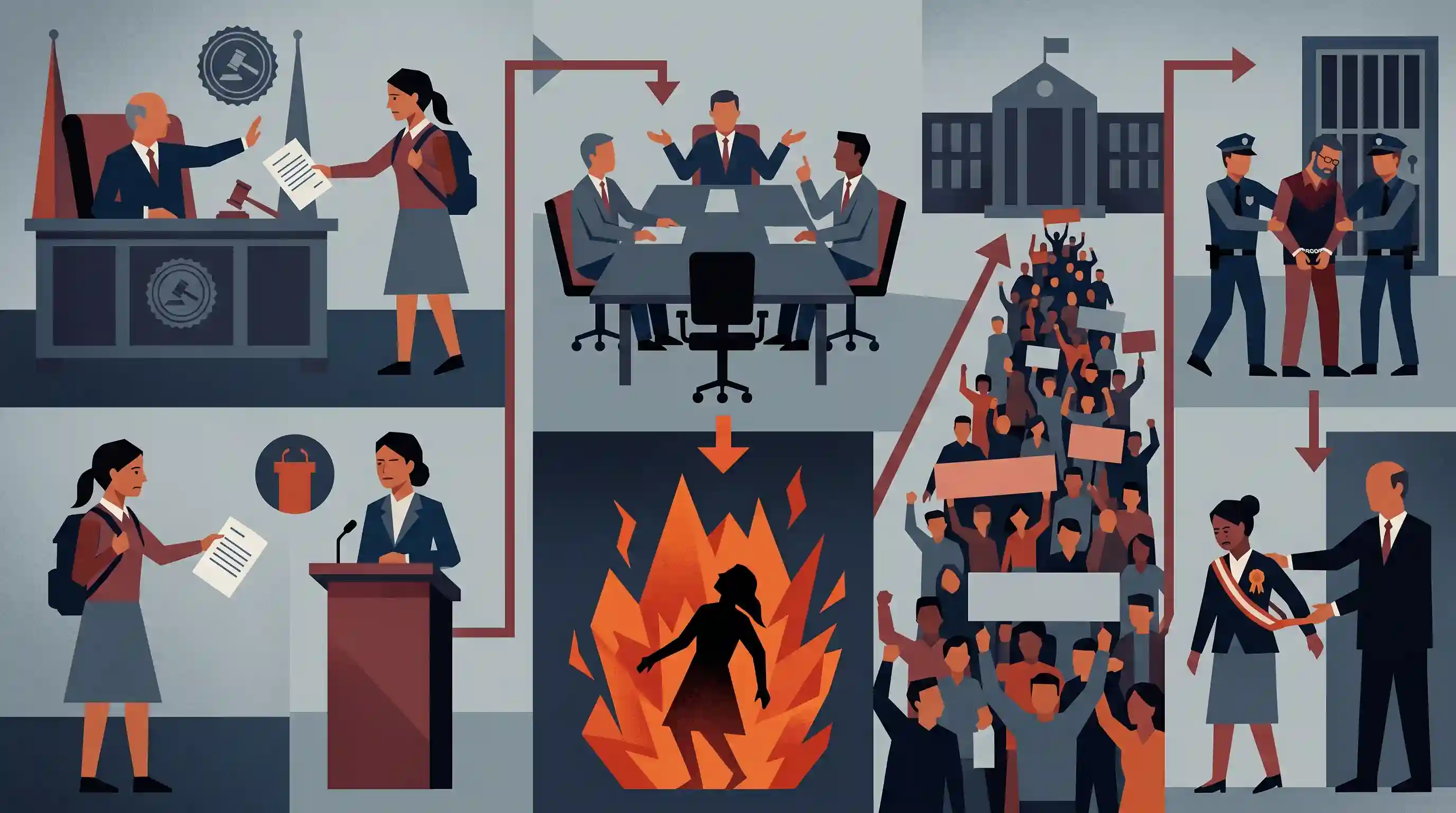
An undergraduate student at Fakir Mohan Autonomous College in Balasore, Odisha, attempted self-immolation after her repeated complaints of sexual harassment against an assistant professor were ignored by college authorities and a local MP. Sustaining 90% burn injuries, the student's desperate act sparked massive protests, leading to the arrest of the accused professor and the suspension of the principal. The incident has drawn intense criticism towards the institutional apathy of the college's internal complaints committee, which reportedly lacked student representation and failed to objectively investigate the matter.
Key Points
- An undergraduate student in Odisha's Balasore district suffered 90% burns after self-immolating to protest the administration's inaction regarding her sexual harassment complaint.
- Assistant Professor Samir Kumar Sahu, the accused, was arrested, and Principal Dilip Ghosh was suspended following widespread protests.
- Students alleged that the college's internal committee lacked student representation and deliberately ignored the complaint.
- The incident exposes deep institutional apathy and the failure of grievance redressal mechanisms in educational spaces.
Important Terms
POSH Act, 2013

Enacted in 2013, this law provides a legal framework to protect women from sexual harassment at workplaces (including educational institutions) and mandates redressal mechanisms.
UPSC context
GS Paper 2: Social Justice; GS Paper 4: Ethics. Fundamental for topics on women's safety and legislative measures.
Internal Complaints Committee (ICC)
A mandatory statutory body within organizations with 10+ employees, tasked with investigating sexual harassment complaints with the powers of a civil court.
UPSC context
GS Paper 2: Governance. Tests knowledge of institutional mechanisms for protecting rights and administrative accountability.
Institutional Apathy
The systemic indifference or lack of response by an organization toward the suffering or grievances of individuals, often leading to administrative failure.
UPSC context
GS Paper 4: Ethics. Key concept for case studies on public service values and administrative ethics.
Vishaka Guidelines
Supreme Court-mandated rules (1997) that defined sexual harassment and established employer responsibilities before the formal enactment of the POSH Act.
UPSC context
GS Paper 2: Judiciary/Social Justice. Essential for understanding the evolution of women's rights and judicial activism in India.
Higher Education Department (Odisha)
The administrative body in Odisha responsible for the management and oversight of state-run colleges, including enforcing safety protocols and disciplinary actions.
UPSC context
GS Paper 2: State Governance. Relevant to administrative oversight and the role of state departments in institutional management.
Grievance Redressal Mechanism
Structured systems within organizations for receiving and resolving complaints, crucial for ensuring transparency and maintaining public trust.
UPSC context
GS Paper 2: Governance/Citizen's Charters. Evaluates the efficiency of public service delivery and accountability frameworks.
Prelims Trap
"The POSH Act mandates that all ICC members must be internal employees of the institution."
The POSH Act mandates at least one external member from an NGO or civil society to prevent institutional bias and ensure fair hearings.
Static Concepts Connected
What is the mandatory composition of an ICC under the POSH Act?
- Presiding Officer: Must be a woman employed at a senior level at the workplace.
- External Member: Requires one member from an NGO or civil society familiar with issues relating to sexual harassment.
- Women Majority: At least one-half of the total members nominated to the committee must be women.
How do UGC regulations adapt the POSH Act for universities?
- Student Representation: Mandates the inclusion of three elected student representatives in the ICC if the matter involves students.
- Strict Penalties: Institutions failing to comply with ICC guidelines can face withdrawal of UGC grants and university affiliation.
Cross-Topic Patterns
Institutional Apathy in GS-IV
This translates directly into an Ethics case study on administrative negligence, testing concepts of moral responsibility, empathy, and the courage of conviction in public officials.
SHe-Box and E-Governance
Links grievance redressal with digital governance. Centralized platforms like the SHe-Box are designed specifically to bypass compromised or biased local mechanisms like college ICCs.

A GS-IV case study on administrative apathy or a GS-II question evaluating the efficacy of the POSH Act after a decade is highly likely.
Linked PYQs · 3
Linked PYQs · 3
- 2022MainsGS4
Apart from intellectual competency and moral qualities, empathy and compassion are some of the other vital attributes that facilitate the civil servants to be more competent in tackling the crucial issues or taking critical decisions. Explain with suitable illustrations.
- 2024MainsGS4
“Ethics encompasses several key dimensions that are crucial in guiding individuals and organizations towards morally responsible behaviour.” Explain the key dimensions of ethics that influence human actions. Discuss how these dimensions shape ethical decision-making in the professional context.
- 2020MainsGS2
Which steps are required for constitutionalization of a Commission ? Do you think imparting constitutionality to the National Commission for Women would ensure greater gender justice and empowerment in India? Give reasons.
